NCLEX Practice Questions Specialty Topics exam set questions and answers verified 100%
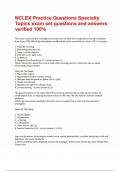
NCLEX Practice Questions Specialty Topics exam set questions and answers verified 100%NCLEX Practice Questions Specialty Topics exam set questions and answers verified 100% The nurse is performing a neurological assessment on an adult client suspected of having a traumatic brain injury (TBI). Which signs/symptoms would indicate to the nurse that the client's ICP is increasing. 1. Projectile vomiting 2. Narrowing pulse pressure 3. Delay in verbal response 4. DTR: left 2+/4+, right 2+/4+ 5. (-) Babinski 6. Glasgow Coma Scale Score 13 - correct answer-1,3 Which intervention would the nurse include when planning care for a client who has increased intracranial pressure (IICP)? Select All That Apply 1. Place client supine. 2. Hyperextend head to maintain airway. 3. Maintain body temperature below 100.4 F (38 C). 4. Cluster nursing care. 5. Monitor vital signs for Cushing's Triad. 6. Limit suctioning. - correct answer-3,5,6 The goal of treatment is to relieve the IICP by reducing cerebral edema, reducing the amount of cerebrospinal fluid, or reducing the blood volume in the brain, We also have to maintain cerebral perfusion. Which signs/symptoms would lead the clinic nurse to suspect that a client may have bacterial meningitis? Select All That Apply 1. Nuchal rigidity 2. Photophobia 3. (+) Kernig 4. (-) Brudzinski 5. Fever 102.8 F (39.3 C) 6. Reports headache 9/10 - correct answer-1,2,3,5,6 Signs and Symptoms of meningitis include nuchal rigidity, photophobia, a positive Kernig sign, chills and high fever, and severe headache. A client is admitted with a diagnosis of bacterial meningitis. Which action should the nurse initiate first? Choose One 1. Darken room. 2. Provide sponge bath for fever of 102 F (38.8 C). 3. Pad side rails. 4. Place on Droplet precautions - correct answer-4 Bacterial meningitis is transmitted through the respiratory system. According to the Center of Disease Control (CDC), clients with bacterial meningitis should be placed on "Droplet Precautions". What assessment finding by the nurse would support a client diagnosis of basilar skull fracture? Select All That Apply 1. (+) Halo test 2. Hyper-reflexia 3. Raccoon eyes 4. Battle's sign 5. Kernig sign - correct answer-1,3,4 Basilar skull fractures are the most serious fracture. You see bleeding where? Eyes, ears, nose, and throat. So, you will see cerebrospinal rhinorrhea with a (+) Halo test. If you have a bloody spot on the sheet, or wherever, when CSF is present, it will settle out and form a ring or halo around the blood spot. Raccoon eyes, is perioribital bruising which is seen with a basilar skull fracture. Battle's sign or bruising over the mastoid is also indicative of a skull fracture. A client, with a T5 injury, has not had a bowel movement in three days. Today, the client reports a headache rated 10/10. The nurse takes the client's vital signs: BP 180/110, HR 52, RR 20. What action by the nurse takes priority? Choose One 1. Administer hydralazine 20 mg IV. 2. Elevate head of bed 45 degrees. 3. Remove impaction with topical anesthetic. 4. Close air vents in the room. - correct answer-2 These signs/symptoms should lead the nurse to realize that the client is experiencing autonomic dysreflexia. The priority is to lower the blood pressure by raising the head of the bed to a semi-fowler's position. The nurse is performing a neurological assesment on a client who reports frequent headaches. What question(s) should the nurse ask during this assessment?
Written for
- Institution
- Nclex
- Course
- Nclex
Document information
- Uploaded on
- December 13, 2024
- Number of pages
- 10
- Written in
- 2024/2025
- Type
- Exam (elaborations)
- Contains
- Questions & answers
Subjects
-
nclex practice questions specialty topics exam set

Also available in package deal