HESI Fundamentals V.2| exam set questions and answers correct and verified A+
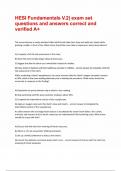
HESI Fundamentals V.2| exam set questions and answers correct and verified A+HESI Fundamentals V.2| exam set questions and answers correct and verified A+ The nurse observes a newly admitted older adult female take short steps and walk very slowly while pushing a walker in front of her. What action should the nurse take in response to these observations? A) Complete a full fall risk assessment of the client. B) Teach the client to take longer steps at faster pace. C) Suggest that the the client use a wheelchair instead of a walker. D) Place client on bedrest until the healthcare provider is notified. - correct answer-A) Complete a full fall risk assessment of the client. While suctioning a client's nasopharynx, the nurse observes that the client's oxygen saturation remains at 94%, which is the same reading obtained prior to starting the procedure. What action should the nurse take in response to this finding? A) Reposition the pulse oximeter clip to obtain a new reading. B) Stop suctioning until the pulse oximeter reading is above 95%. C) Complete the intermittent suction of the nasopharynx. D) Apply an oxygen mask over the client's nose and mouth. - correct answer-C) Complete the intermittent suction of the nasopharynx. An older woman with end stage heart disease is hospitalized for severe heart failure. She is alert, oriented, and requests that no heroic measures are implemented if her breathing stops. What action should the nurse take first? A) Discuss with the client her meaning of heroic measures. B) Obtain a "do not resuscitate" (DNR) prescription. C) Set up a family conference to discuss the client's. D) Consult the palliative care team about client's care. - correct answer-A) Discuss with the client her meaning of heroic measures. A client diagnosed with primary open-angle glaucoma received a prescription for biotic eye drops, pilocarpine HCl (Pilocarpine). What instruction should the nurse plan to include in this client's teaching? A) "Do not allow the dropper bottle to touch the eye." B) "Administer the medication directly on the cornea." C) "Squeeze your eye closed after administering the drops." D) "Wash your hands after each administration of eye drops." - correct answer-A) "Do not allow the dropper bottle to touch the eye." When assessing a client who starts to wheeze related data should obtain? A) Presence of radiation. B) Heart sounds. C) Body temperature. D) Precipitating factors. - correct answer-D) Precipitating factors. The home health nurse is reviewing the personal care of an elderly client who lives alone. Which client assessment findings indicate the need to assign unlicensed assistive personnel (UAP) to provide routine foot care and file the client's toenails? Select all that apply. A) Syncope when bending. B) Hand tremors. C) Diminished visual acuity. D) Urinary incontinence. E) Shuffling gait. - correct answer-A) Syncope when bending. B) Hand tremors. C) Diminished visual acuity. A client is discharged to a long-term care facility with an indwelling urinary catheter. Which nursing action should be included in the plan to reduce the client's risk for infection related to the catheter? A) Flush the catheter daily with sterile saline. B) Encourage increased intake of oral fluids. C) Administer a PRN antipyretic if a fever develops. D) Secure the drainage bag at bladder level during transport. - correct answer-B) Encourage increased intake of oral fluids. To assess the quality of an adult client's pain, what approach should the nurse use? A) Observe body language and movement. B) Provide a numeric pain scale. C) Ask the client to describe the pain. D) Identify effective pain relief measures. - correct answer-C) Ask the client to describe the pain. A client who has been diagnosed with terminal cancer tells the nurse, "The doctor told me I have cancer and do not have long to live." Which response is best for the nurse to provide? A) "That's correct, you do not have long to live." B) "Would you like me to call your minister?" C) "Don't give up, you still have chemotherapy to try." D) "Yes, your condition is serious." - correct answer-D) "Yes, your condition is serious." When performing blood pressure measurement to assess for orthostatic hypotension, which action should the nurse implement first? A) Apply the blood pressure cuff securely. B) Record the client's pulse rate and rhythm. C) Position the client supine for a few minutes. D) Assist the client to stand at bedside. - correct answer-C) Position the client supine for a few minutes. The nurse is providing passive range of motion (ROM) exercises to the hip and knee for a client who is unconscious. After supporting the client's knee with one hand, what action should the nurse take next? A) Raise the bed to a comfortable working level. B) Bend the client's knee. C) Move the knee toward the chest as far as it will go. D) Cradle the client's heel. - correct answer-D) Cradle the client's heel. The nurse is preparing to irrigate a client's indwelling urinary catheter using an open technique. What action should the nurse take after applying gloves? A) Empty the client's urinary drainage bag. B) Draw up the irrigating solution into the syringe. C) Secure the client's catheter to the drainage tubing. D) Use aseptic technique to instill the irrigating solution. - correct answer-B) Draw up the irrigating solution into the syringe. Which client care requires the nurse to wear barrier gloves as required by the protocol for Standard Precautions? A) Removing the empty food tray from a client with a urinary catheter. B) Washing and combing the hair of a client with a fractured leg in traction. C) Administering oral medications to a cooperative client with a wound infection. D) Emptying the urinary catheter drainage bag for a client with Alzheimer's disease. - correct answer-D) Emptying the urinary catheter drainage bag for a client with Alzheimer's disease. What action should the nurse implement to prevent the formation of a sacral ulcer for a client who is immobile? A) Maintain in a lateral position using protective wrist and vest devices. B) Position prone with a small pillow below the diaphragm. C) Raise the head and knee gatch when lying in a supine position. D) Transfer into a wheelchair close to the nurse's station for observation. - correct answer-B) Position prone with a small pillow below the diaphragm. At 0100 on a male client's second postoperative night, the client states he is unstable to sleep and plans to read until feeling sleepy. What action should the nurse implement? A) Leave the room and close the door to the client's room. B) Assess the appearance of the client's surgical dressing. C) Bring the client a prescribed PRN sedative-hypnotic. D) Discuss symptoms of sleep deprivation with the client. - correct answer-C) Bring the client a prescribed PRN sedative-hypnotic. The nursing staff in the cardiovascular intensive care unit are creating a continuous quality improvement project on social media that addresses coronary artery disease (CAD). Which action should the nurse implement to protect client privacy? A) Remove identifying information of the clients who participated. B) Recall that authored content may be legally discoverable. C) Share material from credible, peer reviewed sources only. D) Respect all copyright laws when adding website content. - correct answer-A) Remove identifying information of the clients who participated. A male client with unstable angina needs a cardiac catheterization, so the healthcare provider explains the risks and benefits of the procedure, and then leaves to set up for the procedure. When the nurse presents the consent form for signature, the client hesitates and asks how the wires will keep his heart going. Which action should the nurse take? A) Answer the client's specific questions with a short understandable explanation. B) Postpone the procedure until the client understands the risks and benefits. C) Call the client's next of kin and ask them to provide verbal consent. D) Page the healthcare provider to return and provide additional explanation. - correct answer-B) Postpone the procedure until the client understands the risks and benefits. The nurse is teaching a client how to do active range of motion (ROM) exercises. To exercise the hinge joints, which action should the nurse instruct the client to perform? A) Tilt the pelvis forwards and backwards. B) Bend the arm by flexing the ulnar to the humerus. C) Turn the head to the right and left. D) Extend the arm at the side and rotate in circles. - correct answer-B) Bend the arm by flexing the ulnar to the humerus. A postoperative client has three different PRN analgesics prescribed for different levels of pain. The nurse inadvertently administers a dose that is not within the prescribed parameters. What actions should the nurse take first? A) Assess for side effects of the medication. B) Document the client's responses. C) Complete a medication error report. D) Determine if the pain was relieved. - correct answer-A) Assess for side effects of the medication. When assessing a male client, the nurse finds that he is fatigue, and is experiencing muscle weakness, leg cramps, and cardiac dysrhythmias. Based on these findings, the nurse plans to check the client's laboratory values to validate the existence of which? A) Hyperphosphatemia. B) Hypocalcemia. C) Hypermagnesemia. D) Hypokalemia. - correct answer-D) Hypokalemia. A female client's significant other has been at her bedside providing reassurances and support for the past 3 days, as desired by the client. The client's estranged husband arrives and demands that the significant other not be allowed to visit or be given condition updates. Which intervention should the nurse implement? A) Obtain a prescription from the healthcare provider regarding visitation privileges. B) Request a consultation with the ethics committee for resolution of the situation. C) Encourage the client to speak with her husband regarding his disruptive behavior. D) Communicate the client's wishes to all members of the multidisciplinary team. - correct answer-B) Request a consultation with the ethics committee for resolution of the situation. When measuring vital signs, the nurse observes that a client is using accessory neck muscles during respiration. What follow-up action should the nurses take first? A) Determine pulse pressure. B) Auscultate heart sounds. C) Measure oxygen saturation. D) Check for neck vein distention. - correct answer-D) Check for neck vein distention. To avoid nerve injury, what location should the nurse select to administer a 3 mL IM injection? A) Ventrogluteal. B) Outer upper quadrant of the buttock. C) Two inches below the acromion process. D) Vastus lateralis. - correct answer-A) Ventrogluteal. Which instruction should the nurse include in the discharge teaching plan for an adult client with hypernatremia? A) Monitor daily urine output volume. B) Drink plenty of water whenever thirsty. C) Use salt tablets for sodium content. D) Review food labels for sodium content. - correct answer-D) Review food labels for sodium content. A client is in contact isolation due to stage IV coccyx wound infected with methicillinresistant staphylococcus aureus (MRSA). The nurse plans interventions to prevent multiple reentries to the client's room. In which order should the nurse perform the interventions? A) Change coccyx dressing, perform tracheostomy care, restart the IV. B) Perform tracheostomy care, change coccyx dressing, restart the IV. C) Restart the IV, perform tracheotomy care, change coccyx dressing. D) Change coccyx dressing, restart the IV, perform tracheostomy care. - correct answer-C) Restart the IV, perform tracheotomy care, change coccyx dressing. What self-care outcome is best for the nurse to use in evaluating a client's recovery form a stroke that resulted in left-sided hemiparesis? A) Promote independence by allowing client to perform all self-care activities. B) Participates in self-care to optimal level of capacity. C) Client verbalizes importance of hygienic practices in the recovery process. D) Self-care needs to be completed by the unlicensed assistive personnel. - correct answer-C) Client verbalizes importance of hygienic practices in the recovery process. The nurse observes that there are reddened areas on the cheekbones of a client receiving oxygen per nasal cannula at 3L/minute, and the client's oxygen saturation level is 92%. What intervention should the nurse implement? A) Decrease the flow rate to 1 L/minute. B) Discontinue the use of the nasal cannula. C) Apply lubricant to the cannula tubing. D) Place padding around the cannula tubing. - correct answer-B) Discontinue the use of the nasal cannula. A female nursing home resident and her family only speak Spanish. During a visit, the entire family begins to cry hysterically. When unable to determine why the family is upset, what intervention is most important for the nurse to implement? A) Ask a Spanish speaking staff member to talk with the family. B) Use a Spanish translation reference to interview the family. C) Close the door to client's room to provide family privacy. D) Sit quietly with the family to offer comfort and support. - correct answer-C) Close the door to client's room to provide family privacy. The nurse is performing a routine dressing change for a client with a stage 3 pressure ulcer that is red with significant grandution. The wound has a gauze dressing covering the area. What action should the nurse implemented?
Written for
- Institution
- HESI Fundamentals V.2
- Course
- HESI Fundamentals V.2
Document information
- Uploaded on
- December 13, 2024
- Number of pages
- 60
- Written in
- 2024/2025
- Type
- Exam (elaborations)
- Contains
- Questions & answers
Subjects
-
hesi fundamentals v2 exam set questions and answ

Also available in package deal