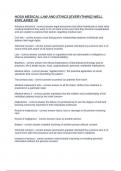
HOSA MEDICAL LAW AND ETHICS [EVERYTHING] WELL
EXPLAINED #8
Advance directives - correct answer legal documents that allow individuals to state what
medical treatment they want or do not want in the event that they become incapacitated
and are unable to express their wishes regarding medical care
Civil law - correct answer a law that governs relationships between individuals and
defines their legal rights.
Informed consent - correct answer permission granted voluntarily by a person who is of
sound mind and aware of all factors involved
Law - correct answer societal rules or regulations that are adviseable or obligatory to
observe (mandatory, face civil or criminal liability).
Bioethics - correct answer the ethical implications of biomedical technology and its
practices; life & death issues; local, organizational, personal, worldwide implications
Medical ethics - correct answer "applied ethics;" the practical application of moral
standards that concern benefiting the patient.
The primary duty - correct answer to protect our patients from harm
Medical malpractice acts - correct answer in all 50 states; define how medicine is
practiced in a particular state.
Medical ethics 2 - correct answer mandates that the welfare and confidentiality of the
individual patients must be the chief concern
Malpractice - correct answer the failure if a professional to use the degree of skill and
learning commonly expected in that individuals profession
Result of malpractice - correct answer injury, loss or damage to the person receiving
care
Result of negligence - correct answer injury to another person
Battery - correct answer unlawful touching of another person without consent
Informed consent - correct answer permission granted voluntarily by a person who is of
sound mine after the procedure and all risks involved have been explained
Invasion of privacy - correct answer unnecessarily exposing or revealing personal
information without the persons consent
,False imprisonment - correct answer restraining an individual or restricting an
individuals freedom
Abuse - correct answer results in physical harm, pain, or mental anguish
Examples of abuse - correct answer physical, verbal, psychological, sexual
Defamation - correct answer false statements either cause a person to be ridiculed or
damage the persons reputation
Slander - correct answer when defamation occurs and the information is spoken
Libel - correct answer when defamation occurs and the information is written
Contract - correct answer an agreement between two or more parties
Part of contracts - correct answer offer, acceptance, consideration
Implied contracts - correct answer obligations that are understood without verbally
expressed terms
Expressed contracts - correct answer stated in distinct and clear language either orally
or in writing
Legal disability - correct answer when someone doesn't have the legal capacity to form
a contract.
Agent - correct answer when a person works under the direction or control of another
person the person working under the employer
Privileged communications - correct answer all information given to health care
personnel by a patient
Patients rights - correct answer the factors of care that patients can expect to retrieve
Patients bill of rights - correct answer recognized by many health care facilities
Living wills - correct answer documents that allow individuals to state what measures
should or should not be taken to prolong life when death is expected
Poa - correct answer designation if health care surrogate / durable power of attorney
Psda - correct answer patient self-determination act
Patient self-determination act - correct answer mandates all health care facilities
receiving any type of federal aid comply with requirements.
,Health service delivery - correct answer transplantation and anatomy act 1979
health rights commission act 1991
anti-discrimination act 1991
workplace health and safety act 1995
information privacy act2009
child protection act 1999
civil liability act 2003
powers of attorney act 1998
guardianship and administration act 2000
Civil law remedies - correct answer financial compensation (damages)
injunction (order to stop doing something)
specific performance (order to do something).
Reportable deaths - correct answer (a) it is not known who the person is;
(b) the death was a violent or otherwise unnatural death;
(c) the death happened in suspicious circumstances;
(d) the death was not reasonably expected to be the outcome of a health procedure;
(e) the cause of death certificate has not been issued;
(f) the death was in care;
(g) the death was in custody;
(h) the person had not consulted a doctor within 3 months before the person's death.
Coronial comments (recommendations) - correct answer public health or safety; or
the administration of justice; or
Ways to prevent deaths from happening in similar
Circumstances in the future.
Passive euthanasia - correct answer -withdrawal of life-sustaining treatment allowing
patient to die from natural causes.
-withdrawal of treatment allowing patient to die of natural causes (passive)
-in response to a medical decision made in the best interests of the patient and in
accordance with good medical practice (non-voluntary)
Active voluntary euthanasia - correct answer •actively assisting a person to die (active)
•in response to a request, and with consent of the person (voluntary)
Unlawful in australia
•amounts to aiding in suicide
•would also amount to murder
•consent to death immaterial
Criminal code 1899 (qld),
Assisted suicide - correct answer any person who—
(a) procures another to kill himself or herself; or
, (b) counsels another to kill himself or herself and thereby induces the other person to do
so; or
(c) aids another in killing himself or herself;
Is guilty of a crime, and is liable to imprisonment for life.
Patient's decision - common law refusal - correct answer if an adult has the capacity to
make a decision to refuse the commencement of life-sustaining medical treatment if it is
required, or to have life sustaining treatment withdrawn, the law is clear.
A competent adult may refuse treatment even if that decision results in the adult's
death.
Advance health directive - correct answer a direction in an advance health directive will
only operate if:
•the person has impaired capacity (at the time the treatment is required);
Powers of attorney act 1998, s36(1)(a).
•the person has no reasonable prospect of regaining capacity for health matters; and
Powers of attorney act 1998, s36(2)(c).
•the person's medical condition falls within one of four categories.
I)the adult has a terminal illness
(ii) the adult is in a persistent vegetative state,
(iii) the adult is permanently unconscious
(iv) the adult has an illness or injury of such severity that there is no reasonable
prospect that the adult will recover
Powers of attorney act 1998, s36(2)(a)(1)-(iv).
Organ donation and transplantation - correct answer common law position
-body parts cannot be removed from living person unless it is for therapeutic purposes
-criminal offence of maiming
-consent is irrelevant
Features of criminal law - correct answer •parties to a criminal matter
•initiation of the action
•elements of a crime
•standard of proof
•presumption of innocence
•liability rests with the accused
Elements of negligence - correct answer 1.the existence of a duty of care;
2.a breach of the standard of care;
3.damage suffered which was reasonably foreseeable; and
4.the breach caused, or materially contributed to the damage (causation).
What is a duty of care? - correct answer a duty of care is owed in circumstances where
there is a foreseeable risk of harm to another.
A court, when determining if a duty of care is owed, would consider the following:
-neighbour principle
EXPLAINED #8
Advance directives - correct answer legal documents that allow individuals to state what
medical treatment they want or do not want in the event that they become incapacitated
and are unable to express their wishes regarding medical care
Civil law - correct answer a law that governs relationships between individuals and
defines their legal rights.
Informed consent - correct answer permission granted voluntarily by a person who is of
sound mind and aware of all factors involved
Law - correct answer societal rules or regulations that are adviseable or obligatory to
observe (mandatory, face civil or criminal liability).
Bioethics - correct answer the ethical implications of biomedical technology and its
practices; life & death issues; local, organizational, personal, worldwide implications
Medical ethics - correct answer "applied ethics;" the practical application of moral
standards that concern benefiting the patient.
The primary duty - correct answer to protect our patients from harm
Medical malpractice acts - correct answer in all 50 states; define how medicine is
practiced in a particular state.
Medical ethics 2 - correct answer mandates that the welfare and confidentiality of the
individual patients must be the chief concern
Malpractice - correct answer the failure if a professional to use the degree of skill and
learning commonly expected in that individuals profession
Result of malpractice - correct answer injury, loss or damage to the person receiving
care
Result of negligence - correct answer injury to another person
Battery - correct answer unlawful touching of another person without consent
Informed consent - correct answer permission granted voluntarily by a person who is of
sound mine after the procedure and all risks involved have been explained
Invasion of privacy - correct answer unnecessarily exposing or revealing personal
information without the persons consent
,False imprisonment - correct answer restraining an individual or restricting an
individuals freedom
Abuse - correct answer results in physical harm, pain, or mental anguish
Examples of abuse - correct answer physical, verbal, psychological, sexual
Defamation - correct answer false statements either cause a person to be ridiculed or
damage the persons reputation
Slander - correct answer when defamation occurs and the information is spoken
Libel - correct answer when defamation occurs and the information is written
Contract - correct answer an agreement between two or more parties
Part of contracts - correct answer offer, acceptance, consideration
Implied contracts - correct answer obligations that are understood without verbally
expressed terms
Expressed contracts - correct answer stated in distinct and clear language either orally
or in writing
Legal disability - correct answer when someone doesn't have the legal capacity to form
a contract.
Agent - correct answer when a person works under the direction or control of another
person the person working under the employer
Privileged communications - correct answer all information given to health care
personnel by a patient
Patients rights - correct answer the factors of care that patients can expect to retrieve
Patients bill of rights - correct answer recognized by many health care facilities
Living wills - correct answer documents that allow individuals to state what measures
should or should not be taken to prolong life when death is expected
Poa - correct answer designation if health care surrogate / durable power of attorney
Psda - correct answer patient self-determination act
Patient self-determination act - correct answer mandates all health care facilities
receiving any type of federal aid comply with requirements.
,Health service delivery - correct answer transplantation and anatomy act 1979
health rights commission act 1991
anti-discrimination act 1991
workplace health and safety act 1995
information privacy act2009
child protection act 1999
civil liability act 2003
powers of attorney act 1998
guardianship and administration act 2000
Civil law remedies - correct answer financial compensation (damages)
injunction (order to stop doing something)
specific performance (order to do something).
Reportable deaths - correct answer (a) it is not known who the person is;
(b) the death was a violent or otherwise unnatural death;
(c) the death happened in suspicious circumstances;
(d) the death was not reasonably expected to be the outcome of a health procedure;
(e) the cause of death certificate has not been issued;
(f) the death was in care;
(g) the death was in custody;
(h) the person had not consulted a doctor within 3 months before the person's death.
Coronial comments (recommendations) - correct answer public health or safety; or
the administration of justice; or
Ways to prevent deaths from happening in similar
Circumstances in the future.
Passive euthanasia - correct answer -withdrawal of life-sustaining treatment allowing
patient to die from natural causes.
-withdrawal of treatment allowing patient to die of natural causes (passive)
-in response to a medical decision made in the best interests of the patient and in
accordance with good medical practice (non-voluntary)
Active voluntary euthanasia - correct answer •actively assisting a person to die (active)
•in response to a request, and with consent of the person (voluntary)
Unlawful in australia
•amounts to aiding in suicide
•would also amount to murder
•consent to death immaterial
Criminal code 1899 (qld),
Assisted suicide - correct answer any person who—
(a) procures another to kill himself or herself; or
, (b) counsels another to kill himself or herself and thereby induces the other person to do
so; or
(c) aids another in killing himself or herself;
Is guilty of a crime, and is liable to imprisonment for life.
Patient's decision - common law refusal - correct answer if an adult has the capacity to
make a decision to refuse the commencement of life-sustaining medical treatment if it is
required, or to have life sustaining treatment withdrawn, the law is clear.
A competent adult may refuse treatment even if that decision results in the adult's
death.
Advance health directive - correct answer a direction in an advance health directive will
only operate if:
•the person has impaired capacity (at the time the treatment is required);
Powers of attorney act 1998, s36(1)(a).
•the person has no reasonable prospect of regaining capacity for health matters; and
Powers of attorney act 1998, s36(2)(c).
•the person's medical condition falls within one of four categories.
I)the adult has a terminal illness
(ii) the adult is in a persistent vegetative state,
(iii) the adult is permanently unconscious
(iv) the adult has an illness or injury of such severity that there is no reasonable
prospect that the adult will recover
Powers of attorney act 1998, s36(2)(a)(1)-(iv).
Organ donation and transplantation - correct answer common law position
-body parts cannot be removed from living person unless it is for therapeutic purposes
-criminal offence of maiming
-consent is irrelevant
Features of criminal law - correct answer •parties to a criminal matter
•initiation of the action
•elements of a crime
•standard of proof
•presumption of innocence
•liability rests with the accused
Elements of negligence - correct answer 1.the existence of a duty of care;
2.a breach of the standard of care;
3.damage suffered which was reasonably foreseeable; and
4.the breach caused, or materially contributed to the damage (causation).
What is a duty of care? - correct answer a duty of care is owed in circumstances where
there is a foreseeable risk of harm to another.
A court, when determining if a duty of care is owed, would consider the following:
-neighbour principle