STCW Basic Training Exam Questions And
Answers
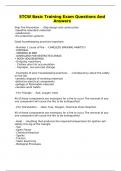
Ship Fire Prevention - -Ship design and construction
-steel/fire retardant materials
-subdivisions
-fire protection systems
Good housekeeping practices important
-Number 1 cause of fire - -CARELESS SMOKING HABITS!!!
- DISPOSAL
- SMOKING IN BED
- DISREGARD FOR RESTRICTED AREAS
• POOR HOUSEKEEPING
- Dirty/oily machinery
- Clothes drier lint accumulation
- Improper, non-secured storage
-Examples of poor housekeeping practices - --Complacency about fire safety
on the job
-careless disposal of smoking materials
-defective electrical components
-spillage of flammable materials
-careless work habits
-Fire Triangle - -fuel, oxygen, heat
All of these components are necessary for a fire to occur The removal of any
one component will cause the fire to be extinguished
-Fire Tetrahedron - -Heat, Fuel, Oxygen, Chemical Chain Reaction
All of these components are necessary for a fire to occur The removal of any
one component will cause the fire to be extinguished
-Heat - -Anything that produces the required temperature for ignition will
satisfy this leg of the triangle
- Sun
- Open Flame
- Chemical Reaction
- Sparks
- Friction
- Static Electricity
- Biological Processes
, -Oxygen - -The Earth's atmosphere consists of 21% oxygen
Because fire needs oxygen to burn, the amount of oxygen available to it
controls the rate at which it burns
-Fuel - -Only vapors burn
• Liquids & solids are too dense and must first be vaporized
• The tendency of a substance to vaporize is an indication of its ability to
burn.
• Liquids vaporize more readily than solids
• Gases are already in a vapor state
-Chain Reaction - -You can have Oxygen - Heat - Fuel in the same place at
the same time and still not have a fire (explain)
• FUEL - OXYGEN relationship must be balanced, i.e., must be in the
Flammable Range
• Heat must be sufficient to bring fuel to its "Ignition Temperature"
-To Stop a Fire - -• remove the fuel
• remove the heat
• remove the oxygen
• interrupt chemical reaction
OR • do any combination of above
-Classifications of Fires - -Five classes of fire:
1. Class A - combustible solids (wood paper, rubber)
2. Class B - combustible and flammable liquids and gases (oil, gasoline)
3. Class C - energized electrical equipment (electrical equipment, wiring,
appliances)
4. Class D - combustible metals (sodium, zinc, manganese)
5. Class K - cooking material (animal/vegetable fats)
-Flash point - -FLASH POINT (of a Liquid)
- The lowest temperature at which a liquid gives off sufficient vapor to form
an ignitable mixture at the surface of the liquid
- Fire flashes across the surface given sufficient oxygen and an external
source of ignition
- Lowest temperature at which we can have a fire
- Indicator of the severity of a fire hazard
-Fire Point - -Just above the flash point - liquid vaporizes rapidly enough to
sustain continuous combustion
-Ignition Temperature - -- Lowest temperature of a combustible substance
at which sustained combustion will occur without a spark or flame
- Substance starts to burn
Answers
Ship Fire Prevention - -Ship design and construction
-steel/fire retardant materials
-subdivisions
-fire protection systems
Good housekeeping practices important
-Number 1 cause of fire - -CARELESS SMOKING HABITS!!!
- DISPOSAL
- SMOKING IN BED
- DISREGARD FOR RESTRICTED AREAS
• POOR HOUSEKEEPING
- Dirty/oily machinery
- Clothes drier lint accumulation
- Improper, non-secured storage
-Examples of poor housekeeping practices - --Complacency about fire safety
on the job
-careless disposal of smoking materials
-defective electrical components
-spillage of flammable materials
-careless work habits
-Fire Triangle - -fuel, oxygen, heat
All of these components are necessary for a fire to occur The removal of any
one component will cause the fire to be extinguished
-Fire Tetrahedron - -Heat, Fuel, Oxygen, Chemical Chain Reaction
All of these components are necessary for a fire to occur The removal of any
one component will cause the fire to be extinguished
-Heat - -Anything that produces the required temperature for ignition will
satisfy this leg of the triangle
- Sun
- Open Flame
- Chemical Reaction
- Sparks
- Friction
- Static Electricity
- Biological Processes
, -Oxygen - -The Earth's atmosphere consists of 21% oxygen
Because fire needs oxygen to burn, the amount of oxygen available to it
controls the rate at which it burns
-Fuel - -Only vapors burn
• Liquids & solids are too dense and must first be vaporized
• The tendency of a substance to vaporize is an indication of its ability to
burn.
• Liquids vaporize more readily than solids
• Gases are already in a vapor state
-Chain Reaction - -You can have Oxygen - Heat - Fuel in the same place at
the same time and still not have a fire (explain)
• FUEL - OXYGEN relationship must be balanced, i.e., must be in the
Flammable Range
• Heat must be sufficient to bring fuel to its "Ignition Temperature"
-To Stop a Fire - -• remove the fuel
• remove the heat
• remove the oxygen
• interrupt chemical reaction
OR • do any combination of above
-Classifications of Fires - -Five classes of fire:
1. Class A - combustible solids (wood paper, rubber)
2. Class B - combustible and flammable liquids and gases (oil, gasoline)
3. Class C - energized electrical equipment (electrical equipment, wiring,
appliances)
4. Class D - combustible metals (sodium, zinc, manganese)
5. Class K - cooking material (animal/vegetable fats)
-Flash point - -FLASH POINT (of a Liquid)
- The lowest temperature at which a liquid gives off sufficient vapor to form
an ignitable mixture at the surface of the liquid
- Fire flashes across the surface given sufficient oxygen and an external
source of ignition
- Lowest temperature at which we can have a fire
- Indicator of the severity of a fire hazard
-Fire Point - -Just above the flash point - liquid vaporizes rapidly enough to
sustain continuous combustion
-Ignition Temperature - -- Lowest temperature of a combustible substance
at which sustained combustion will occur without a spark or flame
- Substance starts to burn