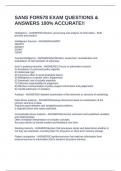
SANS FOR578 EXAM QUESTIONS &
ANSWERS 100% ACCURATE!!
intelligence - ANSWERSCollection, processing and analysis of information - Both
process and product
Intelligence Sources - ANSWERSHUMINT
GEOINT
MASINT
SIGINT
OSINT
Counterintelligence - ANSWERSIdentification, assesment, neutralization and
exploitation of intell activities of adversary
Kent´s analytical doctrine - ANSWERS1) Focus on policmaker concern
2) Avoidance of a personal policy Agenda
3) Intellectual rigor
4) Conscious effort to avoid analytical biases
5) Willingness to consider other Judgements
6) Systematic use of outside expertise
7) Collective responsibility for judgement
8) Effective communication of policy-support information and judgements
9) Candid admission of mistakes
Analysis - ANSWERSA detailed examination of the elements or structure of something.
Data driven analysis - ANSWERSDrawing inferences based on examination of the
intrinsic structure of data.
Requires good datasets and straightforward problems.
Is logically driven and easily replicated.
Conceptually driven analysis - ANSWERSNumerous unknowns and undefined variables
and relationsships.
Often immidiate interpretation of complex concepts.
Accuracy driven by mental models and feedback over time.
Working memory - ANSWERSSystem that processes inputs and determines whether or
not they are important, encoding them for long-term or short-term memory storage
Pattern recognition - ANSWERSCognitive process that matches information from
external sources to information that is stored in long-term memory.
, Template matching - ANSWERSEvery object and experience is processed by brain and
stored as a template in long-term memory. When presented with situation, long-term
memory is searched for matching template from the past.
Prototype matching - ANSWERSWhen presented with situation, long-term memory is
searched for AVERAGE or similiar templates reffered as a "prototype". More flexible
then template matching and better for working with incomplete information.
Top Down - ANSWERSUsing previous knowledge (could be contextual) to fill in gaps
when we do not have complete information.
System I thinking - ANSWERSIntiutive thinking, fast, effective, often accurate but prone
to errors. Draws on available knowledge and experience and existing mental modes.
System II thinking - ANSWERS"Analyttical thinking". slow, methodical and conscious.
Involves analytic processes like scientific method or structured analytical techniques.
Mental Models - ANSWERSSystem I thinking.
Experience base asumptions and expectations of the way the world operates
Structured Analytical Techniques - ANSWERSAlmost al include Decomposition
(breaking problem into components) and Visualization (capturing parts of problem in
organized/visual manner)
6 distinct families:
- Getting Organized
- Reframing Techniques
- Exploration Techniques
- Foresight Techniques
- Diagnostic Techniques
- Decision Support Techniques
Intelligence Cycle - ANSWERSPlanning and Direction
- identification and prioritization of intell gaps and requirements, creation of plan
Collection
- execution of plan and data collection to fiil intell gaps
Processing and exploitation
- preparation needed for raw data collected (filtering, transformation into different
format)
Analysis and Production
- Use of SATs to evaluate processed information to fill intell gaps and meet
requirements
Dissemination
- distribution of intelligence to costumer
Field of View Bias from collection - ANSWERSSecurity firms collectiong from costumers
in US will see different data and threats thene security firm in EU/IRAN etc.
ANSWERS 100% ACCURATE!!
intelligence - ANSWERSCollection, processing and analysis of information - Both
process and product
Intelligence Sources - ANSWERSHUMINT
GEOINT
MASINT
SIGINT
OSINT
Counterintelligence - ANSWERSIdentification, assesment, neutralization and
exploitation of intell activities of adversary
Kent´s analytical doctrine - ANSWERS1) Focus on policmaker concern
2) Avoidance of a personal policy Agenda
3) Intellectual rigor
4) Conscious effort to avoid analytical biases
5) Willingness to consider other Judgements
6) Systematic use of outside expertise
7) Collective responsibility for judgement
8) Effective communication of policy-support information and judgements
9) Candid admission of mistakes
Analysis - ANSWERSA detailed examination of the elements or structure of something.
Data driven analysis - ANSWERSDrawing inferences based on examination of the
intrinsic structure of data.
Requires good datasets and straightforward problems.
Is logically driven and easily replicated.
Conceptually driven analysis - ANSWERSNumerous unknowns and undefined variables
and relationsships.
Often immidiate interpretation of complex concepts.
Accuracy driven by mental models and feedback over time.
Working memory - ANSWERSSystem that processes inputs and determines whether or
not they are important, encoding them for long-term or short-term memory storage
Pattern recognition - ANSWERSCognitive process that matches information from
external sources to information that is stored in long-term memory.
, Template matching - ANSWERSEvery object and experience is processed by brain and
stored as a template in long-term memory. When presented with situation, long-term
memory is searched for matching template from the past.
Prototype matching - ANSWERSWhen presented with situation, long-term memory is
searched for AVERAGE or similiar templates reffered as a "prototype". More flexible
then template matching and better for working with incomplete information.
Top Down - ANSWERSUsing previous knowledge (could be contextual) to fill in gaps
when we do not have complete information.
System I thinking - ANSWERSIntiutive thinking, fast, effective, often accurate but prone
to errors. Draws on available knowledge and experience and existing mental modes.
System II thinking - ANSWERS"Analyttical thinking". slow, methodical and conscious.
Involves analytic processes like scientific method or structured analytical techniques.
Mental Models - ANSWERSSystem I thinking.
Experience base asumptions and expectations of the way the world operates
Structured Analytical Techniques - ANSWERSAlmost al include Decomposition
(breaking problem into components) and Visualization (capturing parts of problem in
organized/visual manner)
6 distinct families:
- Getting Organized
- Reframing Techniques
- Exploration Techniques
- Foresight Techniques
- Diagnostic Techniques
- Decision Support Techniques
Intelligence Cycle - ANSWERSPlanning and Direction
- identification and prioritization of intell gaps and requirements, creation of plan
Collection
- execution of plan and data collection to fiil intell gaps
Processing and exploitation
- preparation needed for raw data collected (filtering, transformation into different
format)
Analysis and Production
- Use of SATs to evaluate processed information to fill intell gaps and meet
requirements
Dissemination
- distribution of intelligence to costumer
Field of View Bias from collection - ANSWERSSecurity firms collectiong from costumers
in US will see different data and threats thene security firm in EU/IRAN etc.