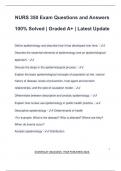
NURS 350 Exam Questions and Answers
100% Solved | Graded A+ | Latest Update
Define epidemiology and describe how it has developed over time. - ✔✔
Describe the essential elements of epidemiology and an epidemiological
approach. - ✔✔
Discuss the steps in the epidemiological process. - ✔✔
Explain the basic epidemiological concepts of population at risk, natural
history of disease, levels of prevention, host-agent-environment
relationships, and the web-of-causation model. - ✔✔
Differentiate between descriptive and analytic epidemiology. - ✔✔
Explain how nurses use epidemiology in public health practice. - ✔✔
Descriptive epidemiology - ✔✔-Determinants of health
-For example: What is the disease? Who is affected? Where are they?
When do events occur?
Analytic epidemiology - ✔✔-Distribution
1
©JOSHCLAY 2024/2025. YEAR PUBLISHED 2024.
, -For example: How does it occur? Why are some people affected more
than others?
Epidemiology is the study of populations to - ✔✔-Determine the causes of
health and disease in a population
-Monitor the health of the population
-Identify the determinants of health and disease in communities
-Investigate and evaluate interventions to prevent disease and maintain
health
How Nurses Use Epidemiology - ✔✔-Nurses look at health and at disease
causation, and how both prevent and treat illness.
-Nurses are involved in the surveillance and monitoring of disease trends,
for example, homes, schools, work places, and clinics.
Basic Concepts in Epidemiology - ✔✔-Measures of morbidity and mortality
-Rates, proportions, and risk
-Measures of incidence
-Prevalence proportion
-Incidence and prevalence compared
-Attack rate
-Mortality rates
-Epidemic
2
©JOSHCLAY 2024/2025. YEAR PUBLISHED 2024.
100% Solved | Graded A+ | Latest Update
Define epidemiology and describe how it has developed over time. - ✔✔
Describe the essential elements of epidemiology and an epidemiological
approach. - ✔✔
Discuss the steps in the epidemiological process. - ✔✔
Explain the basic epidemiological concepts of population at risk, natural
history of disease, levels of prevention, host-agent-environment
relationships, and the web-of-causation model. - ✔✔
Differentiate between descriptive and analytic epidemiology. - ✔✔
Explain how nurses use epidemiology in public health practice. - ✔✔
Descriptive epidemiology - ✔✔-Determinants of health
-For example: What is the disease? Who is affected? Where are they?
When do events occur?
Analytic epidemiology - ✔✔-Distribution
1
©JOSHCLAY 2024/2025. YEAR PUBLISHED 2024.
, -For example: How does it occur? Why are some people affected more
than others?
Epidemiology is the study of populations to - ✔✔-Determine the causes of
health and disease in a population
-Monitor the health of the population
-Identify the determinants of health and disease in communities
-Investigate and evaluate interventions to prevent disease and maintain
health
How Nurses Use Epidemiology - ✔✔-Nurses look at health and at disease
causation, and how both prevent and treat illness.
-Nurses are involved in the surveillance and monitoring of disease trends,
for example, homes, schools, work places, and clinics.
Basic Concepts in Epidemiology - ✔✔-Measures of morbidity and mortality
-Rates, proportions, and risk
-Measures of incidence
-Prevalence proportion
-Incidence and prevalence compared
-Attack rate
-Mortality rates
-Epidemic
2
©JOSHCLAY 2024/2025. YEAR PUBLISHED 2024.