Topic 7: Modern Analytical Techniques I
Topic 7A: Mass spectrometry
1. be able to use data from a mass spectrometer to:
Mass Spectrometry
Molecules are bombarded by high speed electrons in a mass spectrometer and an electron is
removed to form a molecular ion. The +1 charge deflects the molecule onto a detector and the
results can be shown on a graph.
- The x-axis is mass/charge ratio where charge is almost always 1 so effectively displays
the molecular mass
- The y-axis shows the abundance of the ions, often given as a percentage
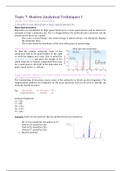
Determine the relative molecular mass Mass spectrum of pentane
To find the relative molecular mass of the
compound, look at the peak furthest to the right
i.e. with the highest m/z ratio. This is called the
molecular ion peak and gives the weight of the
whole molecule. In organic compounds there may
be a small peak to the right of the molecular ion
peak caused by the C13 isotope.
Suggest possible structures of a simple organic compound from the m/z of the molecular ion
and fragmentation patterns.
The bombarding of electrons causes some of the molecules to break up into fragments. The
fragmentation patterns are displayed on the mass spectrum and can be used to identify the
molecule and its structure.
E.g. CH3CH2CH3+ → CH3CH2• + CH3+
propane molecular ion free radical ion
Common fragments:
15 – CH3+
17 – OH+
29 – C2H5+
43 – C3H7+
57 - C4H9+
Example: Work out the molecule that has produced this mass spectrum
- Mr is 72 as molecular ion peak is at 72
- Peak at 29 caused by C2H5+
- Peak at 43 caused by C3H7+
- Peak at 57 caused by C4H9+
Must be pentane
Topic 7A: Mass spectrometry
1. be able to use data from a mass spectrometer to:
Mass Spectrometry
Molecules are bombarded by high speed electrons in a mass spectrometer and an electron is
removed to form a molecular ion. The +1 charge deflects the molecule onto a detector and the
results can be shown on a graph.
- The x-axis is mass/charge ratio where charge is almost always 1 so effectively displays
the molecular mass
- The y-axis shows the abundance of the ions, often given as a percentage
Determine the relative molecular mass Mass spectrum of pentane
To find the relative molecular mass of the
compound, look at the peak furthest to the right
i.e. with the highest m/z ratio. This is called the
molecular ion peak and gives the weight of the
whole molecule. In organic compounds there may
be a small peak to the right of the molecular ion
peak caused by the C13 isotope.
Suggest possible structures of a simple organic compound from the m/z of the molecular ion
and fragmentation patterns.
The bombarding of electrons causes some of the molecules to break up into fragments. The
fragmentation patterns are displayed on the mass spectrum and can be used to identify the
molecule and its structure.
E.g. CH3CH2CH3+ → CH3CH2• + CH3+
propane molecular ion free radical ion
Common fragments:
15 – CH3+
17 – OH+
29 – C2H5+
43 – C3H7+
57 - C4H9+
Example: Work out the molecule that has produced this mass spectrum
- Mr is 72 as molecular ion peak is at 72
- Peak at 29 caused by C2H5+
- Peak at 43 caused by C3H7+
- Peak at 57 caused by C4H9+
Must be pentane