1: The study of life reveals unifying themes
Properties of life include organization, information processing, energy
utilization, and interactions with the environment.
Five unifying themes in biology are organization, information, energy and
matter, interactions, and evolution.
Living things exhibit a high degree of organization, process and store
information, require energy and matter, and interact with the environment
and other organisms.
Theme: New Properties Emerge at Successive Levels of Biological
Organization
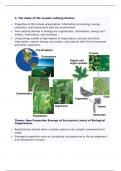
Reductionism breaks down complex systems into simpler components for
study.
Emergent properties arise as complexity increases due to the arrangement
and interactions of parts.
, Systems biology complements reductionism by analyzing interactions among
components.
Structure and function are correlated at each level of the biological
hierarchy.
Cells are the basic units of structure and function in living organisms.
All organisms are made of cells, which can be prokaryotic or eukaryotic.
Prokaryotic cells are smaller and less complex than eukaryotic cells.
Theme: Life’s Processes Involve the Expression and Transmission of
Genetic Information
DNA is the genetic material that contains information for cell development
and function.
Genes are sections of DNA that encode information for building molecules
within cells.
Properties of life include organization, information processing, energy
utilization, and interactions with the environment.
Five unifying themes in biology are organization, information, energy and
matter, interactions, and evolution.
Living things exhibit a high degree of organization, process and store
information, require energy and matter, and interact with the environment
and other organisms.
Theme: New Properties Emerge at Successive Levels of Biological
Organization
Reductionism breaks down complex systems into simpler components for
study.
Emergent properties arise as complexity increases due to the arrangement
and interactions of parts.
, Systems biology complements reductionism by analyzing interactions among
components.
Structure and function are correlated at each level of the biological
hierarchy.
Cells are the basic units of structure and function in living organisms.
All organisms are made of cells, which can be prokaryotic or eukaryotic.
Prokaryotic cells are smaller and less complex than eukaryotic cells.
Theme: Life’s Processes Involve the Expression and Transmission of
Genetic Information
DNA is the genetic material that contains information for cell development
and function.
Genes are sections of DNA that encode information for building molecules
within cells.