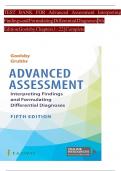
TEST BANK FOR Advanced Assessment Interpreting
Findings and Formulating Differential Diagnoses 5th
b b b b b b
Edition Goolsby Chapters 1 - 22 | Complete
b b b b b b b
, TABLEOFCONTENTS b b
Chapterb 1.b Assessmentb andb Clinicalb Decisionb Making:b Anb Overview
Chapterb 2.b Genomicb Assessment:b Interpretingb Findingsb andb Formulatingb Differentialb Diagnoses
Chapterb 3.b Skin
Chapterb 4.b Head,b Face,b andb Neck
Chapterb 5.b Theb Eye
Chapterb 6.b Ear,b Nose,b Mouth,b andb Throat
Chapterb 7.b Cardiacb andb Peripheralb Vascularb Systems
Chapterb 8.b Respiratoryb System
Chapterb 9.b Breasts
Chapterb 10.b Abdomen
Chapterb 11.b Genitourinaryb System
Chapterb 12.b Maleb Reproductiveb System
Chapterb 13.b Femaleb Reproductiveb System
Chapterb 14.b Musculoskeletalb System
Chapterb 15.b Neurologicalb System
Chapterb 16.b Nonspecificb Complaints
Chapterb 17.b Psychiatricb Mentalb Health
Chapterb 18.b Pediatricb Patients
Chapterb 19.b Pregnantb Patients
Chapterb 20.b Assessmentb ofb theb Transgenderb orb Genderb Diverseb Adult
Chapterb 21.b Olderb Patients
Chapterb 22.b Personsb Withb Disabilities
, Chapter 1. Assessment and Clinical Decision Making: An Overview
b b b b b b b b
Multipleb Choice
Identifyb theb choiceb thatb bestb completesb theb statementKorb answersb theb question.
b 1. Whichb typeb ofb clinicalb decision-makingb isb mostb reliable?
A. Intuitive
B. Analytical
C. Experiential
D. Augenblick
b 2. Whichb ofb theb followingb isb false?b Tob obtainb adequateb history,b health-careb providersb mustb be:
A. Methodicalb andb systematic
B. Attentiveb tob theb patient‘sb verbalb andb nonverbalb langua
g
e
C. Ableb tob accuratelybinterpretb theb patient‘sb responses
D. Adeptb atb readingKintob theb patient‘sb statements
b 3. Essentialb partsb ofb aKhealthb historyb includeb allb ofb theb followingb except:
A. Chiefb complaint
B. Historyb ofb theb presentb illness
C. Currentb vitalb signs
D. Allb ofb theb aboveb areb essentialb historyb compone
n
ts
b 4. Whichb ofb theb followingb isb false?b Whileb performingb theb physicalb examination,b theb examinerKmustb beb ableb to:
A. Differentiatebbetweenb normalb andb abnormalb findings
B. Recallb knowledgeb ofb ab rangeb ofb conditionsb andb theirb associatedb signsb andb sympt
o
ms
C. Recognizeb howb certainb conditionsb affectb theb responseb tob otherb conditions
D. Foreseebunpredictableb findings
b 5. Theb followingb isb theb leastb reliableb sourceb ofb informationb forb diagnosticb statistics:
A. Evidence-basedbinvestigations
B. Primarybreportsb ofb research
C. Estimationb basedb onb ab provider‘sb experienc
e
, D. Publishedbmeta-analyses
b 6. Theb followingb canb beb usedb tob assistb inb soundb clinicalb decision-making:
A. Algorithmbpublishedb inb ab peer-
reviewedb journalb article
B. Clinicalb practiceb guidelines
C. Evidence-basedbresearch
D. Allb ofb theb above
b 7. Ifb ab diagnosticb studyb hasb highb sensitivity,b thisb indicatesb a:
A. Highb percentageb ofb personsb withb theb givenb conditionb willb haveb anb abnormalb re
sult
B. Lowb percentageb ofb personsb withb theb givenb conditionb willb haveb anb abnormalb re
s
ult
C. Lowb likelihoodb ofb normalb resultb inb personsb withoutb ab givenb condition
D. Noneb ofb theb above
b 8. Ifb ab diagnosticb studybhasb highb specificity,b thisb indicatesb a:
A. Lowb percentageb ofb healthyb individualsb willb showb ab normalb result
B. Highb percentageb ofb healthybindividualsb willb showb ab normalb result
C. Highb percentageb ofb individualsb withb ab disorderKwillb showb ab normalb result
D. Lowb percentageb ofb individualsb withb ab disorderb willb showb anb abnormalb re
s
ult
b 9. Ablikelihoodb ratiob aboveb 1b indicatesb thatb ab diagnosticb testb showingb a:
A. Positiveb resultb isb stronglyb associatedb withb theb disease
B. Negativeb resultb isb stronglyb associatedb withb absenceb ofb theb dise
a
se
C. Positiveb resultb isb weaklyb associatedb withb theb disease
D. Negativeb resultb isb weaklyb associatedb withb absenceb ofb theb disea
s
e
Findings and Formulating Differential Diagnoses 5th
b b b b b b
Edition Goolsby Chapters 1 - 22 | Complete
b b b b b b b
, TABLEOFCONTENTS b b
Chapterb 1.b Assessmentb andb Clinicalb Decisionb Making:b Anb Overview
Chapterb 2.b Genomicb Assessment:b Interpretingb Findingsb andb Formulatingb Differentialb Diagnoses
Chapterb 3.b Skin
Chapterb 4.b Head,b Face,b andb Neck
Chapterb 5.b Theb Eye
Chapterb 6.b Ear,b Nose,b Mouth,b andb Throat
Chapterb 7.b Cardiacb andb Peripheralb Vascularb Systems
Chapterb 8.b Respiratoryb System
Chapterb 9.b Breasts
Chapterb 10.b Abdomen
Chapterb 11.b Genitourinaryb System
Chapterb 12.b Maleb Reproductiveb System
Chapterb 13.b Femaleb Reproductiveb System
Chapterb 14.b Musculoskeletalb System
Chapterb 15.b Neurologicalb System
Chapterb 16.b Nonspecificb Complaints
Chapterb 17.b Psychiatricb Mentalb Health
Chapterb 18.b Pediatricb Patients
Chapterb 19.b Pregnantb Patients
Chapterb 20.b Assessmentb ofb theb Transgenderb orb Genderb Diverseb Adult
Chapterb 21.b Olderb Patients
Chapterb 22.b Personsb Withb Disabilities
, Chapter 1. Assessment and Clinical Decision Making: An Overview
b b b b b b b b
Multipleb Choice
Identifyb theb choiceb thatb bestb completesb theb statementKorb answersb theb question.
b 1. Whichb typeb ofb clinicalb decision-makingb isb mostb reliable?
A. Intuitive
B. Analytical
C. Experiential
D. Augenblick
b 2. Whichb ofb theb followingb isb false?b Tob obtainb adequateb history,b health-careb providersb mustb be:
A. Methodicalb andb systematic
B. Attentiveb tob theb patient‘sb verbalb andb nonverbalb langua
g
e
C. Ableb tob accuratelybinterpretb theb patient‘sb responses
D. Adeptb atb readingKintob theb patient‘sb statements
b 3. Essentialb partsb ofb aKhealthb historyb includeb allb ofb theb followingb except:
A. Chiefb complaint
B. Historyb ofb theb presentb illness
C. Currentb vitalb signs
D. Allb ofb theb aboveb areb essentialb historyb compone
n
ts
b 4. Whichb ofb theb followingb isb false?b Whileb performingb theb physicalb examination,b theb examinerKmustb beb ableb to:
A. Differentiatebbetweenb normalb andb abnormalb findings
B. Recallb knowledgeb ofb ab rangeb ofb conditionsb andb theirb associatedb signsb andb sympt
o
ms
C. Recognizeb howb certainb conditionsb affectb theb responseb tob otherb conditions
D. Foreseebunpredictableb findings
b 5. Theb followingb isb theb leastb reliableb sourceb ofb informationb forb diagnosticb statistics:
A. Evidence-basedbinvestigations
B. Primarybreportsb ofb research
C. Estimationb basedb onb ab provider‘sb experienc
e
, D. Publishedbmeta-analyses
b 6. Theb followingb canb beb usedb tob assistb inb soundb clinicalb decision-making:
A. Algorithmbpublishedb inb ab peer-
reviewedb journalb article
B. Clinicalb practiceb guidelines
C. Evidence-basedbresearch
D. Allb ofb theb above
b 7. Ifb ab diagnosticb studyb hasb highb sensitivity,b thisb indicatesb a:
A. Highb percentageb ofb personsb withb theb givenb conditionb willb haveb anb abnormalb re
sult
B. Lowb percentageb ofb personsb withb theb givenb conditionb willb haveb anb abnormalb re
s
ult
C. Lowb likelihoodb ofb normalb resultb inb personsb withoutb ab givenb condition
D. Noneb ofb theb above
b 8. Ifb ab diagnosticb studybhasb highb specificity,b thisb indicatesb a:
A. Lowb percentageb ofb healthyb individualsb willb showb ab normalb result
B. Highb percentageb ofb healthybindividualsb willb showb ab normalb result
C. Highb percentageb ofb individualsb withb ab disorderKwillb showb ab normalb result
D. Lowb percentageb ofb individualsb withb ab disorderb willb showb anb abnormalb re
s
ult
b 9. Ablikelihoodb ratiob aboveb 1b indicatesb thatb ab diagnosticb testb showingb a:
A. Positiveb resultb isb stronglyb associatedb withb theb disease
B. Negativeb resultb isb stronglyb associatedb withb absenceb ofb theb dise
a
se
C. Positiveb resultb isb weaklyb associatedb withb theb disease
D. Negativeb resultb isb weaklyb associatedb withb absenceb ofb theb disea
s
e