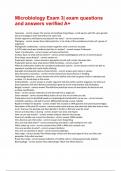
Microbiology Exam 3| exam questions and answers verified A+
Microbiology Exam 3| exam questions and answers verified A+Microbiology Exam 3| exam questions and answers verified A+ Taxonomy - correct answer-The science of classifying living things. a viral species with the same genetic info and ecological niche that infects the same host. Similar organisms and bacteria are placed in the same? - correct answer-taxa Phylogeny - correct answer-Also called systemics. is the study of the evolutionary history of a group of organisms. Phylogenetic relationship - correct answer-organisms with a common ancestor. In 1937 what word was introduced and has no nucleus? - correct answer-Prokaryote Types of prokaryotes - correct answer-archaea and bacteria Archaea have no what and live where? - correct answer-peptidoglycan and live in extreme places Do archaea cause disease? - correct answer-no Prokaryotic Species - correct answer-a population of cells with similar characteristics. Prokaryotic species have what percent DNA Homology - correct answer-70 What do prokaryotes need to be considered prokaryotic species - correct answer-need to be able to reproduce sexually and create viable offspring Examples of prokaryotic species characteristics - correct answer-gram stains or spores. How do bacteria reproduce - correct answer-Asexually by binary fission or budding Thermotoga Maritina - correct answer-one of the earliest cells that has genes similar to bacteria and archaea. It is found deep in the ocean. Endosymbiotic - correct answer-a smaller organism that lives within another organism, the theory of how eukaryotic cells were formed. prokaryotes gave rise to the mitochondria and chloroplast. Bergey's manual - correct answer-The definitive published source of descriptions for bacterial and archaea classification. Strain - correct answer-collection of cells derived from a single cell. Strain example - correct answer-Many strains of ecoli but not all make you sick. Prokaryotes cant be identified based on morphological characteristics so we use: - correct answer-metabolic reactions, cell wall structure, differential staining, source, habitat. Rapid ID method for bacteria - correct answer-this is based on DNA guanine and cytosine percentages. Description of Percent GC content - correct answer-quick and easy way that only takes less than an hour to do. You burn the bacteria and then identify it. Similar to PCR test used for covid. Viruses are describes as having - correct answer-cool sizes and shapes How can you see viruses? - correct answer-using an electron microscope. how much smaller are viruses than bacteria - correct answer-1000x smaller Virus Bacteria can infect what - correct answer-every living thing Virus are only alive when? - correct answer-they are within a cell (multiply in the cell) What makes up a virus - correct answer-either DNA or RNA and a protein coat Virus are sensitive to what? - correct answer-interferon Virus are not sensitive to what? - correct answer-antibiotics Host range - correct answer-The limited range of host cells that each type of virus can infect and parasitize. Only infect one host. Broad host range - correct answer-Infection of multiple cells in a living species body. (rabies) Baceriophage - correct answer-Also called phage. Those that infect bacteria. Viron - correct answer-A complete virus. When a virus is being formed and when it is complete or done being made. Viruses are sequenced by? - correct answer-DNA or RNA Parts of a Virus - correct answer-nucleic acid, capsid, envelope Nucleic acid - correct answer-Can
Written for
- Institution
- Microbiology
- Course
- Microbiology
Document information
- Uploaded on
- December 6, 2024
- Number of pages
- 6
- Written in
- 2024/2025
- Type
- Exam (elaborations)
- Contains
- Questions & answers
Subjects
-
microbiology exam 3 exam questions and answers ve

Also available in package deal