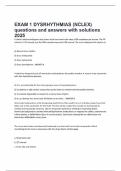
EXAM 1 DYSRHYTHMIAS (NCLEX) questions and answers with solutions 2025
A client's electrocardiogram strip shows atrial and ventricular rates of 80 complexes per minute. The PR interval is 0.14 second, and the QRS complex measures 0.08 second. The nurse interprets this rhythm is: A) Normal sinus rhythm B) Sinus bradycardia C) Sinus tachycardia D) Sinus dysrhythmia - ANSWER A A client has frequent bursts of ventricular tachycardia on the cardiac monitor. A nurse is most concerned with this dysrhythmia because: A) It is uncomfortable for the client, giving a sense of impending doom. B) It produces a high cardiac output that quickly leads to cerebral and myocardial ischemia. C) It is almost impossible to convert to a normal sinus rhythm. D) It can develop into ventricular fibrillation at any time. - ANSWER D Ventricular tachycardia is a life-threatening dysrhythmia that results from an irritable ectopic focus that takes over as the pacemaker for the heart. The low cardiac output that results can lead quickly to cerebral and myocardial ischemia. Client's frequently experience a feeling of impending death. Ventricular tachycardia is treated with antidysrhythmic medications or magnesium sulfate, cardioversion (client awake), or defibrillation (loss of consciousness), Ventricular tachycardia can deteriorate into ventricular defibrillation at any time. The nurse administers amiodarone (Cordarone) to a client with ventricular tachycardia. Which monitoring by the nurse is necessary with this drug? Select all that apply. a. Respiratory rate b. QT interval c. Heart rate and rhythm d. Magnesium level e. Urine output - ANSWER BCD Amiodarone causes prolongation of the QT interval, which can precipitate dysrhythmia. Antidysrhythmic medications cause changes in cardiac rhythm and rate; therefore monitoring of heart rate and rhythm is needed.Electrolyte depletion, specifically potassium and magnesium, may predispose to further dysrhythmia. Although it is always important to monitor vital signs and urine output, these assessments are not specific to amiodarone. The nurse is caring for a client with acute coronary syndrome (ACS) and atrial fibrillation who has a new prescription for metoprolol (Lopressor). Which monitoring is essential when administering the medication? a. ST segment b. Heart rate c. Troponin d. Myoglobin - ANSWER B The effects of metoprolol are to decrease heart rate, blood pressure, and myocardial oxygen demand. ST segment elevation is consistent with MI; it does not address monitoring of metoprolol. Elevation in troponin is consistent with a diagnosis of MI but does not address needed monitoring for metoprolol. Elevation in myoglobin is consistent with myocardial injury in ACS but does not address needed monitoring related to metoprolol. The nurse is caring for a client with atrial fibrillation. In a
Written for
- Institution
- Relias Dysrhythmia Basic
- Course
- Relias Dysrhythmia Basic
Document information
- Uploaded on
- December 5, 2024
- Number of pages
- 17
- Written in
- 2024/2025
- Type
- Exam (elaborations)
- Contains
- Questions & answers
Subjects
-
exam 1 dysrhythmias nclex questions and answers

Also available in package deal