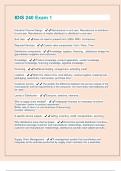
IDIS 240 Exam 1
Industrial Channel Design - ✔️✔️Manufacturer to end user. Manufacturer to distributor
to end user. Manufacturer to master distributor to distributor to end user.
End User - ✔️✔️does not resell in present form (OEM, MRO, Contractors)
Required Services - ✔️✔️Custom value components: Form, Place, Time
Distribution components - ✔️✔️Knowledge, logistics, financing... distributors bridge the
gap between suppliers and customers
Knowledge - ✔️✔️Product knowledge, product application, vendor knowledge,
customer knowledge, financing knowledge, logistical knowledge
Financing - ✔️✔️traditional lending, consignment, extending credit
Logistics - ✔️✔️Wait time, deliver time, local delivery, reverse logistics, breaking bulk,
packaging, assortment, local access, purchase time
Customer service - ✔️✔️The greater the difference between the service outputs of the
manufacturer and the requirements of the consumer, the more likely intermediaries will
be used.
Levels of Distribution - ✔️✔️Exclusive, selective, intensive
Why is supply chain needed? - ✔️✔️Inadequate finances for necessary functions
Customers' desire for product assortment
Better rate of return on core business (Outsourcing)
Contact "efficiency"
5 specific service outputs - ✔️✔️selling, inventory, credit, transportation, servicing
Why distributors have channel power - ✔️✔️Economics provide distribution functions,
distributors leverage customer and manufacturer relationships, distributors leverage
customer and manufacturer relationships, distributors provide value-added services
Supply Chain Management - ✔️✔️A management system that coordinates and
integrates all the activities performed by supply chain members into a seamless
Industrial Channel Design - ✔️✔️Manufacturer to end user. Manufacturer to distributor
to end user. Manufacturer to master distributor to distributor to end user.
End User - ✔️✔️does not resell in present form (OEM, MRO, Contractors)
Required Services - ✔️✔️Custom value components: Form, Place, Time
Distribution components - ✔️✔️Knowledge, logistics, financing... distributors bridge the
gap between suppliers and customers
Knowledge - ✔️✔️Product knowledge, product application, vendor knowledge,
customer knowledge, financing knowledge, logistical knowledge
Financing - ✔️✔️traditional lending, consignment, extending credit
Logistics - ✔️✔️Wait time, deliver time, local delivery, reverse logistics, breaking bulk,
packaging, assortment, local access, purchase time
Customer service - ✔️✔️The greater the difference between the service outputs of the
manufacturer and the requirements of the consumer, the more likely intermediaries will
be used.
Levels of Distribution - ✔️✔️Exclusive, selective, intensive
Why is supply chain needed? - ✔️✔️Inadequate finances for necessary functions
Customers' desire for product assortment
Better rate of return on core business (Outsourcing)
Contact "efficiency"
5 specific service outputs - ✔️✔️selling, inventory, credit, transportation, servicing
Why distributors have channel power - ✔️✔️Economics provide distribution functions,
distributors leverage customer and manufacturer relationships, distributors leverage
customer and manufacturer relationships, distributors provide value-added services
Supply Chain Management - ✔️✔️A management system that coordinates and
integrates all the activities performed by supply chain members into a seamless