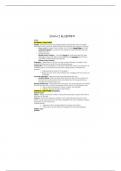
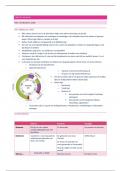
EXAM 2 BLUEPRINT
EYES
EXTERNAL STRUCTURES
Eyelids Protects the eye from foreign bodies and limits the amount of light
entering the eye. Serve to distribute tears that lubricate the surface of the eye.
o Upper eyelid is larger, more mobile, and contains Tarsal Plates (contain
meibomian glands secrete an oily substance that lubricates the eye)
made up of C.T.
o Join at 2 points:
Medial (inner) Canthus Contains Puncta (2 small openings that allow
drainage of tears into the lacrimal system) and Caruncle (Small, fleshy
mass that contain sebaceous glands)
Lateral (outer) Canthus
Eyelashes Projections of stiff hair curving outward along the margins of the
eyelids that filter dust and dirt from air entering the eye.
Conjunctiva Thin, transparent, continuous membrane. Allows for inspection of
underlying tissue and protects the eye from foreign bodies. Divided into 2
portions:
Palpebral (lines inside of the eyelids)
Bulbar (covers most of the anterior eye, merging with the cornea at
the limbs)
Lacrimal Apparatus Glands and ducts that lubricate the eye.
o Lacrimal Gland: Produces tears (they drain into the puncta, empty into
the lacrimal canal and are then channeled into the nasolacrimal sac
through the nasolacrimal duct.)
Extraocular Muscles Responsible for moving the eye in the direction controlled
by that muscles. Each muscle coordinates with a muscle in the opposite eye.
Rectus Muscles (Superior, Inferior, Lateral, and Medial)
Oblique Muscles (Superior and Inferior)
INTERNAL STRUCTURES (3 layers)
External Layer:
Sclera Dense, protective, white covering that physically supports the internal
structures of the eye.
Cornea Permits the entrance of light, which passes through the lens to the
retina. Covers and protects Iris and Pupil. Supplied with nerve endings making it
responsive to pain and touch.
Cranial Nerves:
Trigeminal Nerve (carries afferent sensation into brain)
Facial Nerve (cares efferent message that stimulates blinking)
Middle Layer:
Anterior
, EXAM 2 BLUEPRINT
EYES
EXTERNAL STRUCTURES
Eyelids Protects the eye from foreign bodies and limits the amount of light
entering the eye. Serve to distribute tears that lubricate the surface of the eye.
o Upper eyelid is larger, more mobile, and contains Tarsal P (contain
meibomian glands secrete an oily substance th bricates the eye)
p of C.T.
o Join at 2 points:
Medial (inner) Canthus Contains Puncta (2 small openings that allow
drainage of tears into the lacrim ) and Caruncle (Small, fleshy
mass that contain sebaceous glands)
Lateral (outer) Canthus
Eyelashes Projections of stiff hair curving outward along the margins of the
eyelids that filter dust and dirt from air entering the eye.
Conjunctiva Thin, transparent, continuous membrane. Allows for inspection of
underlying tissue and protects the eye from foreign bodies. Divided into 2
portions:
Palpebral (lines inside of the eyelids)
Bulbar (covers most of the anterior eye, merging with the cornea at
the limbs)
Lacrimal Apparatus Glands and ducts that lubricate the eye.
o Lacrimal Gland: Produces tears (they drain into the puncta, empty into
the lacrimal canal and are then channeled into the nasolacrimal sac
through the
by that muscles. Each muscle coordinates with a muscle in the opposite eye.
Oblique Muscles (Superior and Inferior)
INTERNAL STRUCTURES (3 layers)
External Layer:
Dense, protective, white covering that physically supports the internal
ures of the eye.
Permits the entrance of light, which passes through the lens to the
retina overs and protects Iris and Pupil. Supplied with nerve endings making it
responsive to pain and touch.
Cranial Nerves:
ve (carries afferent sensation into brain)
Facial Nerve (cares efferent message that stimulates blinking)
Middle Layer:
Anterior
, Iris Circular disc of muscle containing pigments that determines eye color.
djust to control the size of the pupil (EX. Constrict and Dilate)
o Contains PUPIL (Controls amount of light entering the eye)
Pu Round.
focusing an object on retina.
Parasympathetic Branch causes cons n.
dilates and elevates eyelid.
Ciliary Bod Consist of muscle tissue that controls the thickness of the lens,
which must be adapted to focus on objects near and far away.
Lens Biconvex, transparent, encapsulated structures located posterior to the
iris.
o Functions to refract (bend) light rays onto the retina.
o Lens BULGES (focus on close objects) and FLATTENS (focus on far objects)
Choroid Layer contains vascularity necessary to provide nourishment to the
f the eye and prevents light from re . Continuous
with ciliary body and iris anteriorly.
Inner Layer:
Retina Receives visual stimuli and sends it to the brain (light waves changed
into nerve impulses).
Consist of photoreceptors (nerve cells):
Rod : Highly sensitive to light, regulate B&W vision, and function in dim
light.
Cones: function in bright light and sensitive to color.
Area in which fibers from retina converge to
o Located towards nasal side of retina.
o Cream-colored, round or oval shaped with distinct margins.
o Includes Physiologic Cup (smaller circular area inside disc where blood
vessels enter and exit).
Retinal Vessels Four sets of arterioles (carry oxygenated blood and appear
brighter red and narrower than veins) and venules (dark red and grow
progressively narrower as they extend out to the peripheral areas).
o Retinal Depression Fovea Centralis surrounded by Macula (form the area
of highest visual resolution and color vision)
and
o Maintain structure, protect against injury, and transmit light right.
o Filled wit (clear liquid substance produced by ciliary
body, helps cleanse and nourish the cornea and lens as well as maintain
intraocular pressure)
SPECIAL POPULATIONS
Infants & Children (Structure and Function are not fully developed):
Peripheral vision is developed, central vision is not.
Macula is absent at birth, develops at 4 mos., mature by 8 mos.
EYES
EXTERNAL STRUCTURES
Eyelids Protects the eye from foreign bodies and limits the amount of light
entering the eye. Serve to distribute tears that lubricate the surface of the eye.
o Upper eyelid is larger, more mobile, and contains Tarsal Plates (contain
meibomian glands secrete an oily substance that lubricates the eye)
made up of C.T.
o Join at 2 points:
Medial (inner) Canthus Contains Puncta (2 small openings that allow
drainage of tears into the lacrimal system) and Caruncle (Small, fleshy
mass that contain sebaceous glands)
Lateral (outer) Canthus
Eyelashes Projections of stiff hair curving outward along the margins of the
eyelids that filter dust and dirt from air entering the eye.
Conjunctiva Thin, transparent, continuous membrane. Allows for inspection of
underlying tissue and protects the eye from foreign bodies. Divided into 2
portions:
Palpebral (lines inside of the eyelids)
Bulbar (covers most of the anterior eye, merging with the cornea at
the limbs)
Lacrimal Apparatus Glands and ducts that lubricate the eye.
o Lacrimal Gland: Produces tears (they drain into the puncta, empty into
the lacrimal canal and are then channeled into the nasolacrimal sac
through the nasolacrimal duct.)
Extraocular Muscles Responsible for moving the eye in the direction controlled
by that muscles. Each muscle coordinates with a muscle in the opposite eye.
Rectus Muscles (Superior, Inferior, Lateral, and Medial)
Oblique Muscles (Superior and Inferior)
INTERNAL STRUCTURES (3 layers)
External Layer:
Sclera Dense, protective, white covering that physically supports the internal
structures of the eye.
Cornea Permits the entrance of light, which passes through the lens to the
retina. Covers and protects Iris and Pupil. Supplied with nerve endings making it
responsive to pain and touch.
Cranial Nerves:
Trigeminal Nerve (carries afferent sensation into brain)
Facial Nerve (cares efferent message that stimulates blinking)
Middle Layer:
Anterior
, EXAM 2 BLUEPRINT
EYES
EXTERNAL STRUCTURES
Eyelids Protects the eye from foreign bodies and limits the amount of light
entering the eye. Serve to distribute tears that lubricate the surface of the eye.
o Upper eyelid is larger, more mobile, and contains Tarsal P (contain
meibomian glands secrete an oily substance th bricates the eye)
p of C.T.
o Join at 2 points:
Medial (inner) Canthus Contains Puncta (2 small openings that allow
drainage of tears into the lacrim ) and Caruncle (Small, fleshy
mass that contain sebaceous glands)
Lateral (outer) Canthus
Eyelashes Projections of stiff hair curving outward along the margins of the
eyelids that filter dust and dirt from air entering the eye.
Conjunctiva Thin, transparent, continuous membrane. Allows for inspection of
underlying tissue and protects the eye from foreign bodies. Divided into 2
portions:
Palpebral (lines inside of the eyelids)
Bulbar (covers most of the anterior eye, merging with the cornea at
the limbs)
Lacrimal Apparatus Glands and ducts that lubricate the eye.
o Lacrimal Gland: Produces tears (they drain into the puncta, empty into
the lacrimal canal and are then channeled into the nasolacrimal sac
through the
by that muscles. Each muscle coordinates with a muscle in the opposite eye.
Oblique Muscles (Superior and Inferior)
INTERNAL STRUCTURES (3 layers)
External Layer:
Dense, protective, white covering that physically supports the internal
ures of the eye.
Permits the entrance of light, which passes through the lens to the
retina overs and protects Iris and Pupil. Supplied with nerve endings making it
responsive to pain and touch.
Cranial Nerves:
ve (carries afferent sensation into brain)
Facial Nerve (cares efferent message that stimulates blinking)
Middle Layer:
Anterior
, Iris Circular disc of muscle containing pigments that determines eye color.
djust to control the size of the pupil (EX. Constrict and Dilate)
o Contains PUPIL (Controls amount of light entering the eye)
Pu Round.
focusing an object on retina.
Parasympathetic Branch causes cons n.
dilates and elevates eyelid.
Ciliary Bod Consist of muscle tissue that controls the thickness of the lens,
which must be adapted to focus on objects near and far away.
Lens Biconvex, transparent, encapsulated structures located posterior to the
iris.
o Functions to refract (bend) light rays onto the retina.
o Lens BULGES (focus on close objects) and FLATTENS (focus on far objects)
Choroid Layer contains vascularity necessary to provide nourishment to the
f the eye and prevents light from re . Continuous
with ciliary body and iris anteriorly.
Inner Layer:
Retina Receives visual stimuli and sends it to the brain (light waves changed
into nerve impulses).
Consist of photoreceptors (nerve cells):
Rod : Highly sensitive to light, regulate B&W vision, and function in dim
light.
Cones: function in bright light and sensitive to color.
Area in which fibers from retina converge to
o Located towards nasal side of retina.
o Cream-colored, round or oval shaped with distinct margins.
o Includes Physiologic Cup (smaller circular area inside disc where blood
vessels enter and exit).
Retinal Vessels Four sets of arterioles (carry oxygenated blood and appear
brighter red and narrower than veins) and venules (dark red and grow
progressively narrower as they extend out to the peripheral areas).
o Retinal Depression Fovea Centralis surrounded by Macula (form the area
of highest visual resolution and color vision)
and
o Maintain structure, protect against injury, and transmit light right.
o Filled wit (clear liquid substance produced by ciliary
body, helps cleanse and nourish the cornea and lens as well as maintain
intraocular pressure)
SPECIAL POPULATIONS
Infants & Children (Structure and Function are not fully developed):
Peripheral vision is developed, central vision is not.
Macula is absent at birth, develops at 4 mos., mature by 8 mos.