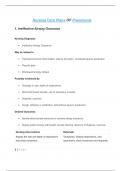
Nursing Care Plans OF Pneumonia
1. Ineffective Airway Clearance
Nursing Diagnosis
Ineffective Airway Clearance
May be related to
Tracheal bronchial inflammation, edema formation, increased sputum production
Pleuritic pain
Decreased energy, fatigue
Possibly evidenced by
Changes in rate, depth of respirations
Abnormal breath sounds, use of accessory muscles
Dyspnea, cyanosis
Cough, effective or ineffective; with/without sputum production
Desired Outcomes
Identify/demonstrate behaviors to achieve airway clearance.
Display patent airway with breath sounds clearing; absence of dyspnea, cyanosis.
Nursing Interventions Rationale
Assess the rate and depth of respirations Tachypnea, shallow respirations, and
and chest movement. asymmetric chest movement are frequently
1 | Page
,Nursing Interventions Rationale
present because of discomfort of moving
chest wall and/or fluid in lung.
Decreased airflow occurs in areas with
consolidated fluid. Bronchial breath sounds
Auscultate lung fields, noting areas of
can also occur in these consolidated areas.
decreased or absent airflow and
Crackles, rhonchi, and wheezes are heard
adventitious breath sounds: crackles,
on inspiration and/or expiration in response
wheezes.
to fluid accumulation, thick secretions, and
airway spams and obstruction.
Doing so would lower the diaphragm and
Elevate head of bed, change position promote chest expansion, aeration of lung
frequently. segments, mobilization and expectoration
of secretions.
Deep breathing exercises facilitates
maximum expansion of the lungs and
Teach and assist patient with proper deep-
smaller airways. Coughing is a reflex and a
breathing exercises. Demonstrate proper
natural self-cleaning mechanism that
splinting of chest and effective coughing
assists the cilia to maintain patent airways.
while in upright position. Encourage him to
Splinting reduces chest discomfort and an
do so often.
upright position favors deeper and more
forceful cough effort.
Stimulates cough or mechanically clears
Suction as indicated: frequent coughing,
airway in patient who is unable to do so
adventitious breath sounds, desaturation
because of ineffective cough or decreased
related to airway secretions.
level of consciousness.
Force fluids to at least 3000 mL/day (unless Fluids, especially warm liquids, aid in
contraindicated, as in heart failure). Offer mobilization and expectoration of
warm, rather than cold, fluids. secretions.
Assist and monitor effects of nebulizer Nebulizers and other respiratory therapy
treatment and other respiratory facilitates liquefaction and expectoration of
physiotherapy: incentive spirometer, IPPB, secretions. Postural drainage may not be
2 | Page
, Nursing Interventions Rationale
as effective in interstitial pneumonias or
percussion, postural drainage. Perform those causing alveolar exudate or
treatments between meals and limit fluids destruction. Coordination of treatments and
when appropriate. oral intake reduces likelihood of vomiting
with coughing, expectorations.
Aids in reduction of bronchospasm and
mobilization of secretions. Analgesics are
Administer medications as indicated:
given to improve cough effort by reducing
mucolytics, expectorants, bronchodilators,
discomfort, but should be used cautiously
analgesics.
because they can decrease cough effort
and depress respirations.
Room humidification has been found to
Provide supplemental fluids: IV. provide minimal benefit and is thought to
increase the risk of transmitting infection.
Followers progress and effects of the
Monitor serial chest x-rays, ABGs, pulse disease process, therapeutic regimen, and
oximetry readings. may facilitate necessary alterations in
therapy.
Occasionally needed to remove mucous
Assist with bronchoscopy and/or
plugs, drain purulent secretions, and/or
thoracentesis, if indicated.
prevent atelectasis.
Urge all bedridden and postoperative
To promote full aeration and drainage of
patients to perform deep breathing and
secretions.
coughing exercises frequently.
2. Impaired Gas Exchange
Nursing Diagnosis
Impaired Gas Exchange
3 | Page
1. Ineffective Airway Clearance
Nursing Diagnosis
Ineffective Airway Clearance
May be related to
Tracheal bronchial inflammation, edema formation, increased sputum production
Pleuritic pain
Decreased energy, fatigue
Possibly evidenced by
Changes in rate, depth of respirations
Abnormal breath sounds, use of accessory muscles
Dyspnea, cyanosis
Cough, effective or ineffective; with/without sputum production
Desired Outcomes
Identify/demonstrate behaviors to achieve airway clearance.
Display patent airway with breath sounds clearing; absence of dyspnea, cyanosis.
Nursing Interventions Rationale
Assess the rate and depth of respirations Tachypnea, shallow respirations, and
and chest movement. asymmetric chest movement are frequently
1 | Page
,Nursing Interventions Rationale
present because of discomfort of moving
chest wall and/or fluid in lung.
Decreased airflow occurs in areas with
consolidated fluid. Bronchial breath sounds
Auscultate lung fields, noting areas of
can also occur in these consolidated areas.
decreased or absent airflow and
Crackles, rhonchi, and wheezes are heard
adventitious breath sounds: crackles,
on inspiration and/or expiration in response
wheezes.
to fluid accumulation, thick secretions, and
airway spams and obstruction.
Doing so would lower the diaphragm and
Elevate head of bed, change position promote chest expansion, aeration of lung
frequently. segments, mobilization and expectoration
of secretions.
Deep breathing exercises facilitates
maximum expansion of the lungs and
Teach and assist patient with proper deep-
smaller airways. Coughing is a reflex and a
breathing exercises. Demonstrate proper
natural self-cleaning mechanism that
splinting of chest and effective coughing
assists the cilia to maintain patent airways.
while in upright position. Encourage him to
Splinting reduces chest discomfort and an
do so often.
upright position favors deeper and more
forceful cough effort.
Stimulates cough or mechanically clears
Suction as indicated: frequent coughing,
airway in patient who is unable to do so
adventitious breath sounds, desaturation
because of ineffective cough or decreased
related to airway secretions.
level of consciousness.
Force fluids to at least 3000 mL/day (unless Fluids, especially warm liquids, aid in
contraindicated, as in heart failure). Offer mobilization and expectoration of
warm, rather than cold, fluids. secretions.
Assist and monitor effects of nebulizer Nebulizers and other respiratory therapy
treatment and other respiratory facilitates liquefaction and expectoration of
physiotherapy: incentive spirometer, IPPB, secretions. Postural drainage may not be
2 | Page
, Nursing Interventions Rationale
as effective in interstitial pneumonias or
percussion, postural drainage. Perform those causing alveolar exudate or
treatments between meals and limit fluids destruction. Coordination of treatments and
when appropriate. oral intake reduces likelihood of vomiting
with coughing, expectorations.
Aids in reduction of bronchospasm and
mobilization of secretions. Analgesics are
Administer medications as indicated:
given to improve cough effort by reducing
mucolytics, expectorants, bronchodilators,
discomfort, but should be used cautiously
analgesics.
because they can decrease cough effort
and depress respirations.
Room humidification has been found to
Provide supplemental fluids: IV. provide minimal benefit and is thought to
increase the risk of transmitting infection.
Followers progress and effects of the
Monitor serial chest x-rays, ABGs, pulse disease process, therapeutic regimen, and
oximetry readings. may facilitate necessary alterations in
therapy.
Occasionally needed to remove mucous
Assist with bronchoscopy and/or
plugs, drain purulent secretions, and/or
thoracentesis, if indicated.
prevent atelectasis.
Urge all bedridden and postoperative
To promote full aeration and drainage of
patients to perform deep breathing and
secretions.
coughing exercises frequently.
2. Impaired Gas Exchange
Nursing Diagnosis
Impaired Gas Exchange
3 | Page