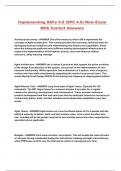
Implementing SAFe 4.0 (SPC 4.0) New Exam
With Correct Answers
Architectural runway - ANSWER One of the means by which SAFe implements the
concepts of Agile architecture. This runway provides the necessary technical basis for
developing business initiatives and implementing new feature and capabilities. Exists
when the enterprise platforms have sufficient existing technological infrastructure to
support the implementation of the highest- priority, near term features without
excessive, delay inducing redesign
Agile Architecture - ANSWER set of values & practices that support the active evolution
of the design & architecture of the system, concurrent w/ the implementation of new
business functionality. W/this approach, the architecture of a system, even a largeone,
evolves over time while simultaneouly supporting the needs of concurrent users. This
avoids Big Up-Front Design (BUFD) & the starting and stopping of staging-gated method
Agile Release Train - ANSWER Long lived team of Agile Teams. Typically 50-125
individuals. The ART aligns teams to a common mission & provides for a regular
cadence for planning, development, and retrospective. Trains provide continuous
product development and flow and each train has the dedicated resources necessary to
continuously define, build, and test valuable and evaluate-able capabilities every two
weeks
Agile Teams - ANSWER Agile teams are cross functional teams of 5 to 9 people with the
ability & authority to define, build, and test solution value- all in a short-iteration time
box. Included will be the people required to successfully deliver this value supported by
specialist where applicable.
Budgets - ANSWER Fund value streams, not projects. This will enable the value streams
w/ streams having a dedicated budget for fast decision making and agile value delivery,
while PPM keeps control over the total spend, which is reassessed over time
,Built-in Quality - ANSWER One of 4 core SAFe values. The enterprises ability to deliver
new functionality w/ the fastest sustainable lead time, along w/the ability to be able to
react to rapidly changing business conditions is dependent on built-in quality
Business Owners - ANSWER Small group of stakeholders, normally 3 to 5, who have
ultimate fiduciary, governance, efficacy, and return on investment responsibility for
value delivered by specific release train. Normally have management responsibilities for
customer relationships, development, solution quality, deployment, operations, product
management, and architecture.
Capabilities - ANSWER Similar to features; however, they account for higher-level
behaviors of the solution, which often spans multiple ARTs. Maintained in the values
stream backlog & sized to fit in the program increment, so that each PI delivers solution
value
Capital Expense (CapEX) ANSWER A value stream budget may include this. Typically
captures the expenses required to purchase, upgrade, or fix tangible physical assets or
other property used to support the solution building. May capture elements of the cost
of labor for development of certain intangible assets.
Operating expense (OpEx) - ANSWER Value steam budget may include this. Typically
include salaries & overhead, contract labor, materials, supplies, & items directly related
to the solution development activities.
Communities of Practice (CoP) - ANSWER An informal group of team members & other
experts, acting within the context of a program or more relevant domains.
Continuous integration Team members integrate and validate their work frequently; in
case of software, this is at least daily or even multiple times a day. Where possible, the
integration should be verified through automated build & test environments that quickly
identify problems with integration and defects.
Core values - ANSWER Alignment, built-in quality, transparency, & program execution
, Customer - ANSWER Whoever consumes the work of the value stream. Ultimate arbiters
of value delivered. Whether internal or external to the development organization, they
are an integral part of the development value stream
Develop on Cadence-ANSWER Basing routine development activities on a fast,
synchronous schedule- a regular, predictive rhythm of important events - helps manage
the inherent variability in the system development. It's a fundamental premise of SAFe,
and the impact is direct and easy to see on the Big Picture-through the fast cadence of
synchronized, short iterations followed by further integration of those iterations into
larger program increments.
DevOps - ANSWER A mindset, culture, and set of technical practice that stress
communication, collaboration, and close cooperation between Agile development
teams and other technology professionals who are necessary for developing, testing,
deploying, and maintaining software & systems.
Economic Framework - ANSWER A set of decision rules that aligns everyone to the
financial objectives of the mission, including budget considerations driven from the
program portfolio. The first LEAN Agile principle for SAFe is to take an economic view;
this captures the essential economic elements for successful development.
Enabler Capability - ANSWER Occur at value steam level, where they capture work of
that type. As these are they type of capability, they share the same attributes, including
a statement of benefits & acceptance criteria, and they must be structured so as to fit w/
in a single PI
Enabler Epic - ANSWER Type of epic, written using value stream format defined for
epics. Tend to cut across value stream & PIs. They require a lightweight business cases
to support their implementation. They are identified and tracked through the portfolio
Kanban system
Enabler feature - ANSWER Occurs at the program level, where they capture work of that
type. Because these enablers represent a type of feature, they have many of the same
attributes including a statement of benefits and acceptance criteria, and are structured
so as to fit within a single PI
With Correct Answers
Architectural runway - ANSWER One of the means by which SAFe implements the
concepts of Agile architecture. This runway provides the necessary technical basis for
developing business initiatives and implementing new feature and capabilities. Exists
when the enterprise platforms have sufficient existing technological infrastructure to
support the implementation of the highest- priority, near term features without
excessive, delay inducing redesign
Agile Architecture - ANSWER set of values & practices that support the active evolution
of the design & architecture of the system, concurrent w/ the implementation of new
business functionality. W/this approach, the architecture of a system, even a largeone,
evolves over time while simultaneouly supporting the needs of concurrent users. This
avoids Big Up-Front Design (BUFD) & the starting and stopping of staging-gated method
Agile Release Train - ANSWER Long lived team of Agile Teams. Typically 50-125
individuals. The ART aligns teams to a common mission & provides for a regular
cadence for planning, development, and retrospective. Trains provide continuous
product development and flow and each train has the dedicated resources necessary to
continuously define, build, and test valuable and evaluate-able capabilities every two
weeks
Agile Teams - ANSWER Agile teams are cross functional teams of 5 to 9 people with the
ability & authority to define, build, and test solution value- all in a short-iteration time
box. Included will be the people required to successfully deliver this value supported by
specialist where applicable.
Budgets - ANSWER Fund value streams, not projects. This will enable the value streams
w/ streams having a dedicated budget for fast decision making and agile value delivery,
while PPM keeps control over the total spend, which is reassessed over time
,Built-in Quality - ANSWER One of 4 core SAFe values. The enterprises ability to deliver
new functionality w/ the fastest sustainable lead time, along w/the ability to be able to
react to rapidly changing business conditions is dependent on built-in quality
Business Owners - ANSWER Small group of stakeholders, normally 3 to 5, who have
ultimate fiduciary, governance, efficacy, and return on investment responsibility for
value delivered by specific release train. Normally have management responsibilities for
customer relationships, development, solution quality, deployment, operations, product
management, and architecture.
Capabilities - ANSWER Similar to features; however, they account for higher-level
behaviors of the solution, which often spans multiple ARTs. Maintained in the values
stream backlog & sized to fit in the program increment, so that each PI delivers solution
value
Capital Expense (CapEX) ANSWER A value stream budget may include this. Typically
captures the expenses required to purchase, upgrade, or fix tangible physical assets or
other property used to support the solution building. May capture elements of the cost
of labor for development of certain intangible assets.
Operating expense (OpEx) - ANSWER Value steam budget may include this. Typically
include salaries & overhead, contract labor, materials, supplies, & items directly related
to the solution development activities.
Communities of Practice (CoP) - ANSWER An informal group of team members & other
experts, acting within the context of a program or more relevant domains.
Continuous integration Team members integrate and validate their work frequently; in
case of software, this is at least daily or even multiple times a day. Where possible, the
integration should be verified through automated build & test environments that quickly
identify problems with integration and defects.
Core values - ANSWER Alignment, built-in quality, transparency, & program execution
, Customer - ANSWER Whoever consumes the work of the value stream. Ultimate arbiters
of value delivered. Whether internal or external to the development organization, they
are an integral part of the development value stream
Develop on Cadence-ANSWER Basing routine development activities on a fast,
synchronous schedule- a regular, predictive rhythm of important events - helps manage
the inherent variability in the system development. It's a fundamental premise of SAFe,
and the impact is direct and easy to see on the Big Picture-through the fast cadence of
synchronized, short iterations followed by further integration of those iterations into
larger program increments.
DevOps - ANSWER A mindset, culture, and set of technical practice that stress
communication, collaboration, and close cooperation between Agile development
teams and other technology professionals who are necessary for developing, testing,
deploying, and maintaining software & systems.
Economic Framework - ANSWER A set of decision rules that aligns everyone to the
financial objectives of the mission, including budget considerations driven from the
program portfolio. The first LEAN Agile principle for SAFe is to take an economic view;
this captures the essential economic elements for successful development.
Enabler Capability - ANSWER Occur at value steam level, where they capture work of
that type. As these are they type of capability, they share the same attributes, including
a statement of benefits & acceptance criteria, and they must be structured so as to fit w/
in a single PI
Enabler Epic - ANSWER Type of epic, written using value stream format defined for
epics. Tend to cut across value stream & PIs. They require a lightweight business cases
to support their implementation. They are identified and tracked through the portfolio
Kanban system
Enabler feature - ANSWER Occurs at the program level, where they capture work of that
type. Because these enablers represent a type of feature, they have many of the same
attributes including a statement of benefits and acceptance criteria, and are structured
so as to fit within a single PI