Tuesday 10 October 2023
Lecture 6a – Cancer Selection: The risks of novelty
Cancers are the result of animals evolving new structures/body parts/life history
Tumours are evolved purposeful entities – they have adaptions and designs that are
intended to promote their own survival at the expense of the host
Cancer Adaptations
Mechanisms that give cancer Self-sufficiency of Growth Signals, e.g. H-Ras mutations
Insensitivity to anti-growth signals produced by cells, e.g. RB- mutations
Apoptosis (programmed cell death) evasion, e.g. produce ICG survival factors
Limitless reproductive potential, e.g. switching on telomerase (produces telomeres at
the ends of chromosomes which are reduced over time with cell division)
Angiogenesis (allows blood vessels to supply tumour cells with nutrients and
oxygen), e.g. VEGF inducers
Tissue invasion and metastasis (late stage cancers to invade into surround tissue and
spread around the body), e.g. E-cadherin mutations
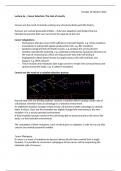
Cancers are the result of a variation-selection process
Normal body cells are dividing (yellow), receives a mutation (blue) causing a faster rate of
cell division, therefore have an advantage in a selective environment
An additional mutation (orange) results in fast cell division/a better advantage so spreads
faster in tissue. Since the first mutation has slightly changed the environment, the new
mutation is in a second selective environment
A third mutation (purple) results in the cells being able to spread around to the rest of the
body, in a third selective environment
The cumulation of these mutations, each of which gives an adaption, is why we can say that
cancers are evolved purposeful entities
Cancer Phylogeny
If cancer is a result of mutations by descent (where all cells have evolved from a single
founder), it is possible to reconstruct a phylogeny of the cancer cells by sequencing the
individual cells of tumours
, Tuesday 10 October 2023
Cancers are ancient in animals. They are found in Mollusca, Arthropoda and Vertebrata,
suggesting they are ancestral in the Metazoan
Cancers are a failure of host adaption
Novel environments (UV, gamma, toxins) result in carcinogens due to environments
where the growth mechanisms of animals are not adapted
Ageing (due to the decline in the force of natural selection with age)
When new structures evolve (meaning animals need to evolve anti-cancer
mechanisms)
James Graham (1992) argues that cancers were the result of new cellular conditions
(morphological evolution) that arise in evolution
He viewed cancer when animals develop new morphologies as analogous to the transient
decline in quality that occurs when a manufacturing process is altered
This would mean that we expect cancers in the rapid evolution of morphology or life history
(to be oncogenic)
Example: dogs vary enormously in body size, and large dogs are susceptible to diseases like
osteosarcoma, finding that rates of the disease increase steeply with weight then plateaus at
40kg meaning dogs have developed fast growth rates in their joints increasing the risk of
cancers due to anti-cancer mechanism not evolving as quickly
Example: ovarian follicle cancer in hens due to being selected to producing many eggs in a
short time
Natural Example: osteosarcoma cancer in human children, causing bone cells to spread
around the body and from tumours, there is an increased risk in tall-for-age children,
occurring at puberty and in rapidly growing joints. Suggesting that humans have evolved
their taller heights relatively quickly, the rate of growth declines after birth but has an
increase during the pubertal growth spurt at ~14 years then continues to decline in growth
rates. In comparison to macaques, which have a constantly decreasing growth rate.
Therefore the presence of a pubertal growth spurt is human-specific as a consequence
osteosarcoma is a result of a rapid evolution of growth rate where anti-cancer mechanisms
have not caught up to supress the extra cell divisions
The distribution of cancer types differs between adults and children (paediatric cancers)
Epithelial cancers (breast, lung, prostate, colon) make up the majority of adult
cancers
Nervous system tumours, leukaemia, lymphomas are more common in children
Nervous system tumours are found in the brain, which has evolved much in human lineage
since divergence from apes, where brain size has increased 3x
Leukaemia is due to the immune system continually rapidly evolving due to pathogens
The cellular mechanisms have evolved but the anti-cancer mechanisms to keep the cancers
under control have not caught up
Lecture 6a – Cancer Selection: The risks of novelty
Cancers are the result of animals evolving new structures/body parts/life history
Tumours are evolved purposeful entities – they have adaptions and designs that are
intended to promote their own survival at the expense of the host
Cancer Adaptations
Mechanisms that give cancer Self-sufficiency of Growth Signals, e.g. H-Ras mutations
Insensitivity to anti-growth signals produced by cells, e.g. RB- mutations
Apoptosis (programmed cell death) evasion, e.g. produce ICG survival factors
Limitless reproductive potential, e.g. switching on telomerase (produces telomeres at
the ends of chromosomes which are reduced over time with cell division)
Angiogenesis (allows blood vessels to supply tumour cells with nutrients and
oxygen), e.g. VEGF inducers
Tissue invasion and metastasis (late stage cancers to invade into surround tissue and
spread around the body), e.g. E-cadherin mutations
Cancers are the result of a variation-selection process
Normal body cells are dividing (yellow), receives a mutation (blue) causing a faster rate of
cell division, therefore have an advantage in a selective environment
An additional mutation (orange) results in fast cell division/a better advantage so spreads
faster in tissue. Since the first mutation has slightly changed the environment, the new
mutation is in a second selective environment
A third mutation (purple) results in the cells being able to spread around to the rest of the
body, in a third selective environment
The cumulation of these mutations, each of which gives an adaption, is why we can say that
cancers are evolved purposeful entities
Cancer Phylogeny
If cancer is a result of mutations by descent (where all cells have evolved from a single
founder), it is possible to reconstruct a phylogeny of the cancer cells by sequencing the
individual cells of tumours
, Tuesday 10 October 2023
Cancers are ancient in animals. They are found in Mollusca, Arthropoda and Vertebrata,
suggesting they are ancestral in the Metazoan
Cancers are a failure of host adaption
Novel environments (UV, gamma, toxins) result in carcinogens due to environments
where the growth mechanisms of animals are not adapted
Ageing (due to the decline in the force of natural selection with age)
When new structures evolve (meaning animals need to evolve anti-cancer
mechanisms)
James Graham (1992) argues that cancers were the result of new cellular conditions
(morphological evolution) that arise in evolution
He viewed cancer when animals develop new morphologies as analogous to the transient
decline in quality that occurs when a manufacturing process is altered
This would mean that we expect cancers in the rapid evolution of morphology or life history
(to be oncogenic)
Example: dogs vary enormously in body size, and large dogs are susceptible to diseases like
osteosarcoma, finding that rates of the disease increase steeply with weight then plateaus at
40kg meaning dogs have developed fast growth rates in their joints increasing the risk of
cancers due to anti-cancer mechanism not evolving as quickly
Example: ovarian follicle cancer in hens due to being selected to producing many eggs in a
short time
Natural Example: osteosarcoma cancer in human children, causing bone cells to spread
around the body and from tumours, there is an increased risk in tall-for-age children,
occurring at puberty and in rapidly growing joints. Suggesting that humans have evolved
their taller heights relatively quickly, the rate of growth declines after birth but has an
increase during the pubertal growth spurt at ~14 years then continues to decline in growth
rates. In comparison to macaques, which have a constantly decreasing growth rate.
Therefore the presence of a pubertal growth spurt is human-specific as a consequence
osteosarcoma is a result of a rapid evolution of growth rate where anti-cancer mechanisms
have not caught up to supress the extra cell divisions
The distribution of cancer types differs between adults and children (paediatric cancers)
Epithelial cancers (breast, lung, prostate, colon) make up the majority of adult
cancers
Nervous system tumours, leukaemia, lymphomas are more common in children
Nervous system tumours are found in the brain, which has evolved much in human lineage
since divergence from apes, where brain size has increased 3x
Leukaemia is due to the immune system continually rapidly evolving due to pathogens
The cellular mechanisms have evolved but the anti-cancer mechanisms to keep the cancers
under control have not caught up