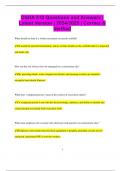
Nursing 202 Final Exam Questions & Answers with Rationales 2024/2025
Nursing 202 Final Exam Questions & Answers with Rationales 2024/2025 1. A client experiencing pain from an amputated limb tells the nurse that the pain is constant and the pain medication is not effective. What would be appropriate for the nurse to say or do in this situation? a. Remind the client that the limb is gone and can't be causing pain. b. Call the healthcare provider to report the ongoing pain. c. Do nothing. In time the pain will diminish on its own. d. Help the client to a sitting position and offer magazines. - ANSWER-Call the healthcare provider to report the ongoing pain. Pain is whatever the person says it is—existing whenever the person says it does. It is highly subjective and cannot be shared with others. The best course of action would be for the nurse to contact the healthcare provider to report the client's ongoing pain. The other options would not be supportive of the client and the pain experience. During a healthcare visit, the nurse learns that a client has had some degree of pain for years yet has never sought medical intervention for the pain. The nurse realizes that one explanation for this might be: a. The client is practicing pain-reducing interventions. b. The client has a history of substance abuse. c. The client doesn't really have pain. d. The client has become accustomed to having pain. - ANSWER-The client has become accustomed to having pain. Previous experiences with pain affect the way an individual responds to pain. This client's history of having pain for years may explain why he/she is able to live with the pain. There is no provided history of pain-reducing interventions or substance abuse. Assuming the client doesn't have pain is a judgment on the nurse's part and a nontherapeutic assessment. A client comes into the clinic complaining of severe lower back pain that began after a round of golf a few days ago. The nurse realizes that this client is experiencing: a. pain during the transduction phase of the pain process b. pain during the transmission phase of the pain process c. pain during the perception phase of the pain process d. pain during the modulation phase of the pain process - ANSWER-pain during the transduction phase of the pain process the receptors that transmit pain sensation are called nociceptors. During the transduction phase, noxious stimuli, such as a muscle spasm, trigger a release of biochemical mediators that sensitize nociceptors. The transmission phase of pain involves transmitting the pain response from the peripheral nerve to the thalamus and sensory cortex. The perception phase is when the client becomes aware of the pain. The modulation phase occurs when substances such as endogenous opioids, serotonin, and norepinephrine are released, which can inhibit painful stimuli. A client with chronic back pain has been prescribed a tricyclic antidepressant medication. The nurse realizes that this medication will: a. does nothing for the client's pain b. causes the client to sleep through most of the pain c. act as a placebo for the client's pain d. increases the modulation phase of the pain cycle - ANSWER-increase the modulation phase of the pain cycle Individuals with chronic pain may be prescribed tricyclic antidepressants to inhibit the reuptake of norepinephrine and serotonin. This action increases the modulation phase that helps inhibit painful ascending stimuli. A medication would not be prescribed if it were not thought to be effective. When treating pain, the primary effect of the medication is not sleep. multiple times over the past 12 months for acute back pain after a motor vehicle accident. From this information, the nurse suspects: a. the client's back and leg pain has resolved b. the client is in severe, acute pain c. the client may be experiencing chronic pain d. nothing. There isn't anything new with this client. - ANSWER-the client might be experiencing chronic pain in chronic pain, the vital signs are normal and the skin is warm and dry; the client may appear depressed and withdrawn, does not mention the pain unless asked, and does not demonstrate pain behavior. Pain is a subjective phenomenon, and the nurse must ask if the client is experiencing pain, not as...
Written for
- Institution
- Nursing 202
- Course
- Nursing 202
Document information
- Uploaded on
- November 28, 2024
- Number of pages
- 28
- Written in
- 2024/2025
- Type
- Exam (elaborations)
- Contains
- Questions & answers
Subjects
- nursing 202 final exam
- nursing 202
- 2024
- 2025
- transduction phase
- nociceptors
- norepinephrine
-
visceral pain
-
hyperalgesia