MATHEMATICS FINAL SUMMARY
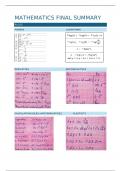
RULES
POWERS LOGARITHMS
DERIVATVES ANTIDERIVATIVES
CALCULATION RULES (ANTI)DERIVATIVES ELASTICITY
, EXTREMA OF A FUNCTION
1. Determine al stationary points first order derivative = 0
2. Make a sign chart
3. Check is it is a minimum/maximum or neither one
o One variable sign chart, use numbers in the neighbourhood
o Two variables Look at each C(xy) and Z’x’x(xy) value
- C(xy)>=0 and Z’x’x(xy)>=0 Convex and minimum
- C(xy)>=0 and Z’x’x(xy)<=0 Concave and maximum
- C(xy)<0 Saddle point
CONVEX AND CONCAVE
Second order derivative
Z’x’x>=0 convex minimum Z’x is increasing
Z’x’x<=0 concave maximum Z’x is decreasing
CONSTRAINT EXTREMUM PROBLEM
Optimize: Z(xy)= 1. Substitution method: X= or Y= Z(x) or Z(y)
stationary point
Subject to: k= 2. First-order condition: Z’x/ Z’y = G’x/G’y
Where: X>0, Y>0 3. Lagrange: L(xyλ) = Z(xy) - λ(G(xy) - k)
APPLICATION
Utility maximization Cost minimization Optimal portfolio
selection
Maximize: U(xy) Minimize: C(LK)=wL+wK Maximize:
μ(s)*w1+μ(a)*w2- ½α (σ^2*w2)^2
Subject to: I = P(x)*x+P(y)*y Subject to: P(LK) Subject to: 1=w1+w2
Where: x>=0, y>=0 Where: L>=0, K>=0 Where: w1>=0, w2>=0
AREA’S AND INTEGRALS
RULES
POWERS LOGARITHMS
DERIVATVES ANTIDERIVATIVES
CALCULATION RULES (ANTI)DERIVATIVES ELASTICITY
, EXTREMA OF A FUNCTION
1. Determine al stationary points first order derivative = 0
2. Make a sign chart
3. Check is it is a minimum/maximum or neither one
o One variable sign chart, use numbers in the neighbourhood
o Two variables Look at each C(xy) and Z’x’x(xy) value
- C(xy)>=0 and Z’x’x(xy)>=0 Convex and minimum
- C(xy)>=0 and Z’x’x(xy)<=0 Concave and maximum
- C(xy)<0 Saddle point
CONVEX AND CONCAVE
Second order derivative
Z’x’x>=0 convex minimum Z’x is increasing
Z’x’x<=0 concave maximum Z’x is decreasing
CONSTRAINT EXTREMUM PROBLEM
Optimize: Z(xy)= 1. Substitution method: X= or Y= Z(x) or Z(y)
stationary point
Subject to: k= 2. First-order condition: Z’x/ Z’y = G’x/G’y
Where: X>0, Y>0 3. Lagrange: L(xyλ) = Z(xy) - λ(G(xy) - k)
APPLICATION
Utility maximization Cost minimization Optimal portfolio
selection
Maximize: U(xy) Minimize: C(LK)=wL+wK Maximize:
μ(s)*w1+μ(a)*w2- ½α (σ^2*w2)^2
Subject to: I = P(x)*x+P(y)*y Subject to: P(LK) Subject to: 1=w1+w2
Where: x>=0, y>=0 Where: L>=0, K>=0 Where: w1>=0, w2>=0
AREA’S AND INTEGRALS