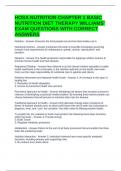
HOSA NUTRITION CHAPTER 1 BASIC
NUTRITION DIET THERAPY WILLIAMS'
EXAM QUESTIONS WITH CORRECT
ANSWERS
Nutrition - Answer-Concerns the food people eat and how their bodies use it.
Nutritional Science - Answer-Comprises the body of scientific knowledge governing
humans' food requirements for maintenance, growth, activity, reproduction, and
lactation.
Dietetics - Answer-The health profession responsible for applying nutrition science to
promote human health and treat disease.
Registered Dietitian - Answer-Also referred to as the clinical nutrition specialist or public
health nutritionist in the community, is the nutrition authority on the health care team.
Carry out the major responsibility of nutritional care in patients and clients.
Wellness Movement and National Health Goals - Answer-1: An increase in the span of
healthy live
2: Reduction of health disparities
3: Access to preventive health care services
Preventive Approach to Health - Answer-Identifying risk factors that increase a person's
chances of developing a particular health problem. By knowing these factors people can
choose behaviors that will prevent or minimize their risks for disease.
Traditional Approach to Health - Answer-Only attempts change when symptoms of
illness of disease already exist, at which point those who are ill seek out a physician to
diagnose, treat, and "cure" the condition. Has little value for lifelong positive health.
To sustain life, the nutrients in foods must perform the following three basic functions
within the body: - Answer-1: Provide energy
2: Build Tissue
3: Regulate metabolic processes
Metabolism - Answer-Refers to the sum of all body processes that accomplish the three
basic life-sustaining tasks.
Nutrition Interaction - Answer-1: Individual nutrients have many specific metabolic
functions, including primary and supporting roles
2: No nutrient ever works alone
NUTRITION DIET THERAPY WILLIAMS'
EXAM QUESTIONS WITH CORRECT
ANSWERS
Nutrition - Answer-Concerns the food people eat and how their bodies use it.
Nutritional Science - Answer-Comprises the body of scientific knowledge governing
humans' food requirements for maintenance, growth, activity, reproduction, and
lactation.
Dietetics - Answer-The health profession responsible for applying nutrition science to
promote human health and treat disease.
Registered Dietitian - Answer-Also referred to as the clinical nutrition specialist or public
health nutritionist in the community, is the nutrition authority on the health care team.
Carry out the major responsibility of nutritional care in patients and clients.
Wellness Movement and National Health Goals - Answer-1: An increase in the span of
healthy live
2: Reduction of health disparities
3: Access to preventive health care services
Preventive Approach to Health - Answer-Identifying risk factors that increase a person's
chances of developing a particular health problem. By knowing these factors people can
choose behaviors that will prevent or minimize their risks for disease.
Traditional Approach to Health - Answer-Only attempts change when symptoms of
illness of disease already exist, at which point those who are ill seek out a physician to
diagnose, treat, and "cure" the condition. Has little value for lifelong positive health.
To sustain life, the nutrients in foods must perform the following three basic functions
within the body: - Answer-1: Provide energy
2: Build Tissue
3: Regulate metabolic processes
Metabolism - Answer-Refers to the sum of all body processes that accomplish the three
basic life-sustaining tasks.
Nutrition Interaction - Answer-1: Individual nutrients have many specific metabolic
functions, including primary and supporting roles
2: No nutrient ever works alone