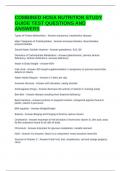
COMBINED HOSA NUTRITION STUDY
GUIDE TEST QUESTIONS AND
ANSWERS
Types of Protein Malnutrition - Answer-marasmus, kwashiorkor disease
Main Categories of Carbohydrates - Answer-monosaccharides, disaccharides,
polysaccharides
Stored Water Soluble Vitamins - Answer-pantothenic, B12, B6
Disorders of Carbohydrate Metabolism - Answer-galactosemic, primary lactose
deficiency, lactose intolerance, sucrase deficiency
Water in Body Weight - Answer-60%
Folic Acid - Answer-400 mcg/d supplementation, in pregnancy to prevent neural tube
defects in infants
Water Adults Require - Answer-2-3 liters per day
Anorexia Nervosa - Answer-self starvation, eating disorder
Anticoagulant Drugs - Answer-decrease the activity of vitamin K, bruising easily
Beri-Beri - Answer-disease resulting from thiamine deficiency
Beta Carotene - Answer-nontoxic to pregnant women, orange/red pigment found in
plants, vitamin A precursor
BMI equation - Answer-Weight/Height
Bulimia - Answer-Binging and Purging of food by various means
Cholesterol - Answer-Important in the formation of hormones vitamin D, bile acid; waxy
fat like substance found in all cells of body
Chromium - Answer-Important for glucose metabolism, metallic element
NAD - Answer-Co-enzyme, Niacin is a component, many functions need this
Sources of Vitamin C - Answer-Fresh fruit, kiwi, strawberries, red and orange peppers,
citrus
, Copper - Answer-Important for haemoglobin synthesis, essential trace mineral,
important for growth and health
Dairy - Answer-Source of Calcium; milk, yogurt and cheese; 2-3 servings per day
Dietary sources of protein - Answer-Compete: animal based
Incomplete: Plant based
Disaccharide - Answer-Any class of sugars whose molecules are two monosaccharides,
sucrose, maltose, lactose.
Disorders of protein - Answer-Celiac disease, milk protein allergy
Factors affecting cholesterol - Answer-Increased trans fats, saturated fats, decreased
fiberl decreased exercise
Fats - Answer-should comprise no more than 30% of daily calories, fatty acids solid at
room temperature
Fat soluble vitamins - Answer-A, E, D, K
Fatty Acids Based ON - Answer-Number of carbohydrates, degree of saturation,
location of first and double bond
Types of Fiber - Answer-Insoluble, soluble
Fluoride - Answer-Important for teeth
Folic Acid Defiency - Answer-Results in macrocytic anemia
Food Allergy - Answer-Medical term, immune system mediated
Food Intolerance - Answer-Reaction isn't immune mediated, digestive system, ex.
lactose intolerance
Food Sensitivity - Answer-General term, any body system can be involved
Biotin Function - Answer-Metabolism of fatty acids, proteins, carbohydrates; maintains
healthy skin, hair and nails; related to B12 and folic acid metabolism
Choline Function - Answer-Part of acetylcholine (memory transmitter; lipotropic factor:
fat metabolism in liver: Lipoprotein production; component of nerve tissue/brain
Fat Function - Answer-Bone health, nerve reactions muscle contraction/relaxation,
numerous enzyme By6 w
GUIDE TEST QUESTIONS AND
ANSWERS
Types of Protein Malnutrition - Answer-marasmus, kwashiorkor disease
Main Categories of Carbohydrates - Answer-monosaccharides, disaccharides,
polysaccharides
Stored Water Soluble Vitamins - Answer-pantothenic, B12, B6
Disorders of Carbohydrate Metabolism - Answer-galactosemic, primary lactose
deficiency, lactose intolerance, sucrase deficiency
Water in Body Weight - Answer-60%
Folic Acid - Answer-400 mcg/d supplementation, in pregnancy to prevent neural tube
defects in infants
Water Adults Require - Answer-2-3 liters per day
Anorexia Nervosa - Answer-self starvation, eating disorder
Anticoagulant Drugs - Answer-decrease the activity of vitamin K, bruising easily
Beri-Beri - Answer-disease resulting from thiamine deficiency
Beta Carotene - Answer-nontoxic to pregnant women, orange/red pigment found in
plants, vitamin A precursor
BMI equation - Answer-Weight/Height
Bulimia - Answer-Binging and Purging of food by various means
Cholesterol - Answer-Important in the formation of hormones vitamin D, bile acid; waxy
fat like substance found in all cells of body
Chromium - Answer-Important for glucose metabolism, metallic element
NAD - Answer-Co-enzyme, Niacin is a component, many functions need this
Sources of Vitamin C - Answer-Fresh fruit, kiwi, strawberries, red and orange peppers,
citrus
, Copper - Answer-Important for haemoglobin synthesis, essential trace mineral,
important for growth and health
Dairy - Answer-Source of Calcium; milk, yogurt and cheese; 2-3 servings per day
Dietary sources of protein - Answer-Compete: animal based
Incomplete: Plant based
Disaccharide - Answer-Any class of sugars whose molecules are two monosaccharides,
sucrose, maltose, lactose.
Disorders of protein - Answer-Celiac disease, milk protein allergy
Factors affecting cholesterol - Answer-Increased trans fats, saturated fats, decreased
fiberl decreased exercise
Fats - Answer-should comprise no more than 30% of daily calories, fatty acids solid at
room temperature
Fat soluble vitamins - Answer-A, E, D, K
Fatty Acids Based ON - Answer-Number of carbohydrates, degree of saturation,
location of first and double bond
Types of Fiber - Answer-Insoluble, soluble
Fluoride - Answer-Important for teeth
Folic Acid Defiency - Answer-Results in macrocytic anemia
Food Allergy - Answer-Medical term, immune system mediated
Food Intolerance - Answer-Reaction isn't immune mediated, digestive system, ex.
lactose intolerance
Food Sensitivity - Answer-General term, any body system can be involved
Biotin Function - Answer-Metabolism of fatty acids, proteins, carbohydrates; maintains
healthy skin, hair and nails; related to B12 and folic acid metabolism
Choline Function - Answer-Part of acetylcholine (memory transmitter; lipotropic factor:
fat metabolism in liver: Lipoprotein production; component of nerve tissue/brain
Fat Function - Answer-Bone health, nerve reactions muscle contraction/relaxation,
numerous enzyme By6 w