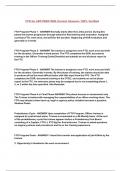
FTO for LEO PBSC With Correct Answers 100% Verified
FTO Program Phase 1 - ANSWER Normally starts after the Limbo period. During this
phase the trainee progresses through extensive field training and evaluation. Assigned
a primary FTO, work area, and shift for the duration. Beginning of DOR evaluation and
generally is 4 weeks
FTO Program Phase 2 - ANSWER The trainee is assigned a new FTO, work area and shift
for the duration. Generally 4 week period. The FTO completes the DOR, documents
training in the Officer Training Guide/Checklist and submits an end of phase report to
the FTC
FTO Program Phase 3 - ANSWER The trainee is assigned a new FTO, work area and shift
for the duration. Generally 4 weeks. By this phase of training, the trainee should be able
to perform all but the most difficult tasks with little input from the FTO. The FTO
completes the DOR, documents training in the OTGC, and submits an end of phase
report to the FTC. An extension phase may be assigned due to not completing phase 1,
2, or 3 within the time specified. Aka Remedial.
FTO Program Phase 4 or Final Phase-ANSWER This phase focuses on assessment only.
The Trainee is tasked with managing the responsibilities of an officer working alone. The
FTO may interject when back up, legal or agency policy violation becomes a question.
Shadow Phase
Probationary Cycle - ANSWER Upon completion of FTO Program, Officer trainee is
assigned to a patrol beat alone. Trainee is evauluated on a Bi-Weekly basis. At the end
of the probabtionary cycle the trainee appears before a Probationary Oral Board
consisting of a Captain, FTO Lt, FTO Sgt for final interview. Trainee is asked questions
on angency polices and procedures and his or her training experience.
FTO Program Goals - ANSWER 1.Assist the transfer and application of job KSAAs by the
trainee.
2. Opportunity to familiarize the work environment.
, 3. Monitoring, guiding, and evaluation of the job performed.
4. Serving as a role model.
Reasons for Implementation of FTO Program - ANSWER 1. Effective on-the-job training.
2. Standardization of agency training policies, procedures, and evaluation.
3. Increased experience of the trainee
4. Guiding and integrating the trainee in Critical Decision Making
5. Generate capable, competent, and safer workers
DOR (Daily Observation Report) - ANSWER Standardized form completed by the FTO
which reflects his or her observation of a trainee's performance in areas predetermined
to be critical in an agency law enforcement duties. The most valuable form in the FTO
program
SEG (Standardized Evaluation Guidelines) - ANSWER Is an accepted measurement
system used to compare the trainee's performance as a a basis for assigning ratings.
(Behavioral anchors)
Objectives of FTO Program - ANSWER 1. Documenting trainee progress in a afair and
objective manner.
2. Identifying the trainee's KSAAs
3. Verify the training is standardized, valid, and job related
4. Documenting remediation
5. Validating agency selection and hiring process
KSAA - ANSWER Knowledge, Skills, Abilities, and Attitudes
5 Key Elements of a successful FTO Program - ANSWER 1. The support of the head of
the agency.
2. Deployment status of the trainee.
FTO Program Phase 1 - ANSWER Normally starts after the Limbo period. During this
phase the trainee progresses through extensive field training and evaluation. Assigned
a primary FTO, work area, and shift for the duration. Beginning of DOR evaluation and
generally is 4 weeks
FTO Program Phase 2 - ANSWER The trainee is assigned a new FTO, work area and shift
for the duration. Generally 4 week period. The FTO completes the DOR, documents
training in the Officer Training Guide/Checklist and submits an end of phase report to
the FTC
FTO Program Phase 3 - ANSWER The trainee is assigned a new FTO, work area and shift
for the duration. Generally 4 weeks. By this phase of training, the trainee should be able
to perform all but the most difficult tasks with little input from the FTO. The FTO
completes the DOR, documents training in the OTGC, and submits an end of phase
report to the FTC. An extension phase may be assigned due to not completing phase 1,
2, or 3 within the time specified. Aka Remedial.
FTO Program Phase 4 or Final Phase-ANSWER This phase focuses on assessment only.
The Trainee is tasked with managing the responsibilities of an officer working alone. The
FTO may interject when back up, legal or agency policy violation becomes a question.
Shadow Phase
Probationary Cycle - ANSWER Upon completion of FTO Program, Officer trainee is
assigned to a patrol beat alone. Trainee is evauluated on a Bi-Weekly basis. At the end
of the probabtionary cycle the trainee appears before a Probationary Oral Board
consisting of a Captain, FTO Lt, FTO Sgt for final interview. Trainee is asked questions
on angency polices and procedures and his or her training experience.
FTO Program Goals - ANSWER 1.Assist the transfer and application of job KSAAs by the
trainee.
2. Opportunity to familiarize the work environment.
, 3. Monitoring, guiding, and evaluation of the job performed.
4. Serving as a role model.
Reasons for Implementation of FTO Program - ANSWER 1. Effective on-the-job training.
2. Standardization of agency training policies, procedures, and evaluation.
3. Increased experience of the trainee
4. Guiding and integrating the trainee in Critical Decision Making
5. Generate capable, competent, and safer workers
DOR (Daily Observation Report) - ANSWER Standardized form completed by the FTO
which reflects his or her observation of a trainee's performance in areas predetermined
to be critical in an agency law enforcement duties. The most valuable form in the FTO
program
SEG (Standardized Evaluation Guidelines) - ANSWER Is an accepted measurement
system used to compare the trainee's performance as a a basis for assigning ratings.
(Behavioral anchors)
Objectives of FTO Program - ANSWER 1. Documenting trainee progress in a afair and
objective manner.
2. Identifying the trainee's KSAAs
3. Verify the training is standardized, valid, and job related
4. Documenting remediation
5. Validating agency selection and hiring process
KSAA - ANSWER Knowledge, Skills, Abilities, and Attitudes
5 Key Elements of a successful FTO Program - ANSWER 1. The support of the head of
the agency.
2. Deployment status of the trainee.