Week 5
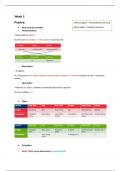
Passive: Indirect object = meewerkend voorwerp
Verb must be transitive Direct object = leidend voorwerp
- Monotransitive:
=Verb needs an object
Ex: He loves his mother. => His mother is loved by him.
- Ditransitive:
= 2 objects
Ex: They gave me (= indirect object) money (=direct object). => Money was given to me./I was given
money.
- Intransitive:
=Verb has no object, sentence cannot be turned into a passive
Ex: He is talking. => /
Times
Formation
- SAME TENSE (as in active form) + past participle
,Example: We have never painted our house => Our house has never been painted.
Example: The rebels are attacking the city. => The city is being attacked by the rebels.
- Subject either not mentioned or by + subject
(without by + agent = short/agentless passive)
- Modal auxiliaries can be used, but remains unchanged.
We can use the passive in all forms. => The passive can be used in all forms.
They might have avoided the accident. => The accident might have been avoided.
- ‘EXPLAINED, DESCRIBED,REPORTED’ ALWAYS NEEDS ‘TO’
Example: It was explained TO me.
Not: It was explained me. – I was explained the problem.
Example: The victim was described TO the police.
Not: The police were described the victim.
- Stative verbs can’t be turned into a passive.
= Verbs that describe a state or condition, rather than an action.
Example: I have a house. = A house is had by me.
Usage
- Passive is used to start the sentence with the thing/person we are talking about.
Example: This is a nice painting. It was painted by Picasso.
Example: What a wonderful dog. She was found last week.
- When we don’t know who/what did something or when it isn’t important.
Example: She was murdered.
Example: He was fired a couple weeks ago
Example: They were run over.
, Britain today: three decades of devolution, Brexit, and more)
1997: election of Tony Blair/labour -> new feeling of optimism after ‘70/’80’s under
conservative rule
Promise of devolution referendums for Scotland and Wales
= process of transferring power from the centre to the nations and regions of the UK
=asymmetric: power to different regions
1998: Good Friday Agreement Referendum
= peace deal intended to bring an end to “The Troubles” (period of unrest-terrorist attacks…
on the British Isles)
International involvement:
90’s: peacekeeping operations -> made Britain seem like a country devoted to the ‘good’ and
made Tony Blair more popular
1999: rejection adoption euro
Dotcom bubble: boom of the internet -> internet start-ups which started failing quickly ->
worsening economy
2001: Tony Blair/labour wins re-election (although not many people voted)
9/11! -> US and UK allies in ‘the war against terrorism’:
- 2001: Britain follows US into war with Afghanistan
- 2003: Britain follow US into armed conflict in Iraq, BUT: division within the labour party +
people are critical -> ‘Why go to war with a country that hasn’t provoked us? Why get
involved in the Middle East again?’ + war was not backed by a United Nations mandate ->
legality of the invasion?
=damages reputation of Tony Blair
2016: Chilcot report: Concluded that Blair had gone to war before all peaceful options
were exhausted
2005: labour wins again
2005: Suicide bombers on London public transport ( “This is because we went to war for no
reason” )
-Britain was not prepared!
2008 Financial crisis:
2009: efforts to stimulate economy: giving money to the banks to ‘bail them out’ (But the
people were against this)
2010: labour loses -> Conservative and LibDem coalition government
Austerity:
= deficit reductions program (less spending + more taxes)
Spent less on National Health Service and education, although they promised not to
Lots of spending cuts
=>riots:
(especially after the police killed a young black man)
More likely in deprived areas
More likely in areas with higher rates of stop and search
Passive: Indirect object = meewerkend voorwerp
Verb must be transitive Direct object = leidend voorwerp
- Monotransitive:
=Verb needs an object
Ex: He loves his mother. => His mother is loved by him.
- Ditransitive:
= 2 objects
Ex: They gave me (= indirect object) money (=direct object). => Money was given to me./I was given
money.
- Intransitive:
=Verb has no object, sentence cannot be turned into a passive
Ex: He is talking. => /
Times
Formation
- SAME TENSE (as in active form) + past participle
,Example: We have never painted our house => Our house has never been painted.
Example: The rebels are attacking the city. => The city is being attacked by the rebels.
- Subject either not mentioned or by + subject
(without by + agent = short/agentless passive)
- Modal auxiliaries can be used, but remains unchanged.
We can use the passive in all forms. => The passive can be used in all forms.
They might have avoided the accident. => The accident might have been avoided.
- ‘EXPLAINED, DESCRIBED,REPORTED’ ALWAYS NEEDS ‘TO’
Example: It was explained TO me.
Not: It was explained me. – I was explained the problem.
Example: The victim was described TO the police.
Not: The police were described the victim.
- Stative verbs can’t be turned into a passive.
= Verbs that describe a state or condition, rather than an action.
Example: I have a house. = A house is had by me.
Usage
- Passive is used to start the sentence with the thing/person we are talking about.
Example: This is a nice painting. It was painted by Picasso.
Example: What a wonderful dog. She was found last week.
- When we don’t know who/what did something or when it isn’t important.
Example: She was murdered.
Example: He was fired a couple weeks ago
Example: They were run over.
, Britain today: three decades of devolution, Brexit, and more)
1997: election of Tony Blair/labour -> new feeling of optimism after ‘70/’80’s under
conservative rule
Promise of devolution referendums for Scotland and Wales
= process of transferring power from the centre to the nations and regions of the UK
=asymmetric: power to different regions
1998: Good Friday Agreement Referendum
= peace deal intended to bring an end to “The Troubles” (period of unrest-terrorist attacks…
on the British Isles)
International involvement:
90’s: peacekeeping operations -> made Britain seem like a country devoted to the ‘good’ and
made Tony Blair more popular
1999: rejection adoption euro
Dotcom bubble: boom of the internet -> internet start-ups which started failing quickly ->
worsening economy
2001: Tony Blair/labour wins re-election (although not many people voted)
9/11! -> US and UK allies in ‘the war against terrorism’:
- 2001: Britain follows US into war with Afghanistan
- 2003: Britain follow US into armed conflict in Iraq, BUT: division within the labour party +
people are critical -> ‘Why go to war with a country that hasn’t provoked us? Why get
involved in the Middle East again?’ + war was not backed by a United Nations mandate ->
legality of the invasion?
=damages reputation of Tony Blair
2016: Chilcot report: Concluded that Blair had gone to war before all peaceful options
were exhausted
2005: labour wins again
2005: Suicide bombers on London public transport ( “This is because we went to war for no
reason” )
-Britain was not prepared!
2008 Financial crisis:
2009: efforts to stimulate economy: giving money to the banks to ‘bail them out’ (But the
people were against this)
2010: labour loses -> Conservative and LibDem coalition government
Austerity:
= deficit reductions program (less spending + more taxes)
Spent less on National Health Service and education, although they promised not to
Lots of spending cuts
=>riots:
(especially after the police killed a young black man)
More likely in deprived areas
More likely in areas with higher rates of stop and search