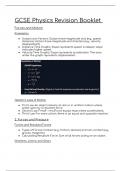
GCSE Physics Revision Booklet
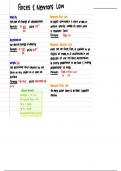
Forces and Motion
Kinematics
● Scalars and Vectors: Scalars have magnitude only (e.g., speed,
distance). Vectors have magnitude and direction (e.g., velocity,
displacement).
● Distance-Time Graphs: Slope represents speed. A steeper slope
indicates higher speed.
● Velocity-Time Graphs: Slope represents acceleration. The area
under the graph represents displacement.
Newton’s Laws of Motion
● First Law: An object remains at rest or in uniform motion unless
acted upon by a resultant force.
● Second Law: F=maF = ma (Force equals mass times acceleration).
● Third Law: For every action, there is an equal and opposite reaction.
2. Forces and Pressure
Forces and Resultant Forces
● Types of Forces: Contact (e.g., friction, tension) and non-contact (e.g.,
gravity, magnetic).
● Calculating Resultant Force: Sum of all forces acting on an object.
Moments, Levers, and Gears
, ● Moment of a Force: Moment=Force×Distance\text{Moment} = \
text{Force} \times \text{Distance} from the pivot.
● Levers and Gears: Used to increase force or speed.
Pressure in Fluids
● Pressure in Liquids: p=hρgp = h \rho g (pressure equals height of
fluid column times density times gravitational field strength).
● Upthrust and Archimedes’ Principle: Upthrust is equal to the weight
of the fluid displaced.
3. Conservation of Energy
Energy Stores and Transfers
● Types of Energy: Kinetic, gravitational potential, elastic potential,
thermal, chemical, nuclear, and more.
● Energy Transfers: Mechanically, electrically, by heating, and by
radiation.
Conservation of Energy
● Principle: Energy cannot be created or destroyed, only transferred
or converted.
● Efficiency:
Work and Power
●
4. Waves
Wave Properties
● Transverse and Longitudinal Waves: Transverse waves oscillate
perpendicular to the direction of energy transfer (e.g., light).
Longitudinal waves oscillate parallel (e.g., sound).
● Wave Equation:
Reflection, Refraction, and Diffraction
● Reflection: Angle of incidence equals angle of reflection.
● Refraction: Bending of waves when they pass from one medium to
another, changing speed.
Forces and Motion
Kinematics
● Scalars and Vectors: Scalars have magnitude only (e.g., speed,
distance). Vectors have magnitude and direction (e.g., velocity,
displacement).
● Distance-Time Graphs: Slope represents speed. A steeper slope
indicates higher speed.
● Velocity-Time Graphs: Slope represents acceleration. The area
under the graph represents displacement.
Newton’s Laws of Motion
● First Law: An object remains at rest or in uniform motion unless
acted upon by a resultant force.
● Second Law: F=maF = ma (Force equals mass times acceleration).
● Third Law: For every action, there is an equal and opposite reaction.
2. Forces and Pressure
Forces and Resultant Forces
● Types of Forces: Contact (e.g., friction, tension) and non-contact (e.g.,
gravity, magnetic).
● Calculating Resultant Force: Sum of all forces acting on an object.
Moments, Levers, and Gears
, ● Moment of a Force: Moment=Force×Distance\text{Moment} = \
text{Force} \times \text{Distance} from the pivot.
● Levers and Gears: Used to increase force or speed.
Pressure in Fluids
● Pressure in Liquids: p=hρgp = h \rho g (pressure equals height of
fluid column times density times gravitational field strength).
● Upthrust and Archimedes’ Principle: Upthrust is equal to the weight
of the fluid displaced.
3. Conservation of Energy
Energy Stores and Transfers
● Types of Energy: Kinetic, gravitational potential, elastic potential,
thermal, chemical, nuclear, and more.
● Energy Transfers: Mechanically, electrically, by heating, and by
radiation.
Conservation of Energy
● Principle: Energy cannot be created or destroyed, only transferred
or converted.
● Efficiency:
Work and Power
●
4. Waves
Wave Properties
● Transverse and Longitudinal Waves: Transverse waves oscillate
perpendicular to the direction of energy transfer (e.g., light).
Longitudinal waves oscillate parallel (e.g., sound).
● Wave Equation:
Reflection, Refraction, and Diffraction
● Reflection: Angle of incidence equals angle of reflection.
● Refraction: Bending of waves when they pass from one medium to
another, changing speed.