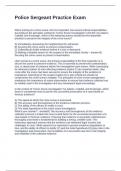
Police Sergeant Practice Exam
When arriving at a crime scene, the first responder has several critical responsibilities.
According to the principles outlined in "Crime Scene Investigation" (2nd Ed.) by Adams,
Caddell, and Krutsinger, which of the following actions should the first responder
prioritize to preserve the integrity of the crime scene?
A) Immediately canvassing the neighborhood for witnesses.
B) Securing the crime scene to prevent contamination.
C) Collecting all visible evidence before it is lost or destroyed.
D) Making a detailed search for the suspect in the immediate vicinity – answer B)
Securing the crime scene to prevent contamination.
Upon arrival at a crime scene, the primary responsibility of the first responder is to
secure the scene to preserve evidence. This is essential to prevent the contamination,
loss, or destruction of evidence before the investigative team arrives. While canvassing
for witnesses (option A) and collecting evidence (option C) are important tasks, they
come after the scene has been secured to ensure the integrity of the evidence is
maintained. Searching for the suspect (option D) is also critical but should not
compromise the crime scene's integrity. The principles of crime scene management
emphasize the importance of scene preservation to ensure that evidence collected can
be reliably used in the investigation and any subsequent legal proceedings.
In the context of "Crime Scene Investigation" by Adams, Caddell, and Krutsinger, which
factor is considered most crucial for the successful prosecution of a case based on
forensic evidence?
A) The speed at which the crime scene is processed.
B) The accuracy and thoroughness of the evidence collection process.
C) The ability of the officers to testify in court.
D) The initial hypothesis of the crime scene investigators.
What's your answer? - answerB) The accuracy and thoroughness of the evidence
collection process is indeed the most crucial factor for the successful prosecution of a
case based on forensic evidence. Ensuring that evidence is accurately collected and
thoroughly processed is fundamental to building a strong, credible case. This
meticulous approach ensures that the evidence can withstand legal scrutiny and
challenges in court. While speed (A) is important to prevent evidence degradation or
loss, and the ability of officers to testify (C) and the initial hypothesis (D) play roles in the
investigation and prosecution, the foundation of a successful case lies in the integrity
and reliability of the collected evidence.
, According to "Legal Guide for Police" (8th Ed.) by Walker and Hemmens, which of the
following scenarios most accurately represents a violation of the Fourth Amendment's
protection against unreasonable searches and seizures?
A) A police officer conducts a search of a vehicle after smelling marijuana coming from
it during a traffic stop for a broken tail light.
B) A police officer detains an individual for questioning because the person matches the
description of a suspect provided in a recent crime alert.
C) A police officer enters a home without a warrant, consent, or exigent circumstances,
based solely on a vague suspicion of illegal activity.
D) A police officer conducts a pat-down search of an individual during a lawful stop
when the officer has a reasonable belief that the person is armed and dangerous. -
answerC) A police officer entering a home without a warrant, consent, or exigent
circumstances, based solely on a vague suspicion of illegal activity, directly violates the
Fourth Amendment's protection against unreasonable searches and seizures. The
Fourth Amendment requires that searches and seizures be reasonable, typically
necessitating a warrant supported by probable cause, except in specific situations
where exigent circumstances, consent, or other established exceptions apply. Options
A, B, and D describe scenarios where officers are either acting on specific evidence or
within the bounds of established legal exceptions, making them lawful under certain
circumstances.
In "Police Administration: Structures, Processes, and Behavior" (7th Ed.) by Swanson,
Territo, and Taylor, which concept is emphasized as key to effective police leadership?
A) Hierarchical command structure
B) Community policing
C) Open lines of communication
D) Routine patrol strategies - answerC) Open lines of communication.
Which factor is most crucial in determining the use of force by police officers in field
operations, as described in "Police Field Operations" (7th Ed.) by Adams?
A) The severity of the crime involved
B) The level of threat posed by the suspect to officers
C) The suspect's compliance with verbal commands
D) The presence of witnesses - answerB) The level of threat posed by the suspect to
officers is the most crucial factor in determining the use of force. This principle aligns
with ensuring officer and public safety while addressing the immediate threat.
According to "Supervision of Police Personnel" (7th Ed.) by Iannone, N.F., Iannone,
M.P., and Bernstein, J., what is considered the most effective leadership style for
supervising police personnel?
A) Authoritarian
B) Democratic
When arriving at a crime scene, the first responder has several critical responsibilities.
According to the principles outlined in "Crime Scene Investigation" (2nd Ed.) by Adams,
Caddell, and Krutsinger, which of the following actions should the first responder
prioritize to preserve the integrity of the crime scene?
A) Immediately canvassing the neighborhood for witnesses.
B) Securing the crime scene to prevent contamination.
C) Collecting all visible evidence before it is lost or destroyed.
D) Making a detailed search for the suspect in the immediate vicinity – answer B)
Securing the crime scene to prevent contamination.
Upon arrival at a crime scene, the primary responsibility of the first responder is to
secure the scene to preserve evidence. This is essential to prevent the contamination,
loss, or destruction of evidence before the investigative team arrives. While canvassing
for witnesses (option A) and collecting evidence (option C) are important tasks, they
come after the scene has been secured to ensure the integrity of the evidence is
maintained. Searching for the suspect (option D) is also critical but should not
compromise the crime scene's integrity. The principles of crime scene management
emphasize the importance of scene preservation to ensure that evidence collected can
be reliably used in the investigation and any subsequent legal proceedings.
In the context of "Crime Scene Investigation" by Adams, Caddell, and Krutsinger, which
factor is considered most crucial for the successful prosecution of a case based on
forensic evidence?
A) The speed at which the crime scene is processed.
B) The accuracy and thoroughness of the evidence collection process.
C) The ability of the officers to testify in court.
D) The initial hypothesis of the crime scene investigators.
What's your answer? - answerB) The accuracy and thoroughness of the evidence
collection process is indeed the most crucial factor for the successful prosecution of a
case based on forensic evidence. Ensuring that evidence is accurately collected and
thoroughly processed is fundamental to building a strong, credible case. This
meticulous approach ensures that the evidence can withstand legal scrutiny and
challenges in court. While speed (A) is important to prevent evidence degradation or
loss, and the ability of officers to testify (C) and the initial hypothesis (D) play roles in the
investigation and prosecution, the foundation of a successful case lies in the integrity
and reliability of the collected evidence.
, According to "Legal Guide for Police" (8th Ed.) by Walker and Hemmens, which of the
following scenarios most accurately represents a violation of the Fourth Amendment's
protection against unreasonable searches and seizures?
A) A police officer conducts a search of a vehicle after smelling marijuana coming from
it during a traffic stop for a broken tail light.
B) A police officer detains an individual for questioning because the person matches the
description of a suspect provided in a recent crime alert.
C) A police officer enters a home without a warrant, consent, or exigent circumstances,
based solely on a vague suspicion of illegal activity.
D) A police officer conducts a pat-down search of an individual during a lawful stop
when the officer has a reasonable belief that the person is armed and dangerous. -
answerC) A police officer entering a home without a warrant, consent, or exigent
circumstances, based solely on a vague suspicion of illegal activity, directly violates the
Fourth Amendment's protection against unreasonable searches and seizures. The
Fourth Amendment requires that searches and seizures be reasonable, typically
necessitating a warrant supported by probable cause, except in specific situations
where exigent circumstances, consent, or other established exceptions apply. Options
A, B, and D describe scenarios where officers are either acting on specific evidence or
within the bounds of established legal exceptions, making them lawful under certain
circumstances.
In "Police Administration: Structures, Processes, and Behavior" (7th Ed.) by Swanson,
Territo, and Taylor, which concept is emphasized as key to effective police leadership?
A) Hierarchical command structure
B) Community policing
C) Open lines of communication
D) Routine patrol strategies - answerC) Open lines of communication.
Which factor is most crucial in determining the use of force by police officers in field
operations, as described in "Police Field Operations" (7th Ed.) by Adams?
A) The severity of the crime involved
B) The level of threat posed by the suspect to officers
C) The suspect's compliance with verbal commands
D) The presence of witnesses - answerB) The level of threat posed by the suspect to
officers is the most crucial factor in determining the use of force. This principle aligns
with ensuring officer and public safety while addressing the immediate threat.
According to "Supervision of Police Personnel" (7th Ed.) by Iannone, N.F., Iannone,
M.P., and Bernstein, J., what is considered the most effective leadership style for
supervising police personnel?
A) Authoritarian
B) Democratic