

100% satisfaction guarantee Immediately available after payment Both online and in PDF No strings attached 4.6 TrustPilot
logo-home
Exam (elaborations)

Myers AP Psychology LEARNING

Rating
-
Sold
-
Pages
4
Grade
A+
Uploaded on
21-11-2024
Written in
2024/2025

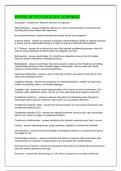
Acquisition - answer-the "learned" behavior or response Albert Bandura - answer-researcher famous for work in observational or social learning including the famous Bobo doll experiment Associative learning - answer-learning that certain events occur together. Aversion theory - answer-an aversive (causing a strong feeling of dislike or disgust) stimulus is paired with an undesirable behavior in order to reduce or eliminate that behavior. B.F. Skinner - answer-he is famous for use of his operant conditioning aparatus which he used to study schedules of reinforcement on pidgeons and rats. Behaviorism - answer-psychology: (1) should be an objective science that (2) studies behavior without reference to mental processes. Biofeedback - answer-a technique that trains people to improve their health by controlling certain bodily processes that normally happen involuntarily, such as heart rate, blood pressure, muscle tension, and skin temperature. Classical conditioning - answer-a type of learning in which one learns to link two or more stimuli and anticipate events Cognitive learning - answer-the acquisition of mental information, whether by observing events, by watching others, or through language Cognitive map - answer-a mental representation of the layout of one's environment. (For example, after exploring a maze, rats act as if they have learned a cognitive map of it) Conditioned reinforcer - answer-a stimulus that gains its reinforcing power through its association with a primary reinforcer; also known as a secondary reinforcer Conditioned response (CR) - answer-the learned reaction to a previously neutral (but now conditioned) stimulus (CS) Conditioned stimulus (CS) - answer-an originally irrelevant stimulus that, after association with an US, comes to trigger a conditioned reaction Continuous reinforcement - answer-reinforcing the desired response every time it occurs Coping - answer-alleviating stress using emotional, cognitive, or behavioral methods Discrimination - answer-the learned ability to distinguish between a CS and stimuli that do not signal an US Discriminative stimulus - answer-a stimulus that elicits a response after association with reinforcement (in contrast to related stimuli not associated with reinforcement) External locus of control - answer-the perception that chance or outside forces beyond your personal control determine your fate. Extinction - answer-the diminishing of a CR; when a response is no longer reinforced Extrinsic motivation - answer-a desire to perform a behavior to receive promised rewards or avoid threatened punishment, OUTSIDE Fixed-interval schedule - answer-a reinforcement schedule that reinforces a response only after a specified time has elapsed Fixed-ratio schedule - answer-a reinforcement schedule that reinforces a response only after a specified number of responses Generalization - answer-the tendency, once a response has been conditioned, for stimuli similar to the CS to elicit responses Habituation - answer-an organism's decreasing response to a stimulus with repeated exposure to it Higher-order conditioning - answer-a procedure in which the CS in one conditioning experience is paired with a new NS, creating a second (often weaker) CS. Insight - answer-a sudden and often novel realization of the solution to a problem Internal locus of control - answer-the perception that you control your own fate Intrinsic motivation - answer-a desire to perform a behavior effectively for its own sake; INSIDE Ivan Pavlov - answer-Russian physiologist who observed conditioned salivary responses in dogs () John Garcia - answer-Researched taste aversion. Showed that when rats ate a novel substance before being nauseated by a drug or radiation, they developed a conditioned taste aversion for the substance. John Watson - answer-behaviorist; famous for Little Albert study in which a baby was taught to fear a white rat Latent learning - answer-learning that occurs but is not apparent until there is an incentive to demonstrate it LATER Law of effect - answer-Thorndike's principle that behaviors followed by favorable consequences become more likely, or where behaviors followed by unfavorable consequences become less likely Learned helplessness - answer-the hopelessness and passive resignation an animal or human learns when unable to avoid repeated aversive events Learned helplessness - answer-the hopelessness and passive resignation an animal or human learns when unable to avoid repeated aversive events Learning - answer-a relatively permanent change in an organism's behavior due to experience Little albert - answer-subject in John Watson's experiment, proved classical conditioning principles, especially the generalization of fear Mirror neurons - answer-frontal lobe neurons that fire when performing certain actions or when observing another doing so. The brain's mirroring of another's actions may enable imitation and empath Modeling - answer-the process of observing and imitating a specific behavior Negative reinforcement - answer-increasing behaviors by stopping or reducing negative stimuli, such as shock. Neutral stimulus (NS) - answer-environmental factor that doesn't elicit a CR until it is repeatedly paired with the US (ex/ bell in Pavlov experiment) Observational learning - answer-learning by observing others; also called social learning Operant chamber - answer-Skinner box containing a bar or key that an animal can manipulate to obtain food or water reinforce; attached devices record the animal's rate of bar pressing or key pecking Operant conditioning - answer-a type of learning in which behavior is strengthened if followed by a reinforcer or diminished followed by a punisher Partial (intermittent) reinforcement - answer-reinforcing a response only part of the time; results in slower acquisition of a response but much greater resistance to extinction than does continuous reinforcement

Show more Read less
Institution
Myers AP Psychology LEARNING
Course
Myers AP Psychology LEARNING


Whoops! We can’t load your doc right now. Try again or contact support.

Written for

Institution
Myers AP Psychology LEARNING
Course
Myers AP Psychology LEARNING

Document information

Uploaded on
November 21, 2024
Number of pages
4
Written in
2024/2025
Type
Exam (elaborations)
Contains
Questions & answers

Subjects

Content preview

MYERS AP PSYCHOLOGY LEARNING
Acquisition - answer-the "learned" behavior or response

Albert Bandura - answer-researcher famous for work in observational or social learning
including the famous Bobo doll experiment

Associative learning - answer-learning that certain events occur together.

Aversion theory - answer-an aversive (causing a strong feeling of dislike or disgust) stimulus
is paired with an undesirable behavior in order to reduce or eliminate that behavior.

B.F. Skinner - answer-he is famous for use of his operant conditioning aparatus which he
used to study schedules of reinforcement on pidgeons and rats.

Behaviorism - answer-psychology: (1) should be an objective science that (2) studies
behavior without reference to mental processes.

Biofeedback - answer-a technique that trains people to improve their health by controlling
certain bodily processes that normally happen involuntarily, such as heart rate, blood
pressure, muscle tension, and skin temperature.

Classical conditioning - answer-a type of learning in which one learns to link two or more
stimuli and anticipate events

Cognitive learning - answer-the acquisition of mental information, whether by observing
events, by watching others, or through language

Cognitive map - answer-a mental representation of the layout of one's environment. (For
example, after exploring a maze, rats act as if they have learned a cognitive map of it)

Conditioned reinforcer - answer-a stimulus that gains its reinforcing power through its
association with a primary reinforcer; also known as a secondary reinforcer

Conditioned response (CR) - answer-the learned reaction to a previously neutral (but now
conditioned) stimulus (CS)

Conditioned stimulus (CS) - answer-an originally irrelevant stimulus that, after association
with an US, comes to trigger a conditioned reaction

Continuous reinforcement - answer-reinforcing the desired response every time it occurs

Coping - answer-alleviating stress using emotional, cognitive, or behavioral methods

Discrimination - answer-the learned ability to distinguish between a CS and stimuli that do
not signal an US

Discriminative stimulus - answer-a stimulus that elicits a response after association with
reinforcement (in contrast to related stimuli not associated with reinforcement)

External locus of control - answer-the perception that chance or outside forces beyond your
personal control determine your fate.

Extinction - answer-the diminishing of a CR; when a response is no longer reinforced

Get to know the seller

Seller avatar
Reputation scores are based on the amount of documents a seller has sold for a fee and the reviews they have received for those documents. There are three levels: Bronze, Silver and Gold. The better the reputation, the more your can rely on the quality of the sellers work.
TOPDOCTOR Abacus College, Oxford
View profile
Follow You need to be logged in order to follow users or courses
Sold
10
Member since
2 year
Number of followers
5
Documents
3396
Last sold
3 months ago
TOPGRADER!!

Looking for relevant and updated study material to help you ace your exams? TOPTIERGRADES has your back!!! I have essential exams, test-banks, study bites, assignments all graded A+, Have Complete solutions, and are updated regularly. Please feel free to message me if you are looking for a specific test bank that is not listed on my profile or want a test bank or exam sent to you directly as google doc link. In the event that any of the materials have an issue, please let me know and I\'ll do my best to resolve it or provide an alternative. Thank You & All The Very BEST!!!!!

Read more Read less
5.0

1 reviews

5
1
4
0
3
0
2
0
1
0

Recently viewed by you

Why students choose Stuvia

Created by fellow students, verified by reviews

Quality you can trust: written by students who passed their tests and reviewed by others who've used these notes.

Didn't get what you expected? Choose another document

No worries! You can instantly pick a different document that better fits what you're looking for.

Pay as you like, start learning right away

No subscription, no commitments. Pay the way you're used to via credit card and download your PDF document instantly.

Student with book image

“Bought, downloaded, and aced it. It really can be that simple.”

Alisha Student

Frequently asked questions
