HESI Case Studies--Pediatrics-Burns (David Harper)
45%
according to the Rule of Nines:
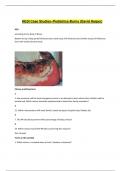
Bottom to top: Deep partial-thickness burn (red area); full-thickness burn (white area); full-thickness
burn with eschar (brown area).
Choose matching term
1
2. Some parents call the local emergency rooms in an attempt to learn where their children will be
transferred. Which action should be implemented to help these family members?
2
21. Which interventions will meet David's needs during his hospital stay? (Select all)
3
7. The RN should document which percentage of body surface?
4
10. Which action should the RN take concerning this request?
Don't know?
Terms in this set (32)
1. Which action is included when a level 1 disaster is declared?
, All local hospitals prepare to receive casualties
Classification as a Level I disaster indicates that local emergency response personnel and organizations
can contain and effectively manage the disaster and its aftermath.
2. Some parents call the local emergency rooms in an attempt to learn where their children will be
transferred. Which action should be implemented to help these family members?
Designate specific family areas that are staffed with counselors
3. Paramedics are triaging clients at the accident site. Which action is implemented by the triage
personnel.
Place a disaster tag securely on each victim
Victim tracking is a critical component in casualty management. Disaster tags are color-coded and
numbered to indicate triage priority. They include the client's name, address, and age, as well as a
description and location of the client's injuries
4. Which of the following clients would be given a red tag? (Select all)
-A client whose vitals signs are as follows: RR 22, HR 120, BP 85/52
*Client is going into shock and should be seen immediately*
-A client with a pulsating femur wound
*client has an arterial bleed and can go into shock and therefore should be seen immediately**
-A client with full-thickness burns over 50% of the body
*client should be attended to immediately*
5. Into which triage category should David be placed?
Red—Most urgent; first priority
First-priority patients have life-threatening injuries and are experiencing hypoxia or nearing hypoxia.
Examples of injuries in this category include shock, chest wounds, internal hemorrhage, head injuries
producing increased loss of consciousness, partial- or full-thickness burns over 20% to 60% of the body
surface, and chest pain.
Yellow—Urgent; second priority
Second-priority patients have injuries with systemic effects and complications but are not yet hypoxic or
in shock. The patients appear stable enough to withstand up to a 2-hour wait without immediate risk.
Examples of injuries in this category include multiple fractures, open fractures, spinal injuries, large
lacerations, partial- or full-thickness burns over 10% to 20% of the body surface, and medical
emergencies, such as diabetic coma, insulin shock, and epileptic seizure. Patients with second-priority
status might need to be observed closely for signs of shock, at which time they would be re-categorized
to first priority.
Green—Third priority
45%
according to the Rule of Nines:
Bottom to top: Deep partial-thickness burn (red area); full-thickness burn (white area); full-thickness
burn with eschar (brown area).
Choose matching term
1
2. Some parents call the local emergency rooms in an attempt to learn where their children will be
transferred. Which action should be implemented to help these family members?
2
21. Which interventions will meet David's needs during his hospital stay? (Select all)
3
7. The RN should document which percentage of body surface?
4
10. Which action should the RN take concerning this request?
Don't know?
Terms in this set (32)
1. Which action is included when a level 1 disaster is declared?
, All local hospitals prepare to receive casualties
Classification as a Level I disaster indicates that local emergency response personnel and organizations
can contain and effectively manage the disaster and its aftermath.
2. Some parents call the local emergency rooms in an attempt to learn where their children will be
transferred. Which action should be implemented to help these family members?
Designate specific family areas that are staffed with counselors
3. Paramedics are triaging clients at the accident site. Which action is implemented by the triage
personnel.
Place a disaster tag securely on each victim
Victim tracking is a critical component in casualty management. Disaster tags are color-coded and
numbered to indicate triage priority. They include the client's name, address, and age, as well as a
description and location of the client's injuries
4. Which of the following clients would be given a red tag? (Select all)
-A client whose vitals signs are as follows: RR 22, HR 120, BP 85/52
*Client is going into shock and should be seen immediately*
-A client with a pulsating femur wound
*client has an arterial bleed and can go into shock and therefore should be seen immediately**
-A client with full-thickness burns over 50% of the body
*client should be attended to immediately*
5. Into which triage category should David be placed?
Red—Most urgent; first priority
First-priority patients have life-threatening injuries and are experiencing hypoxia or nearing hypoxia.
Examples of injuries in this category include shock, chest wounds, internal hemorrhage, head injuries
producing increased loss of consciousness, partial- or full-thickness burns over 20% to 60% of the body
surface, and chest pain.
Yellow—Urgent; second priority
Second-priority patients have injuries with systemic effects and complications but are not yet hypoxic or
in shock. The patients appear stable enough to withstand up to a 2-hour wait without immediate risk.
Examples of injuries in this category include multiple fractures, open fractures, spinal injuries, large
lacerations, partial- or full-thickness burns over 10% to 20% of the body surface, and medical
emergencies, such as diabetic coma, insulin shock, and epileptic seizure. Patients with second-priority
status might need to be observed closely for signs of shock, at which time they would be re-categorized
to first priority.
Green—Third priority