Ooo oINTRODUCTION TO ECOLOGYo o
Part A: What is Ecology?
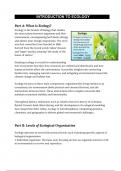
Ecology is the branch of biology that studies
the interactions between organisms and their
environment, encompassing both biotic (living)
and abiotic (non-living) components. The term
was first coined by Ernst Haeckel in 1866,
derived from the Greek words "oikos" (house)
and "logos" (study), meaning "the study of the
house of nature."
Studying ecology is crucial for understanding
how ecosystems function, how resources are utilized and distributed, and how
human activities affect the environment. It provides insights into conserving
biodiversity, managing natural resources, and mitigating environmental issues like
climate change and habitat loss.
Ecology focuses on three main components: organisms (the living entities in an
ecosystem), the environment (both physical and chemical factors), and the
interactions between them. These interactions form complex networks that
maintain ecosystem stability and functionality.
Throughout history, milestones such as Charles Darwin's theory of evolution,
Rachel Carson’s book Silent Spring, and the development of ecological modeling
have shaped the field. Today, ecology is interdisciplinary, integrating genetics,
chemistry, and geography to address global environmental challenges.
Part B: Levels of Ecological Organization
Ecology operates at several hierarchical levels, each examining specific aspects of
biological organization:
1. Individual organisms: The basic unit, focusing on how an organism interacts with
its environment to survive and reproduce.
, 2. Populations: Groups of individuals of the
same species living in a specific area,
studied in terms of size, density, and
dynamics.
3. Communities: Assemblages of
populations of different species interacting
in a shared environment, influencing
processes like predation and competition.
4. Ecosystems: Communities and their
abiotic surroundings, such as forests,
deserts, or oceans, examined as functional
systems.
5. Biomes: Large-scale ecosystems
classified by dominant vegetation and climate (e.g., tundra, rainforest).
6. Biosphere: The global sum of all ecosystems, encompassing life and its
interaction with Earth's atmosphere, hydrosphere, and lithosphere.
This framework helps ecologists study life from microscopic interactions to global
systems.
Part C: Abiotic and Biotic Factors
Abiotic factors refer to non-living components
of an environment that influence life, such as
sunlight, temperature, wind, water, and soil
composition. For example, sunlight drives
photosynthesis, and soil nutrients determine
plant growth.
Biotic factors include living organisms that
interact within an ecosystem, such as plants,
animals, fungi, and microorganisms. These factors are essential for energy flow and
nutrient cycling in ecosystems.
Part A: What is Ecology?
Ecology is the branch of biology that studies
the interactions between organisms and their
environment, encompassing both biotic (living)
and abiotic (non-living) components. The term
was first coined by Ernst Haeckel in 1866,
derived from the Greek words "oikos" (house)
and "logos" (study), meaning "the study of the
house of nature."
Studying ecology is crucial for understanding
how ecosystems function, how resources are utilized and distributed, and how
human activities affect the environment. It provides insights into conserving
biodiversity, managing natural resources, and mitigating environmental issues like
climate change and habitat loss.
Ecology focuses on three main components: organisms (the living entities in an
ecosystem), the environment (both physical and chemical factors), and the
interactions between them. These interactions form complex networks that
maintain ecosystem stability and functionality.
Throughout history, milestones such as Charles Darwin's theory of evolution,
Rachel Carson’s book Silent Spring, and the development of ecological modeling
have shaped the field. Today, ecology is interdisciplinary, integrating genetics,
chemistry, and geography to address global environmental challenges.
Part B: Levels of Ecological Organization
Ecology operates at several hierarchical levels, each examining specific aspects of
biological organization:
1. Individual organisms: The basic unit, focusing on how an organism interacts with
its environment to survive and reproduce.
, 2. Populations: Groups of individuals of the
same species living in a specific area,
studied in terms of size, density, and
dynamics.
3. Communities: Assemblages of
populations of different species interacting
in a shared environment, influencing
processes like predation and competition.
4. Ecosystems: Communities and their
abiotic surroundings, such as forests,
deserts, or oceans, examined as functional
systems.
5. Biomes: Large-scale ecosystems
classified by dominant vegetation and climate (e.g., tundra, rainforest).
6. Biosphere: The global sum of all ecosystems, encompassing life and its
interaction with Earth's atmosphere, hydrosphere, and lithosphere.
This framework helps ecologists study life from microscopic interactions to global
systems.
Part C: Abiotic and Biotic Factors
Abiotic factors refer to non-living components
of an environment that influence life, such as
sunlight, temperature, wind, water, and soil
composition. For example, sunlight drives
photosynthesis, and soil nutrients determine
plant growth.
Biotic factors include living organisms that
interact within an ecosystem, such as plants,
animals, fungi, and microorganisms. These factors are essential for energy flow and
nutrient cycling in ecosystems.