Nclex Fundamentals of Nursing Exam Answers With Rationale
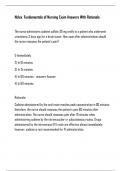
The nurse administers codeine sulfate 30 mg orally to a patient who underwent
craniotomy 3 days ago for a brain tumor. How soon after administration should
the nurse reassess the patient's pain?
1) Immediately
2) In 10 minutes
3) In 15 minutes
4) In 60 minutes - answers-Answer:
4) In 60 minutes
Rationale:
Codeine administered by the oral route reaches peak concentration in 60 minutes;
therefore, the nurse should reassess the patient's pain 60 minutes after
administration. The nurse should reassess pain after 10 minutes when
administering codeine by the intramuscular or subcutaneous routes. Drugs
administered by the intravenous (IV) route are effective almost immediately;
however, codeine is not recommended for IV administration.
,Which nonsteroidal anti-inflammatory drug might be administered to inhibit
platelet aggregation in a patient at risk for thrombophlebitis?
1) Ibuprofen (Motrin)
2) Celecoxib (Celebrex)
3) Aspirin (Ecotrin)
4) Indomethacin (Indocin) - answers-Answer:
3) Aspirin (Ecotrin)
Rationale:
Aspirin is a unique NSAID that inhibits platelet aggregation. Low-dose aspirin
therapy is commonly administered to decrease the risk of thrombophlebitis,
myocardial infarction, and stroke. Ibuprofen, celecoxib, and indomethacin are
NSAIDs, but they do not inhibit platelet aggregation.
A client who is receiving epidural analgesia complains of nausea and loss of motor
function in his legs. The nurse obtains his blood pressure and notes a drop in his
blood pressure from the previous reading. Which complication is the patient most
likely experiencing?
1) Infection at the catheter insertion site
,2) Side effect of the epidural analgesic
3) Epidural catheter migration
4) Spinal cord damage - answers-Answer:
3) Epidural catheter migration
Rationale:
The patient is exhibiting signs of epidural catheter migration, which include
nausea, a decrease in blood pressure, and loss of motor function without an
identifiable cause. Signs of infection at the catheter site include redness, swelling,
and drainage. Loss of motor function is not a typical side effect associated with
epidural analgesics. These are common signs of catheter migration, not spinal
cord damage.
Which of the following clients is experiencing an abnormal change in vital signs? A
client whose (select all that apply):
1) Blood pressure (BP) was 132/80 mm Hg sitting and is 120/60 mm Hg upon
standing
2) Rectal temperature is 97.9°F in the morning and 99.2°F in the evening
3) Heart rate was 76 before eating and is 60 after eating
, 4) Respiratory rate was 14 when standing and is 22 after walking - answers-
Answer:
1) Blood pressure (BP) was 132/80 mm Hg sitting and is 120/60 mm Hg upon
standing
3) Heart rate was 76 before eating and is 60 after eating
Rationale:
The BP change is abnormal; a BP change greater than 10 mm Hg may indicate
postural hypotension. The change in heart rate is abnormal; heart rate usually
increases slightly after eating rather than decreasing. The temperatures are
within normal range for the rectal route, and temperature increases throughout
the day. It is normal to have an increased respiratory rate after exercise.
A 73-year-old patient who sustained a right hip fracture in a fall requests pain
medication from the nurse. Based on his injury, which type of pain is this patient
most likely experiencing?
1) Phantom
2) Visceral
3) Deep somatic
4) Referred - answers-Answer:
The nurse administers codeine sulfate 30 mg orally to a patient who underwent
craniotomy 3 days ago for a brain tumor. How soon after administration should
the nurse reassess the patient's pain?
1) Immediately
2) In 10 minutes
3) In 15 minutes
4) In 60 minutes - answers-Answer:
4) In 60 minutes
Rationale:
Codeine administered by the oral route reaches peak concentration in 60 minutes;
therefore, the nurse should reassess the patient's pain 60 minutes after
administration. The nurse should reassess pain after 10 minutes when
administering codeine by the intramuscular or subcutaneous routes. Drugs
administered by the intravenous (IV) route are effective almost immediately;
however, codeine is not recommended for IV administration.
,Which nonsteroidal anti-inflammatory drug might be administered to inhibit
platelet aggregation in a patient at risk for thrombophlebitis?
1) Ibuprofen (Motrin)
2) Celecoxib (Celebrex)
3) Aspirin (Ecotrin)
4) Indomethacin (Indocin) - answers-Answer:
3) Aspirin (Ecotrin)
Rationale:
Aspirin is a unique NSAID that inhibits platelet aggregation. Low-dose aspirin
therapy is commonly administered to decrease the risk of thrombophlebitis,
myocardial infarction, and stroke. Ibuprofen, celecoxib, and indomethacin are
NSAIDs, but they do not inhibit platelet aggregation.
A client who is receiving epidural analgesia complains of nausea and loss of motor
function in his legs. The nurse obtains his blood pressure and notes a drop in his
blood pressure from the previous reading. Which complication is the patient most
likely experiencing?
1) Infection at the catheter insertion site
,2) Side effect of the epidural analgesic
3) Epidural catheter migration
4) Spinal cord damage - answers-Answer:
3) Epidural catheter migration
Rationale:
The patient is exhibiting signs of epidural catheter migration, which include
nausea, a decrease in blood pressure, and loss of motor function without an
identifiable cause. Signs of infection at the catheter site include redness, swelling,
and drainage. Loss of motor function is not a typical side effect associated with
epidural analgesics. These are common signs of catheter migration, not spinal
cord damage.
Which of the following clients is experiencing an abnormal change in vital signs? A
client whose (select all that apply):
1) Blood pressure (BP) was 132/80 mm Hg sitting and is 120/60 mm Hg upon
standing
2) Rectal temperature is 97.9°F in the morning and 99.2°F in the evening
3) Heart rate was 76 before eating and is 60 after eating
, 4) Respiratory rate was 14 when standing and is 22 after walking - answers-
Answer:
1) Blood pressure (BP) was 132/80 mm Hg sitting and is 120/60 mm Hg upon
standing
3) Heart rate was 76 before eating and is 60 after eating
Rationale:
The BP change is abnormal; a BP change greater than 10 mm Hg may indicate
postural hypotension. The change in heart rate is abnormal; heart rate usually
increases slightly after eating rather than decreasing. The temperatures are
within normal range for the rectal route, and temperature increases throughout
the day. It is normal to have an increased respiratory rate after exercise.
A 73-year-old patient who sustained a right hip fracture in a fall requests pain
medication from the nurse. Based on his injury, which type of pain is this patient
most likely experiencing?
1) Phantom
2) Visceral
3) Deep somatic
4) Referred - answers-Answer: