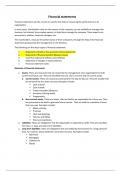
Financial statements
Financial statements are the records or reports that help at measuring the performance of an
organization.
In most cases, shareholders who are the owners of the company, are not available to manage their
business, but instead, they employ experts, to help them manage the company. These experts can
accountants, auditors, financial managers, etc.
The shareholders, measure the performance of their companies, through the help of the financial
statements prepared by the management or the directors.
The following are the major types of financial statement:
i. Statement of profit or loss account (income statement)
ii. Statement of financial position (Balance sheet)
iii. Cash flow statement (inflows and outflows)
iv. Statement of changes in equity (Shares)
v. Financial statement notes
Elements of financial statements
1. Assets: These are resources that are owned by the management of an organization for both
current and future use. They are classified into two, that is Current and nit current assets.
a. Current assets: These are resources purchased for the day-to-day use. They are usually held
for period of the less than one year. Examples include:
✓ Cash at hand
✓ Cash at bank
✓ Trade receivables (Debtors)
✓ Inventory (Closing stock)
✓ Prepayments
b. Non-current assets: These are assets, that are held by an organization for future use. They
are presumed to be held to generate future income. They are held for a duration of more
than one year. Examples include:
✓ Motor vehicles
✓ Premises
✓ Land and buildings
✓ Fixtures and fitting
✓ Plant and machinery
2. Liabilities: These are obligations that the organization is expected to settle. They are classified
into two, i.e. long- and short-term liabilities.
a. Long term liabilities: these are obligations that are settled by the business for a long period of
time, for instance, those settled for more than one year. Examples include:
✓ Bank loan
✓ Mortgages
✓ Debentures
✓ Bonds
, b. Short term liabilities: these are obligations that the company settles within a duration of one
year. Examples include:
✓ Accounts payables (Creditors)
✓ Bank overdraft (fuliza)
✓ Accruals
3. Capital: these is the amount of money contributed by the owner, to start a business. It can also
be the retained earnings by the owner of the business.
An accounting equation
1. Assets = Capital + liabilities
2. Assets = Capital + Profit (retained earnings) + Liabilities
3. Assets = Capital + (profit -drawings) + liabilities
Formats of financial statement
1. Statement of profit or loss account
XYZ Ltd
Statement of profit or loss account
For year ending, 31st Dec, 2023
Ksh. Ksh.
Sales xxx
Less sales return (return (xxx)
inwards)
Net sales xxx
Less cost of goods sold
Opening stock xxx
Purchase xxx
Less purchases return (return (xxx)
outwards)
Add carriage inwards xxx
(transport)
Less closing stock (xxx) (xxx)
Gross profit xxx
Less expenses
Salaries and Wages xxx
Rent xxx
Carriage outwards xxx
Electricity xxx (xxx)
Net profit xxx
Financial statements are the records or reports that help at measuring the performance of an
organization.
In most cases, shareholders who are the owners of the company, are not available to manage their
business, but instead, they employ experts, to help them manage the company. These experts can
accountants, auditors, financial managers, etc.
The shareholders, measure the performance of their companies, through the help of the financial
statements prepared by the management or the directors.
The following are the major types of financial statement:
i. Statement of profit or loss account (income statement)
ii. Statement of financial position (Balance sheet)
iii. Cash flow statement (inflows and outflows)
iv. Statement of changes in equity (Shares)
v. Financial statement notes
Elements of financial statements
1. Assets: These are resources that are owned by the management of an organization for both
current and future use. They are classified into two, that is Current and nit current assets.
a. Current assets: These are resources purchased for the day-to-day use. They are usually held
for period of the less than one year. Examples include:
✓ Cash at hand
✓ Cash at bank
✓ Trade receivables (Debtors)
✓ Inventory (Closing stock)
✓ Prepayments
b. Non-current assets: These are assets, that are held by an organization for future use. They
are presumed to be held to generate future income. They are held for a duration of more
than one year. Examples include:
✓ Motor vehicles
✓ Premises
✓ Land and buildings
✓ Fixtures and fitting
✓ Plant and machinery
2. Liabilities: These are obligations that the organization is expected to settle. They are classified
into two, i.e. long- and short-term liabilities.
a. Long term liabilities: these are obligations that are settled by the business for a long period of
time, for instance, those settled for more than one year. Examples include:
✓ Bank loan
✓ Mortgages
✓ Debentures
✓ Bonds
, b. Short term liabilities: these are obligations that the company settles within a duration of one
year. Examples include:
✓ Accounts payables (Creditors)
✓ Bank overdraft (fuliza)
✓ Accruals
3. Capital: these is the amount of money contributed by the owner, to start a business. It can also
be the retained earnings by the owner of the business.
An accounting equation
1. Assets = Capital + liabilities
2. Assets = Capital + Profit (retained earnings) + Liabilities
3. Assets = Capital + (profit -drawings) + liabilities
Formats of financial statement
1. Statement of profit or loss account
XYZ Ltd
Statement of profit or loss account
For year ending, 31st Dec, 2023
Ksh. Ksh.
Sales xxx
Less sales return (return (xxx)
inwards)
Net sales xxx
Less cost of goods sold
Opening stock xxx
Purchase xxx
Less purchases return (return (xxx)
outwards)
Add carriage inwards xxx
(transport)
Less closing stock (xxx) (xxx)
Gross profit xxx
Less expenses
Salaries and Wages xxx
Rent xxx
Carriage outwards xxx
Electricity xxx (xxx)
Net profit xxx