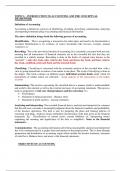
TOPIC 1; - INTRODUCTION TO ACCOUNTING AND THE CONCEPTUAL
FRAMEWORK
Definition of Accounting
Accounting is defined as a process of identifying, recording, classifying, summarizing, analyzing
and reporting/communicating of accounting and financial information.
The above definition brings forth the following process of accounting
Identification – This is recognizing a transaction has taken place and need to be documented or
recorded. Identification is by evidence of source documents like invoices, receipts, journal
vouchers e.t.c
Recording: This is the most basic function of accounting. It is essentially concerned with not only
ensuring that all transactions of financial character are in fact recorded but also that they are
recorded in a orderly manner. Recording is done in the books of original entry known as the
“journals”. ( sales day book, sales returns day book, purchases day book, purchase returns
day book, cashbbok, pettycash book and the Journal book)
Classifying: Classifying is concerned with the systematic analysis of the recorded data, with a
view to group transactions or entries of one nature at one place. The work of classifying is done in
the ledger. This book contains on different pages individual account heads under which all
transactions of similar nature are collected.- actual analysis of the transactions in the ledger
accounts
Summarizing: This involves presenting the classified data in a manner which is understandable
and useful to the internal as well as the external end users of accounting statements. This process
leads to preparation of end year closing balances and the extraction of a
• Trial balance
• Statement of financial position – Balance sheet
• Statement of profit and loss – Income statement
Analyzing and interpreting: The recorded financial data is analyzed and interpreted in a manner
that the end users can make a meaningful judgment about the financial condition and profitability
of the business operations. The data is also for preparing the plans and framing policies of
executing such plans. Analysis means methodical classification of the data given in the financial
statements. Eg. Classification of current assets, current liabilities etc. Interpreting means
explaining the meaning and significance of the data so simplified.- Notes to the financial
statement s
Communication: The accounting information after being meaningfully analyzed and interpreted
has to be communicated in a proper form and manner to the proper person. This is done through
preparation and distribution of accounting report which include the income statement, statement
of cash flows, Balance sheet, and notes to the financial statements
OBJECTIVES OF ACCOUNTING
, 1. To have permanent record of all the business transactions.
2. To keep records of incomes and expenses in such a way that the net profit or net loss may
be calculated.
3. To keep records of assets and liabilities in such a way that the financial position/wealth of
the business may be ascertained.
4. To keep control on expenses with a view to minimize the same in order to maximize the
profit.
5. To have important information for legal and tax purpose.
6. For credit purposes (Determining borrowing capacity)
Stakeholders/users of Financial Information
Stakeholders are users of financial information. They are organizations or individuals who are
affected by the information generated by an organization. The stakeholders are divided into two
categories as follows;
• Internal Stakeholders – people within the organization
• External stakeholders –users outside the organization
Internal Stakeholders
These are the stakeholders who are directly affected by the activities of an organization. The
stakeholders in this category include;
i. The Management: These are the people who are entrusted with stewardship
management of an enterprise. They manage the organization by putting the capital of
that organization for the best interest of the capital providers (Owners).
ii. The Owner (s): These are the individuals/organizations who provide equity for starting
up an organization. They are interested in seeing the organization improve in terms of
profitability (profit maximization) and wealth (shareholders wealth maximization)
iii. The Employees: These are the people who work for an organization. They perfume
duties assigned to them by the management.
External Stakeholders
These are the stakeholders who do not directly affect the operations of an Organization. The
stakeholders include;
i. Investors: These are the individuals or organizations that commit funds for a return.
They are interested in seeing that the Organization give them high returns for their
investments
FRAMEWORK
Definition of Accounting
Accounting is defined as a process of identifying, recording, classifying, summarizing, analyzing
and reporting/communicating of accounting and financial information.
The above definition brings forth the following process of accounting
Identification – This is recognizing a transaction has taken place and need to be documented or
recorded. Identification is by evidence of source documents like invoices, receipts, journal
vouchers e.t.c
Recording: This is the most basic function of accounting. It is essentially concerned with not only
ensuring that all transactions of financial character are in fact recorded but also that they are
recorded in a orderly manner. Recording is done in the books of original entry known as the
“journals”. ( sales day book, sales returns day book, purchases day book, purchase returns
day book, cashbbok, pettycash book and the Journal book)
Classifying: Classifying is concerned with the systematic analysis of the recorded data, with a
view to group transactions or entries of one nature at one place. The work of classifying is done in
the ledger. This book contains on different pages individual account heads under which all
transactions of similar nature are collected.- actual analysis of the transactions in the ledger
accounts
Summarizing: This involves presenting the classified data in a manner which is understandable
and useful to the internal as well as the external end users of accounting statements. This process
leads to preparation of end year closing balances and the extraction of a
• Trial balance
• Statement of financial position – Balance sheet
• Statement of profit and loss – Income statement
Analyzing and interpreting: The recorded financial data is analyzed and interpreted in a manner
that the end users can make a meaningful judgment about the financial condition and profitability
of the business operations. The data is also for preparing the plans and framing policies of
executing such plans. Analysis means methodical classification of the data given in the financial
statements. Eg. Classification of current assets, current liabilities etc. Interpreting means
explaining the meaning and significance of the data so simplified.- Notes to the financial
statement s
Communication: The accounting information after being meaningfully analyzed and interpreted
has to be communicated in a proper form and manner to the proper person. This is done through
preparation and distribution of accounting report which include the income statement, statement
of cash flows, Balance sheet, and notes to the financial statements
OBJECTIVES OF ACCOUNTING
, 1. To have permanent record of all the business transactions.
2. To keep records of incomes and expenses in such a way that the net profit or net loss may
be calculated.
3. To keep records of assets and liabilities in such a way that the financial position/wealth of
the business may be ascertained.
4. To keep control on expenses with a view to minimize the same in order to maximize the
profit.
5. To have important information for legal and tax purpose.
6. For credit purposes (Determining borrowing capacity)
Stakeholders/users of Financial Information
Stakeholders are users of financial information. They are organizations or individuals who are
affected by the information generated by an organization. The stakeholders are divided into two
categories as follows;
• Internal Stakeholders – people within the organization
• External stakeholders –users outside the organization
Internal Stakeholders
These are the stakeholders who are directly affected by the activities of an organization. The
stakeholders in this category include;
i. The Management: These are the people who are entrusted with stewardship
management of an enterprise. They manage the organization by putting the capital of
that organization for the best interest of the capital providers (Owners).
ii. The Owner (s): These are the individuals/organizations who provide equity for starting
up an organization. They are interested in seeing the organization improve in terms of
profitability (profit maximization) and wealth (shareholders wealth maximization)
iii. The Employees: These are the people who work for an organization. They perfume
duties assigned to them by the management.
External Stakeholders
These are the stakeholders who do not directly affect the operations of an Organization. The
stakeholders include;
i. Investors: These are the individuals or organizations that commit funds for a return.
They are interested in seeing that the Organization give them high returns for their
investments