

Tuesday, 9/10
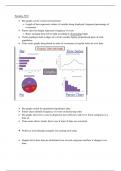
➢ Bar graphs can be vertical or horizontal
→ Length of bars represents values of variable being displayed, frequency/percentage of
occurrence
➢ Pareto chart-bar height represents frequency of event
→ Baras arranged from left to right according to decreasing height
➢ Circle graph/pie chart-wedges of a circle visually display proportional parts of total
population
➢ Time-series graph: data plotted in order of occurrence at regular intervals over time
➢ Bar graphs useful for quantitative/qualitative data
➢ Pareto charts identify frequency of events in decreasing order
➢ Pie graphs show how a total is dispersed, most effective with 10 or fewer categories in a
data set
➢ Time-series shows trends, best to use if units of time are consistent
Professor went through examples for creating each chart
➢ Graphs tell us how data are distributed over several categories and how it changes over
time
➢ Bar graphs can be vertical or horizontal
→ Length of bars represents values of variable being displayed, frequency/percentage of
occurrence
➢ Pareto chart-bar height represents frequency of event
→ Baras arranged from left to right according to decreasing height
➢ Circle graph/pie chart-wedges of a circle visually display proportional parts of total
population
➢ Time-series graph: data plotted in order of occurrence at regular intervals over time
➢ Bar graphs useful for quantitative/qualitative data
➢ Pareto charts identify frequency of events in decreasing order
➢ Pie graphs show how a total is dispersed, most effective with 10 or fewer categories in a
data set
➢ Time-series shows trends, best to use if units of time are consistent
Professor went through examples for creating each chart
➢ Graphs tell us how data are distributed over several categories and how it changes over
time


