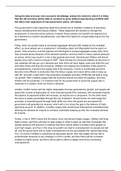
MGT 330 EXAM QUESTIONS AND CORRECT ANSWERS LATEST UPDATE 2024-2025 (GRADED A+)
Framing bias - Answers The tendency for people's decisions and judgements to be influenced by how
information is presented
Example of framing bias - Answers In Q3 we were supposed to be 1.27 but we made 1.25 compared to
our earnings were 1.25 when last quarter they were 1.21
Overconfidence bias - Answers Individuals tendency to have an inflated belief in their own abilities,
knowledge, or predictions
Example of overconfidence bias - Answers 94% of college professors and 90% of drivers believe that
they are above average
Confirmation bias - Answers Tendency to search for, interpret, and remember information in a way that
confirms one's preexisting beliefs
Decision fatigue bias - Answers the deteriorating quality of decisions made by an individual after a long
session of decision making
Example of decision fatigue bias - Answers Study reveals that judges parole decisions were a function of
the time of day that the judge heard the case rather than the ethical background, crime, length of
current sentence, etc.
Demonstrable task - Answers A task that has an obvious, correct answer
Group to individual transfer - Answers Individual group members become more knowledgeable, skillful,
and confident in the process of group interaction as they
share insights and info.
Learn and reinforce new skills
Are exposed to diverse insights within the team
group polarization - Answers The tendency of group discussions to intensify group opinion, producing
more extreme judgements than might be obtained from individuals views separately
Psychological explanations for group polarization - Answers The need to be right and the need to be
liked
Informational Influence - Answers People change their opinions or behaviors based on the information
they receive from others
Normative Influence - Answers Influence on an individual by a reference group to conform to its norms
Conformity Pressure - Answers On average, people follow the norm one-third of the time when others
give the obviously incorrect answer
, Conformity pressure on groups - Answers More consensus among group members because of the
greater pressure
Group think - Answers Occurs when team members place decision agreement above all other decision
priorities including good judgement
Three key symptoms of groupthink - Answers Overestimation of the group
Closed-mindedness
Illusion of unanimity (due to pressure to conform)
Escalation of commitment - Answers When individuals or groups continue to invest time, money or
resources into a failing course of action despite evidence indicating that it is not working
Minority and majority conflict - Answers Disagreements within a group based on differing perspectives
or opinions held by larger versus smaller subjects of members
Minority and majority conflict: direct influence - Answers Explicit communication via persuasion,
argumentation, or presenting evidence, etc.
Minority and majority conflict in teams: indirect influence - Answers Subtler methods such as nonverbal
cues, social dynamics, or the establishment of norms
Three things used to change attitudes and behavior as a result of influence or pressure - Answers
Compliance, conversion, and sleeper effect
Minority and majority conflict: compliance - Answers Changes due to pressure
Minority and majority conflict: conversion - Answers Genuine changes in beliefs or attitudes
Majority and minority conflict: sleeper effect - Answers Delayed conversion
Common information effect - Answers Members tend to focus on information that is shared among the
group rather than unique or unshared information (in group decision making)
Hidden profiles - Answers Superior decision alternative, superiority of the choice is hidden from group
members because each individual member only has a portion of the information supporting the superior
alternative choice
The Abilene paradox - Answers Form of pluralistic ignorance in which group members adopt a position
because they feel other members desire it (team members don't challenge each other because they
want to avoid conflict)
Self limiting behavior - Answers A persons reluctance to air or defense their viewpoints can lead to
problems like the Abilene paradox
Framing bias - Answers The tendency for people's decisions and judgements to be influenced by how
information is presented
Example of framing bias - Answers In Q3 we were supposed to be 1.27 but we made 1.25 compared to
our earnings were 1.25 when last quarter they were 1.21
Overconfidence bias - Answers Individuals tendency to have an inflated belief in their own abilities,
knowledge, or predictions
Example of overconfidence bias - Answers 94% of college professors and 90% of drivers believe that
they are above average
Confirmation bias - Answers Tendency to search for, interpret, and remember information in a way that
confirms one's preexisting beliefs
Decision fatigue bias - Answers the deteriorating quality of decisions made by an individual after a long
session of decision making
Example of decision fatigue bias - Answers Study reveals that judges parole decisions were a function of
the time of day that the judge heard the case rather than the ethical background, crime, length of
current sentence, etc.
Demonstrable task - Answers A task that has an obvious, correct answer
Group to individual transfer - Answers Individual group members become more knowledgeable, skillful,
and confident in the process of group interaction as they
share insights and info.
Learn and reinforce new skills
Are exposed to diverse insights within the team
group polarization - Answers The tendency of group discussions to intensify group opinion, producing
more extreme judgements than might be obtained from individuals views separately
Psychological explanations for group polarization - Answers The need to be right and the need to be
liked
Informational Influence - Answers People change their opinions or behaviors based on the information
they receive from others
Normative Influence - Answers Influence on an individual by a reference group to conform to its norms
Conformity Pressure - Answers On average, people follow the norm one-third of the time when others
give the obviously incorrect answer
, Conformity pressure on groups - Answers More consensus among group members because of the
greater pressure
Group think - Answers Occurs when team members place decision agreement above all other decision
priorities including good judgement
Three key symptoms of groupthink - Answers Overestimation of the group
Closed-mindedness
Illusion of unanimity (due to pressure to conform)
Escalation of commitment - Answers When individuals or groups continue to invest time, money or
resources into a failing course of action despite evidence indicating that it is not working
Minority and majority conflict - Answers Disagreements within a group based on differing perspectives
or opinions held by larger versus smaller subjects of members
Minority and majority conflict: direct influence - Answers Explicit communication via persuasion,
argumentation, or presenting evidence, etc.
Minority and majority conflict in teams: indirect influence - Answers Subtler methods such as nonverbal
cues, social dynamics, or the establishment of norms
Three things used to change attitudes and behavior as a result of influence or pressure - Answers
Compliance, conversion, and sleeper effect
Minority and majority conflict: compliance - Answers Changes due to pressure
Minority and majority conflict: conversion - Answers Genuine changes in beliefs or attitudes
Majority and minority conflict: sleeper effect - Answers Delayed conversion
Common information effect - Answers Members tend to focus on information that is shared among the
group rather than unique or unshared information (in group decision making)
Hidden profiles - Answers Superior decision alternative, superiority of the choice is hidden from group
members because each individual member only has a portion of the information supporting the superior
alternative choice
The Abilene paradox - Answers Form of pluralistic ignorance in which group members adopt a position
because they feel other members desire it (team members don't challenge each other because they
want to avoid conflict)
Self limiting behavior - Answers A persons reluctance to air or defense their viewpoints can lead to
problems like the Abilene paradox