100% satisfaction guarantee Immediately available after payment Both online and in PDF No strings attached 4.2 TrustPilot
logo-home
Exam (elaborations)

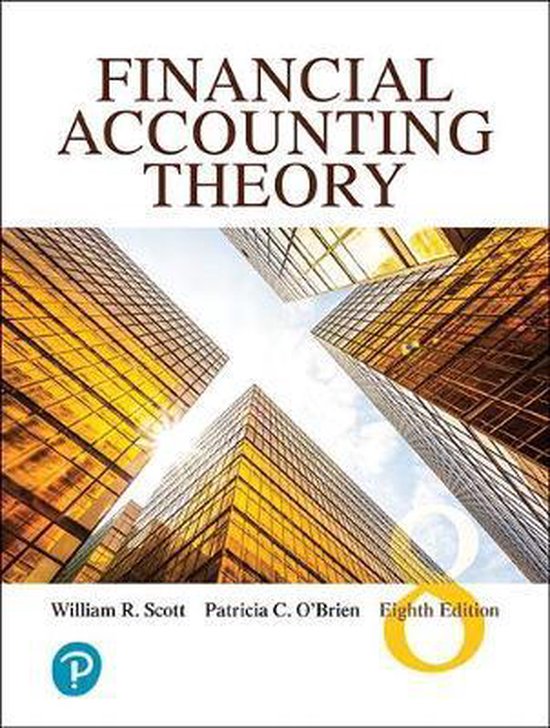
Solution Manual for Financial Accounting Theory 8th Edition by William Scott, Patricia O'Brien ||Complete A+ Guide

Rating
-
Sold
1
Pages
568
Grade
A+
Uploaded on
14-11-2024
Written in
2025/2026

Solution Manual for Financial Accounting Theory 8th Edition by William Scott, Patricia O'Brien ||Complete A+ Guide

Institution
Solution Manual
Course
Solution Manual


Whoops! We can’t load your doc right now. Try again or contact support.

Written for

Institution
Solution Manual
Course
Solution Manual

Document information

Uploaded on
November 14, 2024
File latest updated on
November 15, 2024
Number of pages
568
Written in
2025/2026
Type
Exam (elaborations)
Contains
Questions & answers

Subjects

  • 9780134166681
  • solution manual

Content preview

, Contents


Chapter 1 F Introduction ............................................................................................................ 1

Chapter 2 F Accounting Under Ideal Conditions ................................................................... 7
F F F


Chapter 3 F The Decision Usefulness Approach to Financial Reporting................................68
F F F F F F


Chapter 4 F Efficient Securities Markets ................................................................................. 129
F F


Chapter 5 F The Value Relevance of Accounting Information ............................................... 153
F F F F F


Chapter 6 F The Measurement Approach to Decision Usefulness .......................................... 194
F F F F F


Chapter 7 F Measurement Applications ................................................................................... 237
F


Chapter 8 F The Efficient Contracting Approach to Decision Usefulness .............................. 285
F F F F F F


Chapter 9 F An Analysis of Conflict .................................................................................... 321
F F F


Chapter 10 Executive Compensation .................................................................................... 371
F FF F


Chapter 11 Earnings Management ........................................................................................ 425
F FF F


Chapter 12 Standard Setting: Economic Issues .................................................................... 487
F FF F F F


Chapter 13 Standard Setting: Political Issues ....................................................................... 527
F FF F F F

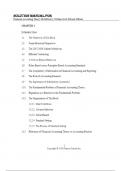
,Scott, FFinancial FAccounting FTheory, F8th FEdition Instructor’s FSolutions FManual FChapter
F1


CHAPTER 1 F


INTRODUCTION
F


1.1 The Objective of This Book
F F F F


1.2 Some Historical Perspective
F F


1.3 The 2007-2008 Market Meltdowns
F F F


1.4 Efficient Contracting
F


1.5 A Note on Ethical Behaviour
F F F F


1.6 Rules-Based v. Principles-Based Accounting Standards
F F F F


1.7 The Complexity of Information in Financial Accounting and Reporting
F F F F F F F F


1.8 The Role of Accounting Research
F F F F


1.9 The Importance of Information Asymmetry
F F F F


1.10 The Fundamental Problem of Financial Accounting Theory
F F F F F F


1.11 Regulation as a Reaction to the Fundamental Problem
F F F F F F F


1.12 The Organization of This Book
F F F F


1.12.1 Ideal Conditions F


1.12.2 Adverse Selection F


1.12.3 Moral Hazard F


1.12.4 Standard Setting F


1.12.5 The Process of Standard Setting
F F F F


1.13 Relevance of Financial Accounting Theory to Accounting Practice
F F F F F F F

, Scott, FFinancial FAccounting FTheory, F8th FEdition Instructor’s FSolutions FManual FChapter
F1


LEARNING OBJECTIVES AND SUGGESTED TEACHING APPROACHES
F F F F F


1. The Broad Outline of the Book
F F F F F


I use Figure 1.1 as a template to describe the broad outline of the book. Since the
F F F F F F F F F F F F F F F F


students typically have not had a chance to read Chapter 1 in the first coursesession,
F F F F F F F F F F F F F F F F


I stick fairly closely to the chapter material.
F F F F F F F F


The major points I discuss are:
F F F F F


• Accounting in an ideal setting. Here, present-value-based accounting is
F F F F F F F F


natural. I go over the ideal conditions needed for sucha basis of
F F F F F F F F F F F F F


accounting to be feasible, but do not go into much detail because this
F F F F F F F F F F F F F


topic is covered in greater depth in Chapter 2.
F F F F F F F F F


• An introduction to the concept of information asymmetry and resulting
F F F F F F F F F


problems of adverse selection and moral hazard. These problems are
F F F F F F F F F F


basic to the book and I feel it is desirable for the students to have a
F F F F F F F F F F F F F F F F


“first go” at them at this point. I concentrate on the intuition underlying
F F F F F F F F F F F F F


the two problems. For example, adverse selection can be illustrated by
F F F F F F F F F F F


asking who would be first in line to purchase life insurance if there was
F F F F F F F F F F F F F F


no medical examination, or what quality of used cars are likely to be
F F F F F F F F F F F F F


brought to market. For moral hazard I try to pin them down on how hard
F F F F F F F F F F F F F F F


they would work inthis course if there were no exams.
F F F F F F F F F F F


• The environment in which financial accounting and reporting operates.
F F F F F F F F


My main goal at this point is that the students do not takethis
F F F F F F F F F F F F F F


environment for granted. I discuss the procedures of standard setting
F F F F F F F F F F


briefly and point out that this is really a process of regulation. In the
F F F F F F F F F F F F F F


past, there have been well-known cases of deregulation, such as
F F F F F F F F F F


airlines, trucking, financial institutions, powergeneration. However, we
F F F F F F F F


are entering what is likely to be a period of increasing regulation, at
F F F F F F F F F F F F F


least for financial institutions. Instructors
F F F F F

Get to know the seller

Seller avatar
Reputation scores are based on the amount of documents a seller has sold for a fee and the reviews they have received for those documents. There are three levels: Bronze, Silver and Gold. The better the reputation, the more your can rely on the quality of the sellers work.
Ascorers Chamberlain College Of Nursing
View profile
Follow You need to be logged in order to follow users or courses
Sold
895
Member since
1 year
Number of followers
59
Documents
3655
Last sold
2 hours ago
ASCORERSHUB

Welcome to your one-stop destination for high-quality academic resources! Here you’ll find test banks, solution manuals, ATI study guides, iHuman case studies, nursing exam prep materials, and verified textbook answers — all carefully selected to help you study smarter and score higher. Whether you’re preparing for nursing exams, business courses, medical case studies, or general college tests, this store offers reliable, up-to-date materials used by top students worldwide. Popular categories include: ✅ Test Banks & Solution Manuals ✅ ATI & HESI Study Guides ✅ iHuman Case Studies & Answers ✅ NCLEX & Nursing Exam Prep ✅ Business, Accounting & Economics Test Banks ✅ Psychology, Biology & Anatomy Materials Boost your academic performance with expertly curated resources that match real exams and class content.

Read more Read less
4.8

1078 reviews

5
963
4
47
3
45
2
9
1
14

Recently viewed by you

Why students choose Stuvia

Created by fellow students, verified by reviews

Quality you can trust: written by students who passed their tests and reviewed by others who've used these notes.

Didn't get what you expected? Choose another document

No worries! You can instantly pick a different document that better fits what you're looking for.

Pay as you like, start learning right away

No subscription, no commitments. Pay the way you're used to via credit card and download your PDF document instantly.

Student with book image

“Bought, downloaded, and aced it. It really can be that simple.”

Alisha Student

Frequently asked questions