NCLEX RN EXAM 2024 -LASTEST QUESTIONS & ANSWERS
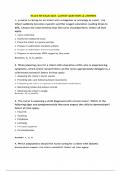
1. A nurse is caring for an infant with a diagnosis of tetralogy of Fallot. The infant suddenly becomes cyanotic and the oxygen saturation reading drops to 60%. Choose the interventions that the nurse shouldperform. Select all that apply. 1. Call a code blue. 2. Notify the registered nurse. 3. Place the infant in a prone position. 4. Prepare to administer morphine sulfate. 5. Prepare to administer intravenous fluids. 6. Prepare to administer 100% oxygen by face mask. Answers: 2, 4, 5, and 6. 2. When planning care for a client with ulcerative colitis who is experiencing symptoms, which client careactivities can the nurse appropriately delegate to a unlicensed assistant? Select all that apply. 1. Assessing the client’s bowel sounds 2. Providing skin care following bowel movements 3. Evaluating the client’s response to antidiarrheal medications 4. Maintaining intake and output records 5. Obtaining the client’s weight. Answer: 2, 4, and 5. 3. The nurse is assessing a child diagnosed with a brain tumor. Which of the following signs and symptomswould the nurse expect the child to demonstrate? Select all that apply. 1. Head tilt 2. Vomiting 3. Polydipsia 4. Lethargy 5. Increased appetite 6. Increased pulse Answer: 1, 2, 4. 4. Which adaptations should the nurse caring for a client with diabetic ketoacidosis expect the client toexhibit? Select all that apply: 1. Sweating 2. Low PCO2 3. Retinopathy 4. Acetone breath 5. Elevated serum bicarbonate Answer: 2, 4. 5. A client has died, and a nurse asks a family member about the funeral arrangements. The family memberrefuses to discuss the issue. The nurse’s appropriate action is to: 1. Show acceptance of feelings. 2. Provide information needed for decision making. 3. Suggest a referral to a mental health professional. 4. Remain with the family member without discussing funeral arrangements. Answer: 4. 6. A 16-year-old child is brought to the emergency department by his mother with a complaint that the childjust experienced a tonic-clonic seizure. On arrival in the emergency department no apparent seizures were occurring. The mother states that her son is taking medication for the seizure disorder. The nurse plans care, knowing that which of the following medications are used for long-term control of tonic-clonic seizures? Select all that apply. 1. Diazepam (Valium) 2. Alprazolam (Xanax) 3. Gabapentin (Neurontin) 4. Ethosuximide (Zarontin) 5. Carbamazepine (Tegretol) 6. Methylphenidate (Ritalin) Answers: 3, 4, and 5. 7. A nurse employed in an emergency department is assigned to assist with the triage of clients arriving tothe emergency department for treatment on the evening shift. The nurse would assign the highest priority to which of the following clients? 1. A client complaining of muscle aches, a headache, and malaise 2. A client who twisted her ankle when she fell while rollerblading 3. A client with a minor laceration on the index finger sustained while cutting an eggplant 4. A client with chest pain who states that he just ate pizza that was made with a very spicy sauce Answers: 4. 8. A nurse is assigned to care for a client with a peripheral IV infusion. The nurse is providing hygiene careto the client and would avoid which of the following while changing the client’s hospital gown? 1. Using a hospital gown with snaps at the sleeves 2. Disconnecting the IV tubing from the catheter in the vein 3. Checking the IV flow rate immediately after changing the hospital gown 4. Putting the bag and tubing through the sleeve, followed by the client’s arm Answer: 2. 9. A nurse is collecting data on a client with severe preeclampsia. Choose the findings that would be notedin severe preeclampsia. Select all that apply. 1. Oliguria 2. Seizures 3. Contractions 4. Proteinuria 3+ 5. Muscle cramps 6. Blood pressure 168/116 mm Hg Answers: 1, 4, and 6. 10. A nurse is caring for a client with leukemia and notes that the client has poor skin turgor and flat neck and hand veins. The nurse suspects hyponatremia. What additional signs would the nurse expect to note inthis client if hyponatremia is present? 1. Intense thirst 2. Slow bounding pulse 3. Dry mucous membranes 4. Postural blood pressure changes Answer: 4. 11. The nurse is providing discharge teaching to the client who was given a prescription for nifedipine (Adalat) for blood pressure management. Which instructions should the nurse include? Select all that apply. 1. “Increase water intake.” 2. “Increase calcium intake.” 3. “Take pulse rate each day.” 4. “Weigh at the same time each day.” 5. “Palpitations may occur early in therapy.” Answer: 1, 2, and 3 6. “Be careful when rising from sitting to standing.” Answers: 3, 4, 5, and 6. 12. A nurse is reviewing the health records of assigned clients. The nurse plans care knowing that whichclient is at risk for fluid volume deficit? 1. The client with cirrhosis 2. The client with a colostomy 3. The client with decreased kidney function 4. The client with congestive heart failure (CHF) Answer 2. 13. A patient is admitted to the hospital with suspected polycythemia vera. Which of the following symptomsis consistent with the diagnosis? Select all that apply. 1. Weight loss. 2. Increased clotting time. 3. Hypertension. 4. Headaches. Answer: 2, 3, and 4 14. A nurse reinforces instructions to the mother of a child who has been hospitalized with croup. Which ofthe following statements, if made by the mother, would indicate the need for further instruction? 1. “I will give my child cough syrup if a cough develops.” 2. “During an attack, I will take my child to a cool location.” 3. “I will give acetaminophen (Tylenol) if my child develops a fever.” 4. “I will be sure that my child drinks at least three to four glasses of fluids every day.” Answer: 1. 15. A patient is admitted to the same day surgery unit for liver biopsy. Which of the following laboratorytests assesses coagulation? Select all that apply. 1. Partial thromboplastin time. 2. Prothrombin time. 3. Platelet count. 4. Hemoglobin 5. Complete Blood Count 6. White Blood Cell Count Minor battering incidents, such as the throwing C. of food or dishes at her 16. Nursing assessment of early evidence of septic shock in children at risk includes: A. Fever, tachycardia, and tachypnea B. Respiratory distress, cold skin, and pale extremities C. Elevated blood pressure, hyperventilation, and thready pulses D. Normal pulses, hypotension, and oliguria Answer: A 17 A 3-year-old child is in the burn unit following a home accident. The first sign of sepsis in burned childrenis: A. Disorientation B. Low-grade fever C. Diarrhea D. Hypertension Answer: A 18 Which of the following should the nurse anticipate receiving as an as-needed order for a postoperativecarotid endarterectomy client? A. Nifedipine 10 mg SL for B/P 140/90 B. Furosemide 20 mg/PO for decreased urine output C. Magnesium salicylate to decrease inflammation D. Nitroglycerin gr 1/150 for chest pain Answer: A 19 A client is a victim of domestic violence. She is now receiving assistance at a shelter for battered women.She tells the nurse about the cycle of violence that she has been experiencing in her relationship with her husband of 5 years. In the "tension-building phase," the nurse might expect the client to describe which of the following? A. Promises of gifts that her husband made to her B. Acute battering of the client, characterized by his volatile discharge of tension Answer: C D. A period of tenderness between the couple Answer: C 20 The nurse in the mental health center is instructing a depressed client about the dietary restrictionsnecessary in taking her medication, which is a monoamine oxidase (MAO) inhibitor. Which of the following is she restricting from the client’s diet? A. Cream cheese B. Fresh fruits C. Aged cheese D. Yeast bread Answer: C 21 A 15-year-old client was diagnosed as having cystic fibrosis at 8 months of age. He is in the hospital for a course of IV antibiotic therapy and vigorous chest physiotherapy. He has a poor appetite. The nurse can best help him to meet the desired outcome of consuming a prescribed number of calories by: A. Including the client in planning sessions to select the type of meal plan and foods for his diet B. Working with the nutritionist to devise a diet with significantly increased calories C. Selecting foods for the client’s diet that are high in calories and instituting a strict calorie count D. Constantly providing him with chips, dips, and candies, because the number of caloriesconsumed is more important than the quality of foods Answer: A 22 A 16-year-old student has a long history of bronchial asthma and has experienced several severe asthmatic attacks during the school year. The school nurse is required to administer 0.2 mL of 1/1000solution of epinephrine SC during an asthma attack. How does the school nurse evaluate the effectiveness of this intervention? A. Increased pulse rate B. Increased expectorate of secretions C. Decreased inspiratory difficulty D. Increased respiratory rate 23 A postpartum client complains of rectal pressure and severe pain in her perineum; this may be indicativeof: A. Afterbirth pains B. Constipation C. Cystitis D. A hematoma of the vagina or vulva Answer: D 24 After a 10-year-old child with insulin-dependent diabetes mellitus receives her dinner tray, she tells the nurse that she hates broccoli and wants some corn on the cob. The nurse’s appropriate response is: A. "No vegetable exchanges are allowed." B. "Corn and other starchy vegetables are considered to be bread exchanges." C. "Yes, you may exchange any vegetable for any other vegetable." D. "Yes, but only one-half ear is allowed." Answer: B 25 The nurse is teaching a 10-year-old insulin-dependent diabetic how to administer insulin. Which one ofthe following steps must be taught for insulin administration? A. Never use abdominal site for a rotation site. B. Pinch the skin up to form a subcutaneous pocket. C. Avoid applying pressure after injection. D. Change needles after injection. Answer: B 26 In assessing the nature of the stool of a client who has cystic fibrosis, what would the nurse expect tosee? A. Clay-colored stools B. Steatorrhea stools C. Dark brown stools D. Blood-tinged stools Answer: B 27 Which of the following signs might indicate a complication during the labor process with vertexpresentation? A. Fetal tachycardia to 170 bpm during a contraction B. Nausea and vomiting at 810 cm dilation C. Contraction lasting 60 seconds D. Appearance of dark-colored amniotic fluid Answer: D 28 A client is admitted to the hospital for an induction of labor owing to a gestation of 42 weeks confirmed by dates and ultrasound. When she is dilated 3 cm, she has a contraction of 70 seconds. She is receivingoxytocin. The nurse’s first intervention should be to: A. Check FHT B. Notify the attending physician C. Turn off the IV oxytocin D. Prepare for the delivery because the client is probably in transition Answer: C 29 During a client’s first postpartum day, the nurse assessed that the fundus was located laterally to the umbilicus. This may be due to: A. Endometritis B. Fibroid tumor on the uterus C. Displacement due to bowel distention D. Urine retention or a distended bladder Answer: D 30 The nurse would be concerned if a client exhibited which of the following symptoms during herpostpartum stay? A. Pulse rate of 5070 bpm by her third postpartum day B. Diuresis by her second or third postpartum day C. Vaginal discharge or rubra, serosa, then rubra D. Diaphoresis by her third postpartum day Answer: BC 31 During the active phase of rheumatic fever, the nurse teaches parents of a child with acute rheumaticfever to assist in minimizing joint pain and promoting healing by: A. Putting all joints through full range-of-motion twice daily B. Massaging the joints briskly with lotion or liniment after bath C. Immobilizing the joints in functional position using splints, rolls, and pillows D. Applying warm water bottle or heating pads over involved joints Answer: C 32 The initial focus when providing nursing care for a child with rheumatic fever during the acute phase ofthe illness should be to: A. Maintain contact with her parents B. Provide for physical and psychological rest C. Provide a nutritious diet D. Maintain her interest in school Answer: C 33 Loss of appetite for a child with leukemia is a major recurrent problem. The plan of care should bedesigned to: A. Reinforce attempts to eat B. Help the child gain weight C. Increase his appetite D. Make mealtimes pleasant 34 The mother of a child taking phenytoin will need to plan appropriate mouth care and gingival stimulation. When tooth-brushing is contraindicated, the next most effective cleansing and gingivalstimulation technique would be: A. Using a water pik B. Rinsing with water C. Rinsing with hydrogen peroxide 35 The parents of a 9-year-old child with acute lymphocytic leukemia expressed concern about his alopeciafrom cranial irradiation. The nurse explains that: A. Alopecia is an unavoidable side effect. B. There are several wig makers for children. C. Most children select a favorite hat to protect their heads. D. His hair will grow back in a few months. Answer: D 35An 18-month-old child has been playing in the garage. His mother brings him to a nurse’s home complaining of his mouth being sore. His lips and mouth are soapy and white, with small ulcerated areasbeginning to form. The child begins to vomit. His pulse is rapid and weak. The nurse suspects that the child has: A. Inhaled gasoline fumes B. Ingested a caustic alkali C. Eaten construction chalk Answer: B 36 In discussing the plan of care for a child with chronic nephrosis with the mother, the nurse identifies thatthe purpose of weighing the child is to: A. Measure adequacy of nutritional management B. Check the accuracy of the fluid intake record C. Impress the child with the importance of eating well D. Determine changes in the amount of edema Answer: D 37 A client states to his nurse that "I was told by the doctor not to take one of my drugs because it seems to have caused decreasing blood cells." Based on this information, which drug might the nurse expect tobe discontinued? A. Prednisone B. Timolol maleate (Blocadren) C. Garamycin (Gentamicin) D. Phenytoin (Dilantin) Answer: B 38 Forty-eight hours after a thyroidectomy, a female client complains of numbness and tingling of the toesand fingers. The nurse notes upper arm and facial twitching. The nurse needs to: A. Report the findings to the physician B. Assist the client to do range of motion exercises C. Check the client’s potassium level D. Administer the as-needed dose of phenytoin (Dilantin) Answer: A 39 The nurse is admitting a client with folic acid deficiency anemia. Which of the following questions ismost important for the nurse to ask the client? A. "Do you take aspirin on a regular basis?" B. "Do you drink alcohol on a regular basis?" C. "Do you eat red meat?" D. "Have your stools been normal?" Answer: B 40 The nurse is collecting a nutritional history on a 28- year-old female client with iron-deficiency anemia and learns that the client likes to eat white chalk. When implementing a teaching plan, the nurse shouldexplain that this practice: A. Will bind calcium and therefore interfere with its metabolism B. Will cause more premenstrual cramping C. Interferes with iron absorption because the iron precipitates as an insoluble substance D. Causes competition at iron-receptor sites between iron and vitamin B1 Answer: C 41 Which of the following lab data is representative of a client with aplastic anemia? A. Hemoglobin 9.2, hematocrit 27, red blood cells 3.2 million B. White blood cells 4000, erythrocytes 2.5 million, thrombocytes 100,000 C. White blood cells 3000, hematocrit 27, red blood cells 2.8 million swer: A lanation: Answer: D 42 During discharge planning, parents of a child with rheumatic fever should be able to identify which ofthe following as toxic symptoms of sodium salicylate? A. Tinnitus and nausea B. Dermatitis and blurred vision C. Unconsciousness and acetone odor of the breath D. Chills and an elevation of temperature 43 Parents of a child with rheumatic fever express concern that she will always be arthritic. The nursediscusses their concerns and tells them the joint pain usually: A. Subsides in<3 weeks B. Is relieved by aspirin C. Is responsive to ibuprofen (Motrin) D. Subsides in 36 days Answer: A 44 In caring at home for a child who just ingested a caustic alkali, the nurse would immediately tell themother to: A. Give vinegar, lemon juice, or orange juice B. Phone the doctor C. Take the child to the emergency room D. Induce vomiting Answer: C 45 sTwheer:mBost important goal in the care plan for a child who was hospitalized with an accidental overdosewould be to: A. Determine child’s activity pattern B. Reduce mother’s sense of guilt C. Instruct parents in use of ipecac D. Teach parents appropriate safety precautions Answer: D 46 When planning care for a 9-year-old client, the nurse uses which of the most effective means of helpingsiblings cope with their feelings about a brother who is terminally ill? A. Open discussion and understanding B. Play-acting out feelings in different roles C. Storytelling D. Drawing pictures Answer: C 47 During the active phase of rheumatic fever, the nurse teaches parents of a child with acute rheumaticfever to assist in minimizing joint pain and promoting healing by: A. Putting all joints through full range-of-motion twice daily B. Massaging the joints briskly with lotion or liniment after bath C. Immobilizing the joints in functional position using splints, rolls, and pillows D. Applying warm water bottle or heating pads over involved joints Answer: C s4w8eTrh: eB initial focus when providing nursing care for a child with rheumatic fever during the acute phase ofthe illness should be to: A. Maintain contact with her parents B. Provide for physical and psychological rest C. Provide a nutritious diet D. Maintain her interest in school Answer: D 49 Loss of appetite for a child with leukemia is a major recurrent problem. The plan of care should bedesigned to: A. Reinforce attempts to eat B. Help the child gain weight C. Increase his appetite D. Make mealtimes pleasant Answer: A 50 The mother of a child taking phenytoin will need to plan appropriate mouth care and gingival stimulation. When tooth-brushing is contraindicated, the next most effective cleansing and gingivalstimulation technique would be: A. Using a water pik B. Rinsing with water C. Rinsing with hydrogen peroxide D. Rinsing with baking soda swer: A 51 The parents of a 9-year-old child with acute lymphocytic leukemia expressed concern about his alopeciafrom cranial irradiation. The nurse explains that: A. Alopecia is an unavoidable side effect. B. There are several wig makers for children. C. Most children select a favorite hat to protect their heads. D. His hair will grow back in a few months. Answer: D 51 An 18-month-old child has been playing in the garage. His mother brings him to a nurse’s home complaining of his mouth being sore. His lips and mouth are soapy and white, with small ulcerated areasbeginning to form. The child begins to vomit. His pulse is rapid and weak. The nurse suspects that the child has: A. Inhaled gasoline fumes B. Ingested a caustic alkali C. Eaten construction chalk d poisoning Answer: B 52 In discussing the plan of care for a child with chronic nephrosis with the mother, the nurse identifies thatthe purpose of weighing the child is to: A. Measure adequacy of nutritional management B. Check the accuracy of the fluid intake record C. Impress the child with the importance of eating well D. Determine changes in the amount of edema Answer: D 53 A client states to his nurse that "I was told by the doctor not to take one of my drugs because it seems to have caused decreasing blood cells." Based on this information, which drug might the nurse expect tobe discontinued? A. Prednisone B. Timolol maleate (Blocadren) C. Garamycin (Gentamicin) D. Phenytoin (Dilantin) swer: D 54 Forty-eight hours after a thyroidectomy, a female client complains of numbness and tingling of the toesand fingers. The nurse notes upper arm and facial twitching. The nurse needs to: A. Report the findings to the physician B. Assist the client to do range of motion exercises C. Check the client’s potassium level D. Administer the as-needed dose of phenytoin (Dilantin) Answer: A 55 The nurse is admitting a client with folic acid deficiency anemia. Which of the following questions ismost important for the nurse to ask the client? A. "Do you take aspirin on a regular basis?" B. "Do you drink alcohol on a regular basis?" C. "Do you eat red meat?" D. "Have your stools been normal?" Answer: C swer: B 56The nurse is collecting a nutritional history on a 28- year-old female client with iron-deficiency anemia and learns that the client likes to eat white chalk. When implementing a teaching plan, the nurse shouldexplain that this practice: A. Will bind calcium and therefore interfere with its metabolism B. Will cause more premenstrual cramping C. Interferes with iron absorption because the iron precipitates as an insoluble substance D. Causes competition at iron-receptor sites between iron and vitamin B1 Answer: C 57 Which of the following lab data is representative of a client with aplastic anemia? A. Hemoglobin 9.2, hematocrit 27, red blood cells 3.2 million B. White blood cells 4000, erythrocytes 2.5 million, thrombocytes 100,000 C. White blood cells 3000, hematocrit 27, red blood cells 2.8 million swer: B Answer: D 58 A 20-year-old male client is being treated for protein deficiency. If he likes all of the following foods,which one would the nurse recommend to increase in the diet? A. Cantaloupe B. Rice C. Chicken D. Green beans Answer: C 59 A client admitted with a diagnosis of possible myocardial infarction is admitted to the unit from the emergency room. The nurse’s first action when admitting the client will be to: A. Obtain vital signs B. Connect the client to the cardiac monitor C. Ask the client if he is still having chest pain Answer: B 60 The nurse is interviewing a client with a diagnosis of possible abdominal aortic aneurysm. Which of the following statements will be reflected in the client’s chief complaint? A. "I’ve been having a dull pain at the upper left shoulder." B. "My legs have been numb for three months." C. "I’ve only been urinating three times a day lately." D. "I don’t remember anything in particular, I just haven’t felt well." swer: B Answer: D 61 The nurse is teaching a client how to perform monthly testicular self-examination (TSE) and states that itis best to perform the procedure right after showering. This statement is made by the nurse based on the knowledge that: The client is more likely to remember to perform the TSE when in the nude A. When the scrotum is exposed to cool temperatures, the testicles become large and bulky B. The scrotum will be softer and more relaxed after a warm shower, making the testicles easier topalpate C. The examination will be less painful at this time Answer: C 62 The nurse discovers that a 78-year-old client who received hydralazine (Apresoline) 20 mg 45 minutesago has a blood pressure of 70/40 mm Hg. The client has been on this dose of the medication for 3 years. Which of the following data is most likely significant in relation to the cause of the low blood pressure? A. Pedal pulses 11 (weak) B. Twenty-four-hour intake 1000 mL/day for past 2 days C. Serum potassium 3.3 D. Pulse rate 150 bpm Answer: B 63 Which of the following physician’s orders would the nurse question on a client with chronic swer: B arterialinsufficiency? A. Neurovascular checks every 2 hours B. Elevate legs on pillows C. Arteriogram in the morning D. No smoking Answer: B 64 A client is admitted to the hospital with a diagnosis of aplastic anemia and placed on isolation. The nursenotices a family member entering the room without applying the appropriate apparel. The nurse will approach the family member using the following information as a basis for discussion: A. The risks of exposure of the visitor to infectious organisms is great. B. Hospital regulations mandate that everyone in the facility adhere to appropriate codes. C. The client is at extreme risk of acquiring infections. D. Adherence to the guidelines are the latest Centers for Disease Control and Preventionrecommendations on use of protective apparel. Answer: C 65 The nurse enters the room of a client on which a "do not resuscitate" order has been written and discovers that she is not breathing. Once the husband realizes what has occurred he yells, "please saveher!" The nurse’s action would be: A. Call the physician and inform him that the client has expired. B. Remind the husband that the physician wrote an order not to resuscitate. C. Discuss with the husband that these orders are written only on clients who are not likely torecover with resuscitative efforts. D. Call a code and proceed with cardiopulmonary resuscitation. swer: B Answer: D 66 The nurse is in the hallway and one of the visitors faints. The nurse should: A. Sit the victim up and lightly slap his face B. Elevate the victim’s legs C. Apply a cool cloth to the victim’s neck and forehead until he recovers D. Sit the victim up and place the head between the knees Answer: C swer: D 67 Three hours postoperatively, a 27-year-old client complains of right leg pain after knee reduction. Thefirst action by the nurse will be to: A. Assess vital signs B. Elevate the extremity C. Perform a lower extremity neurovascular check D. Remind the client that he has a client-controlled analgesic pump, and reinstruct him on its use Answer: C 68 Goal setting for a client with Meniere’s disease should include which of the following? A. Frequent ambulation B. Prevention of a fall injury C. Consumption of three meals per day D. Prevention of infection E. Answer: A 69The nurse assesses a postoperative mastectomy client and notes that breath sounds are diminished in both posterior bases. The nurse’s action should be to: A. Encourage coughing and deep breathing each hour B. Obtain arterial blood gases C. Increase O2 from 23 L/min D. Remove the postoperative dressing to check for bleeding 70 Which of the following should the nurse anticipate receiving as an as-needed order for a postoperativecarotid endarterectomy client? A. Nifedipine 10 mg SL for B/P 140/90 swer: D B. Furosemide 20 mg/PO for decreased urine output C. Magnesium salicylate to decrease inflammation D. Nitroglycerin gr 1/150 for chest pain Answer: C 71 Which of the following findings would necessitate discontinuing an IV potassium infusion in an adultwith ketoacidosis? A. Urine output 22 mL/hr for 2 hours B. Serum potassium level of 3.7 C. Small T wave of ECG D. Serum glucose level of 180 Answer: A 72 A client is receiving IV morphine 2 days after colorectal surgery. Which of the following observationsindicate that he may be becoming drug dependent? A. The client requests pain medicine every 4 hours. B. He is asleep 30 minutes after receiving the IV morphine. C. He asks for pain medication although his blood pressure and pulse rate are normal. D. He is euphoric for about an hour after each injection. 73 The nurse is assessing breath sounds in a bronchovesicular client. She should expect that: A. Inspiration is longer than expiration B. Breath sounds are high pitched C. Breath sounds are slightly muffled D. Inspiration and expiration are equal Answer: D swer: D 74 Discharge teaching for the client who has a total gastrectomy should include which of the following? A. Need for the client to increase fluid intake to 3000 mL/day B. Follow-up visits every 3 weeks for the first 6 months C. B12 injections needed for the rest of the client’s life D. Need to eat three full meals with plenty of fiber per day 75 sAwpesry:cChiatric client has been stabilized and is to be discharged. The nurse will recognize client insightand behavioral change by which of the following client statements? A. "When I get home, I will need to take my medicines and call my therapist if I have any sideeffects or begin to hear voices." B. "If I have any side effects from my medicines, I will take an extra dose of Cogentin." C. "When I get home, I should be able to taper myself off the Haldol because the voices are gone now." D. "As soon as I leave here, I’m throwing away my medicines. I never thought I needed them anyway." Answer: A lanation: 76 The nurse is developing a plan of care for a client with an electrolyte imbalance and identifies a nursingdiagnosis of decreased physical mobility. Which alteration is most likely the etiology? A. Hypernatremia B. Hypocalcemia C. Hypokalemia D. Hypomagnesemia Answer: C 77 The physician orders medication for a client’s unpleasant side effects from the haloperidol. The mostappropriate drug at this time is: A. Lorazepam B. Triazolam (Halcion) C. Benztropine D. Thiothixene Answer: C 78 The physician orders haloperidol 5 mg IM stat for a client and tells the nurse that the dose can berepeated in 12 hours if needed. The most likely rationale for this order is: A. The client will settle down more quickly if he thinks the staff is medicating him B. The medication will sedate the client until the physician arrives C. Haloperidol is a minor tranquilizer and will not oversedate the client D. Rapid neuroleptization is the most effective approach to care for the violent or potentiallyviolent client lanation: Answer: D 79 Two hours after the second injection of haloperidol, a client complains to the nurse of a stiff neck andinability to sit still. He is experiencing symptoms consistent with: A. Parkinsonism and dystonia B. Dystonia and akathisia C. Akathisia and parkinsonism D. Neuroleptic malignant syndrome Answer: B 80 The mother of a 1‐year‐old child says that breast‐ feeding her infant is sufficient to provide immunity She does not want to sign the permit for immunizations. What is the nurse's best approach in working with this client? 1. ‐ Discuss active and passive immunity. 2. ‐ Tell her immunizations are legally mandatory. 3. ‐ Ask about the mother’s diet. 4. ‐ Give the immunization without her permission. Correct answer: 1 81 The nurse is caring for several children in a hospital unit where there has been a recent outbreak of bacterial diarrhea. None of these children were admitted for diarrhea, but the nurse is aware that they may be exposed. After assessing the client population on the unit, the nurse determines that the child most susceptible to developing diarrhea would be the: 1. ‐ Toddler with severe combined immunodeficiency disease. 2. ‐ Preschooler in traction for a fractured femur. 3‐ School‐age child with eczema. 4‐ Teenager with frequent stools secondary to malabsorption syndrome. lanation: Correct answer: 1 82 A child is admitted to the hospital with an allergic reaction. The physician orders a complete blood count (CBC) with differential. The nurse would expect to see . an elevation in the level of: 1. ‐ Red blood cells (RBCs). 2. ‐ Hemoglobin. 3. ‐ Leukocytes. 4. ‐ Eosinophils. Correct answer: 4 83 A toddler is being discharged from the hospital diagnosed with allergies. The child is on corticosteroids and prophylactic antibiotics. The nurse will discuss environmental control of the home and include which of the following suggestions: (Select all that apply.) 1. ‐ Cleaning the baby's room with sterile water. 2. ‐ Covering the wood floor with carpeting for easier cleaning. 3. ‐ Not allowing the dog outside because it will pick up pollens in its coat. 4.‐ Insisting that no one smoke in the house. 5.‐ Storing the out of season clothes in another room. Correct answer: 4, 5 84 A child is being seen in ambulatory clinic for vague symptoms. A CBC with differential is drawn. The nurse notes that the basophil count on the CBC is elevated. The nurse concludes that the problem is probably: 1. ‐ Allergic in nature. 2. ‐ Viral‐based. 3. ‐ Bacterial in nature. 4. ‐ A chronic condition. Correct answer: 4 85 The nurse would expect which of the following findings in a client with an immunologic disorder associated with an HLA antigen? 1. ‐ Acute course 2. ‐ Frequent effects on reproductive capacity 3.‐ Genetic determination 4.‐ Chronic and possibly subacute course Correct answer: 4 86 A client will undergo scratch tests for allergies. In teaching the client about the planned tests, the nurse should include which of the following information? 1‐ This test allows us to rule out one or two specific antigens. lanation: 2.‐ The scratch test is the most sensitive allergy test. 3‐ Results can be obtained in 30 minutes. 4‐ The scratch test involves drawing a small amount of blood from the client . Correct answer: 3 87 A 1000-mL dose of lactated Ringer’s solution is to be infused in 8 hours. The drop factor for the tubing is 10 gtt/mL. How many drops per minute should the nurse administer? A. 125 gtt/min B. 48 gtt/min C. 20 gtt/min D. 21 gtt/min Answer: D 88 A 1000-mL dose of D5W 1/2 normal saline is to be infused in 8 hours. The drop factor for the tubing is 60gtt/min. How many drops per minute should the nurse administer? A. 75 gtt/min B. 100 gtt/min C. 125 gtt/min D. 150 gtt/min 89 A physician’s order reads: Administer furosemide oral solution 0.5 mL stat. The furosemide bottle dosage is 10 mg/mL. What dosage of furosemide should the nurse give to this infant? A. 5 mg B. 0.5 mg C. 0.05 mg D. 20 mg Answer: A lanation: 90A physician’s order reads: Administer KCl 10% oral solution 1.5 mL. The KCl bottle reads 20 mEq/15 mL. What dosage should the nurse administer to the infant? A. 1 mEq B. 1.13 mEq C. 2 mEq D. Not enough information to calculate 91 A 2-month-old infant is receiving IV fluids with a volume control set. The nurse uses this type of tubingbecause it: A. Prevents administration of other drugs B. Prevents entry of air into tubing C. Prevents inadvertent administration of a large amount of fluids D. Prevents phlebitis Answer: C 92 Which type of insulin can be administered by a continuous IV drip? A. Humulin N B. NPH insulin C. Regular insulin D. Lente insulin Answer: C lanation: 93 A type I diabetic client delivers a male newborn. The newborn is 45 minutes old. What is the primarynursing goal in the nursery during the first hours for this newborn? A. Bonding B. Maintain normal blood sugar C. Maintain normal nutrition D. Monitor intake and output Answer: B 94 A 16-month-old infant is being prepared for tetralogy of Fallot repair. In the nursing assessment, whichlab value should elicit further assessment and requires notification of physician? A. pH 7.39 B. White blood cell (WBC) count 10,000 WBCs/mm3 C. Hematocrit 60% D. Bleeding time of 4 minutes Answer: C 95 A 13-year-old hemophiliac is hospitalized for hemarthrosis of his right knee. To relieve the pain, thenurse should: A. Place on bed rest; elevate and splint the right knee B. Apply moist heat to the right knee C. Administer aspirin for pain D. Encourage active range of motion to right knee Answer: A lanation: 96 A 3-month-old infant has had a unilateral cleft lip repair. He has resumed feedings of oral formula. Thenurse should feed the infant with: A. Gavage tube B. Nipple and bottle C. A straw and cup D. Syringe Answer: D
Written for
- Institution
-
South University
- Course
-
NURS 201
Document information
- Uploaded on
- November 14, 2024
- Number of pages
- 71
- Written in
- 2024/2025
- Type
- Exam (elaborations)
- Contains
- Questions & answers
Subjects
- nclex rn
-
nclex rn exam 2024 lastest questions answers

Also available in package deal