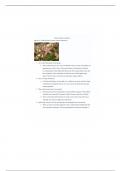
Sea Otter Case Study
1. Explain the importance of keystone species.
A keystone species is a species whose impact on its community is much larger than its total mass
or abundance indicates. The phrase keystone species originated from the wedge-shaped stone at
the top of an arch that locks the other pieces in place. If the keystone is removed, the arch
collapses. A keystone species occupies an ecological niche and asks as the center of an entire
ecological community
2. In 4-5 sentences describe the problem that the case study describes.
A man named Dr. James Estes was studying sea otters with his coworkers and they realized that
the sea otter populations in the Aleutian Islands of Alaska has been crashing since the 1990’s. On
some islands the sea otter populations declined by 90 percent in less than 10 years, this was
surprising and complexing. After the sea otter decline in 1970 due to the fur trade they had
thought that the strong recovery would continue upward. So the problem they were trying to
asses would be answering the question of what would cause such a rapid decline in sea otters?
3. Describe the habitat in which sea otters live
Sea otters live all throughout the northern Pacific Ocean. They usually habitat on coastal regions
because they collect all the food they eat from the ocean floor.
4. Describe two adaptations that allow sea otters to survive in their habitat
Since otters spend a lot of their time in the water the temperature they swim in can be as low as
-4 degrees. They have evolved their bodies to remain at a constant temperature that is higher than
that of their surroundings. They also have two layers of fur which traps the body heat they give
off.
5. Discuss mating and caring of offspring. How many pups does each female typically produce?
Sea otters group by gender. A group of males will mix with a group of females for the purpose of
mating. A male grabs a female with his front paws and flips her, belly-up, onto his belly. The
male bites the female's nose, holding onto her in this fashion. A female is pregnant for
approximately five months and gives birth to a single pup. The pup will remain with the mother,
initially nursing and later eating prey collected by the mother, until it is approximately 12 months
old.
1. Explain the importance of keystone species.
A keystone species is a species whose impact on its community is much larger than its total mass
or abundance indicates. The phrase keystone species originated from the wedge-shaped stone at
the top of an arch that locks the other pieces in place. If the keystone is removed, the arch
collapses. A keystone species occupies an ecological niche and asks as the center of an entire
ecological community
2. In 4-5 sentences describe the problem that the case study describes.
A man named Dr. James Estes was studying sea otters with his coworkers and they realized that
the sea otter populations in the Aleutian Islands of Alaska has been crashing since the 1990’s. On
some islands the sea otter populations declined by 90 percent in less than 10 years, this was
surprising and complexing. After the sea otter decline in 1970 due to the fur trade they had
thought that the strong recovery would continue upward. So the problem they were trying to
asses would be answering the question of what would cause such a rapid decline in sea otters?
3. Describe the habitat in which sea otters live
Sea otters live all throughout the northern Pacific Ocean. They usually habitat on coastal regions
because they collect all the food they eat from the ocean floor.
4. Describe two adaptations that allow sea otters to survive in their habitat
Since otters spend a lot of their time in the water the temperature they swim in can be as low as
-4 degrees. They have evolved their bodies to remain at a constant temperature that is higher than
that of their surroundings. They also have two layers of fur which traps the body heat they give
off.
5. Discuss mating and caring of offspring. How many pups does each female typically produce?
Sea otters group by gender. A group of males will mix with a group of females for the purpose of
mating. A male grabs a female with his front paws and flips her, belly-up, onto his belly. The
male bites the female's nose, holding onto her in this fashion. A female is pregnant for
approximately five months and gives birth to a single pup. The pup will remain with the mother,
initially nursing and later eating prey collected by the mother, until it is approximately 12 months
old.