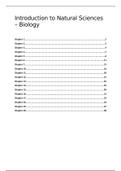
Introduction to Natural Sciences
– Biology
Chapter 1...........................................................................................................................2
Chapter 2...........................................................................................................................3
Chapter 3...........................................................................................................................4
Chapter 4...........................................................................................................................5
Chapter 5...........................................................................................................................6
Chapter 6..........................................................................................................................11
Chapter 7..........................................................................................................................13
Chapter 10........................................................................................................................16
Chapter 11........................................................................................................................18
Chapter 12........................................................................................................................21
Chapter 13........................................................................................................................25
Chapter 14........................................................................................................................29
Chapter 15........................................................................................................................30
Chapter 16........................................................................................................................31
Chapter 17........................................................................................................................33
Chapter 26........................................................................................................................34
Chapter 35........................................................................................................................37
Chapter 40........................................................................................................................38
,Chapter 1
Biology The scientific study of life
System biology The exploration of a biological system by analyzing the interactions
among it’s parts
Evolution The process of change that has formed life on earth
Cells - the smallest unit of organization that can perform all activities required for life.
Prokaryotic: cells of bacteria and archaea, single celled, lacks a nucleus and
membrane enclosed organelles, smaller than eukaryotic cells.
Eukaryotic: cells of plants and animals (all other forms of life), contain membrane
enclosed organelles
DNA (deoxyribonucleic acid)
Part of chromosomes
Made of two long chains of nucleotides (A,C,T,G) arranged in a double helix.
Contain genes (storage of genetic information)
Is replicated when the cell divides
Genes – the units of inheritance
Control protein production using mRNA for gene expression
The sequence of nucleotides in DNA is transcribed into mRNA, which is translated
into a linked series of amino acids.
Genome The genetic material of an organism
Genomics The study of sets of genes
Proteome The entire set of proteins expressed by a given cell or group of cells
Proteomics The study of sets of proteins.
Bioinformatics The use of computational tools to store, organize, and analyze a huge
volume of data in biological research.
The key of many biological processes is to self-regulate by a mechanism called feedback.
Feedback regulation The output, or product of a process regulates that very process.
Negative feedback A loop in which the response reduces the initial stimulus.
Positive feedback A loop in which the end product speeds up it’s own production.
Classification/taxonomy – the branch of biology that names and classifies species of groups
of increasing breath, based on the degree to which they share characteristics.
3 domains: Bacteria, Archea, Eukarya
3 kingdoms within the domain of Eukarya: Animals, Plants, Fungi, (Protists)
Different levels of classification: domain, kingdom, phylum, class, order, family,
genus, species
Darwinism
, Natural selection: The natural environment selects for the propagation of certain
traits among naturally occurring variant traits in the population. It favors those
variations in a population that increase relative fitness.
Adaption: Animals change to special circumstances of their way of life and their
environment.
Isolation:
Chapter 2
Organisms are composed of matter, which is anything that takes up space and has mass.
Matter is made up of elements, which is a substance that cannot be broken down to other
substances by chemical reactions. A compound is a substance consisting of two or more
different elements combined in a fixed ratio. Each element consists of a certain type of
atom, the smallest unit of matter that can be considered an element.
Essential elements Elements that organisms need to live a healthy life and reproduce.
Just 4 elements - oxygen (O), Carbon (C), hydrogen (H), and nitrogen
(N) – make up 96% of living matter.
Trace elements Required by organisms in low quantities.
Subatomic particles – what atoms are composed of
Neutrons: electrically neutral
Electrons: has one unit of negative charge
Protons: has one unit of positive charge
Protons and neutrons are packed together tightly in the positive charged atomic core
(atomic nucleus). The electrons form a cloud of negative charge around the nucleus. They
are found in different electron shells, each with a characteristic average distance and
potential energy level.
Atomic number The number of protons in the nucleus of an atom
Mass number The number of protons and neutrons in the nucleus of an atom.
Atomic mass The total mass of an atom in Dalton
Isotopes Atoms with the same number of protons (same element), but a
different number of neutrons.
Radioactive isotope An unstable isotope that will decay, give of particles and energy and
form a different element.
Half time The time it takes for 50% of the parent isotope to decay into its
daughter isotope. (not affected by any environmental variable)
Valence electrons Electrons (max 8) in de cells outermost shell, the valence shell.
Atom valence Bonding capacity of atoms
, Electronegativity The attraction of a particular atom for the valence electron of a
covalent bond. When the atom is strongly electronegative it will pull
the shared electron towards itself.
Chemical bonds – forces holding atoms/molecules together
Covalent bonds: when 2 atoms share a pair of valence electrons
Non polar: between two atoms of the same electronegativity
Polar: between two atoms of different electronegativity
Ionic bonds: complete transfer of valence electrons, generating 2 opposite charged
ions. A bond between 2 ions of opposite charge (cation + and anion -)
Hydrogen bonds: attraction between a hydrogen atom and an electronegative atom.
(oxygen and nitrogen/oxygen/fluorine)
Van der Waals bond: between transiently positive and negative regions of all
molecules.
Chemical reaction The making and breaking of chemical bonds, leading to changes of
composition of matter. Reactants products
Chemical equilibrium Occurs when a reaction is still going on, but with no effect on the
concentrations of reactants and products.
Chapter 3
When a molecule contains polar covalent bonds, it’s overall charge is unevenly distributed.
One side of the molecule has a partial negative charge (-) and the other side has a partial
positive charge(+). This molecule is called a polar molecule.
In water (H2O), the oxygen region of the molecule has a partial negative charge and each
hydrogen has a partial positive charge. The slightly positive charged hydrogen of one water
molecule is attracted to the slightly negative oxygen of another molecule. This interaction is
called a hydrogen bond.
Emergent properties of water:
Cohesive behavior – water molecules stay close as a result of hydrogen bonding
(cohesion, adhesion, surface tension)
Ability to moderate temperature – water has a high specific heat (J/g/K), which
means it will change its temperature less than other liquids when it absorbs or loses
a given amount of heat. Also, the heat of vaporization of water is high, which
means a lot of heat is needed to turn liquid water into gas.
Expansion upon freezing – water is less dense as a solid than as a liquid, so ice floats
on liquid water.
Versatility as a solvent – water is a very versatile solvent because of it’s polarity.
When an ionic compound (salt) dissolves in water, water molecules form hydration
shells around the ions.
Solution A liquid that is a completely homogenous mixture of two or more
substances.
Solvent The dissolving agent
Solute The substance that is dissolved
Aqueous solution A solution in which water is the solvent.
– Biology
Chapter 1...........................................................................................................................2
Chapter 2...........................................................................................................................3
Chapter 3...........................................................................................................................4
Chapter 4...........................................................................................................................5
Chapter 5...........................................................................................................................6
Chapter 6..........................................................................................................................11
Chapter 7..........................................................................................................................13
Chapter 10........................................................................................................................16
Chapter 11........................................................................................................................18
Chapter 12........................................................................................................................21
Chapter 13........................................................................................................................25
Chapter 14........................................................................................................................29
Chapter 15........................................................................................................................30
Chapter 16........................................................................................................................31
Chapter 17........................................................................................................................33
Chapter 26........................................................................................................................34
Chapter 35........................................................................................................................37
Chapter 40........................................................................................................................38
,Chapter 1
Biology The scientific study of life
System biology The exploration of a biological system by analyzing the interactions
among it’s parts
Evolution The process of change that has formed life on earth
Cells - the smallest unit of organization that can perform all activities required for life.
Prokaryotic: cells of bacteria and archaea, single celled, lacks a nucleus and
membrane enclosed organelles, smaller than eukaryotic cells.
Eukaryotic: cells of plants and animals (all other forms of life), contain membrane
enclosed organelles
DNA (deoxyribonucleic acid)
Part of chromosomes
Made of two long chains of nucleotides (A,C,T,G) arranged in a double helix.
Contain genes (storage of genetic information)
Is replicated when the cell divides
Genes – the units of inheritance
Control protein production using mRNA for gene expression
The sequence of nucleotides in DNA is transcribed into mRNA, which is translated
into a linked series of amino acids.
Genome The genetic material of an organism
Genomics The study of sets of genes
Proteome The entire set of proteins expressed by a given cell or group of cells
Proteomics The study of sets of proteins.
Bioinformatics The use of computational tools to store, organize, and analyze a huge
volume of data in biological research.
The key of many biological processes is to self-regulate by a mechanism called feedback.
Feedback regulation The output, or product of a process regulates that very process.
Negative feedback A loop in which the response reduces the initial stimulus.
Positive feedback A loop in which the end product speeds up it’s own production.
Classification/taxonomy – the branch of biology that names and classifies species of groups
of increasing breath, based on the degree to which they share characteristics.
3 domains: Bacteria, Archea, Eukarya
3 kingdoms within the domain of Eukarya: Animals, Plants, Fungi, (Protists)
Different levels of classification: domain, kingdom, phylum, class, order, family,
genus, species
Darwinism
, Natural selection: The natural environment selects for the propagation of certain
traits among naturally occurring variant traits in the population. It favors those
variations in a population that increase relative fitness.
Adaption: Animals change to special circumstances of their way of life and their
environment.
Isolation:
Chapter 2
Organisms are composed of matter, which is anything that takes up space and has mass.
Matter is made up of elements, which is a substance that cannot be broken down to other
substances by chemical reactions. A compound is a substance consisting of two or more
different elements combined in a fixed ratio. Each element consists of a certain type of
atom, the smallest unit of matter that can be considered an element.
Essential elements Elements that organisms need to live a healthy life and reproduce.
Just 4 elements - oxygen (O), Carbon (C), hydrogen (H), and nitrogen
(N) – make up 96% of living matter.
Trace elements Required by organisms in low quantities.
Subatomic particles – what atoms are composed of
Neutrons: electrically neutral
Electrons: has one unit of negative charge
Protons: has one unit of positive charge
Protons and neutrons are packed together tightly in the positive charged atomic core
(atomic nucleus). The electrons form a cloud of negative charge around the nucleus. They
are found in different electron shells, each with a characteristic average distance and
potential energy level.
Atomic number The number of protons in the nucleus of an atom
Mass number The number of protons and neutrons in the nucleus of an atom.
Atomic mass The total mass of an atom in Dalton
Isotopes Atoms with the same number of protons (same element), but a
different number of neutrons.
Radioactive isotope An unstable isotope that will decay, give of particles and energy and
form a different element.
Half time The time it takes for 50% of the parent isotope to decay into its
daughter isotope. (not affected by any environmental variable)
Valence electrons Electrons (max 8) in de cells outermost shell, the valence shell.
Atom valence Bonding capacity of atoms
, Electronegativity The attraction of a particular atom for the valence electron of a
covalent bond. When the atom is strongly electronegative it will pull
the shared electron towards itself.
Chemical bonds – forces holding atoms/molecules together
Covalent bonds: when 2 atoms share a pair of valence electrons
Non polar: between two atoms of the same electronegativity
Polar: between two atoms of different electronegativity
Ionic bonds: complete transfer of valence electrons, generating 2 opposite charged
ions. A bond between 2 ions of opposite charge (cation + and anion -)
Hydrogen bonds: attraction between a hydrogen atom and an electronegative atom.
(oxygen and nitrogen/oxygen/fluorine)
Van der Waals bond: between transiently positive and negative regions of all
molecules.
Chemical reaction The making and breaking of chemical bonds, leading to changes of
composition of matter. Reactants products
Chemical equilibrium Occurs when a reaction is still going on, but with no effect on the
concentrations of reactants and products.
Chapter 3
When a molecule contains polar covalent bonds, it’s overall charge is unevenly distributed.
One side of the molecule has a partial negative charge (-) and the other side has a partial
positive charge(+). This molecule is called a polar molecule.
In water (H2O), the oxygen region of the molecule has a partial negative charge and each
hydrogen has a partial positive charge. The slightly positive charged hydrogen of one water
molecule is attracted to the slightly negative oxygen of another molecule. This interaction is
called a hydrogen bond.
Emergent properties of water:
Cohesive behavior – water molecules stay close as a result of hydrogen bonding
(cohesion, adhesion, surface tension)
Ability to moderate temperature – water has a high specific heat (J/g/K), which
means it will change its temperature less than other liquids when it absorbs or loses
a given amount of heat. Also, the heat of vaporization of water is high, which
means a lot of heat is needed to turn liquid water into gas.
Expansion upon freezing – water is less dense as a solid than as a liquid, so ice floats
on liquid water.
Versatility as a solvent – water is a very versatile solvent because of it’s polarity.
When an ionic compound (salt) dissolves in water, water molecules form hydration
shells around the ions.
Solution A liquid that is a completely homogenous mixture of two or more
substances.
Solvent The dissolving agent
Solute The substance that is dissolved
Aqueous solution A solution in which water is the solvent.