

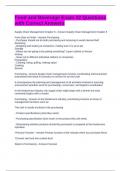
Food and Beverage Exam #2 Questions
with Correct Answers
Supply Chain Management Chapter 8 - Answer-Supply Chain Management Chapter 8
From Start to Finish - Answer-Purchasing
- Purchaser should not do both purchasing and receiving to avoid internal theft
Receiving
- Weighing and looking at containers, making sure it is up to par
Storage
- Where are we going to be putting everything? Liquor cabinet or freezer
Issuing
- Issue out to different individual stations or companies
Preparation
- Cooking, frying, grilling, making salad
Cooking
Service
Purchasing - Answer-Supply chain management involves coordinating interconnected
businesses that result in a product or service for an end user
It encompasses the planning and management of all activities involved in sourcing,
procurement (another word for purchasing), conversion, and logistics coordination
In the foodservice industry, the supply chain might begin with a farmer but most
commonly begins with a vendor
Purchasing - Answer-In the foodservice industry, purchasing involves an array of
management functions such as:
The chef is mostly involved in the purchasing
- Product specifications (what they need)
- Purchasing specification (how much of the product they will need)
- Determining whether products should be purchased or prepared at the foodservice
operation
*Primary Function - Answer-Primary function of the industry when you purchase items
*Convert raw food into cooked food
Steps to Purchasing - Answer-Forecast
,- Take this time last year and forecast to see what sales are going to be (factors could
be events that wont take place this year)
Check inventory on hand
- Check what you already have and what more you might need
Determine the amount needed to purchase
- Determine what you need to purchase based on what you already have
*Buying Methods - Answer-Informal
- Telephone, and getting quotes directly from vendor and supplier, purchase from
market, chef has to go buy item
Formal
- Getting competitive bet. Looked at fixed prices, know what you already need.
Delivered everyday or every other day. Recurring orders
Purchasing Managers - Answer-Given the sizable purchasing decisions required, the
role of the purchasing manager has grown as the foodservice industry has evolved
In large onsite foodservice companies such as ARAMARK, the purchasing function is
executed by an entire department that has specialized purchasing managers delineated
by product category
Use of rebates is becoming more and more common
Distribution Channel - Answer-The path or pipeline through which goods flow from a
vendor to the consumer
Foodservice operators use multiple channels of distribution, but the management and
profit opportunities are the same
Product Management - Answer-One of the best ways to understand distribution
channels is to explore how products move from the source to the guest-and how these
must be managed
Source
Manufacturer or Processor
Distributor
Foodservice Operation
Foodservice Guest
Product Management - Answer-In the foodservice industry, distributors do much more
than just deliver food and beverage products including:
- Free assistance with menu development
, - Money-saving alternative food products
- Furnish promotional material, nutritional information, and ingredient information
- Large distributors frequently host 'open houses' in which foodservice operators can
tour the warehouse and learn about new products
Supplier Selection - Answer-These decisions, which should be aimed at maximizing
profit by effectively managing the supply chain, cannot be made in a vacuum or on the
basis of price alone
Supplier as Partner - Answer-An emerging practice in supply chain management views
the foodservice operation-distributor relationship not simply as a business arrangement
but as a partnership
Such a partnership, like any relationship, is influenced by a variety of factors:
- Purchasing volume
- Types of items needed
- Are fresh, direct-from-the-processor, items required?
- Location
- Number of units and their locations
- Variety of foodservice operations involved
- Expertise
Suppliers and Ethics - Answer-Mutual trust is key
Ethical dilemmas abound include:
- Insider information
- Manager's personal gain
- The ethical treatment of distributors
The best approach for any foodservice manager to ensure proper ethical behavior is to
place the interest of the foodservice operation first and accept nothing that could be
viewed as a personal benefit
Buying - Answer-Foodservice operators typically weigh several options for purchasing
food and beverage items:
with Correct Answers
Supply Chain Management Chapter 8 - Answer-Supply Chain Management Chapter 8
From Start to Finish - Answer-Purchasing
- Purchaser should not do both purchasing and receiving to avoid internal theft
Receiving
- Weighing and looking at containers, making sure it is up to par
Storage
- Where are we going to be putting everything? Liquor cabinet or freezer
Issuing
- Issue out to different individual stations or companies
Preparation
- Cooking, frying, grilling, making salad
Cooking
Service
Purchasing - Answer-Supply chain management involves coordinating interconnected
businesses that result in a product or service for an end user
It encompasses the planning and management of all activities involved in sourcing,
procurement (another word for purchasing), conversion, and logistics coordination
In the foodservice industry, the supply chain might begin with a farmer but most
commonly begins with a vendor
Purchasing - Answer-In the foodservice industry, purchasing involves an array of
management functions such as:
The chef is mostly involved in the purchasing
- Product specifications (what they need)
- Purchasing specification (how much of the product they will need)
- Determining whether products should be purchased or prepared at the foodservice
operation
*Primary Function - Answer-Primary function of the industry when you purchase items
*Convert raw food into cooked food
Steps to Purchasing - Answer-Forecast
,- Take this time last year and forecast to see what sales are going to be (factors could
be events that wont take place this year)
Check inventory on hand
- Check what you already have and what more you might need
Determine the amount needed to purchase
- Determine what you need to purchase based on what you already have
*Buying Methods - Answer-Informal
- Telephone, and getting quotes directly from vendor and supplier, purchase from
market, chef has to go buy item
Formal
- Getting competitive bet. Looked at fixed prices, know what you already need.
Delivered everyday or every other day. Recurring orders
Purchasing Managers - Answer-Given the sizable purchasing decisions required, the
role of the purchasing manager has grown as the foodservice industry has evolved
In large onsite foodservice companies such as ARAMARK, the purchasing function is
executed by an entire department that has specialized purchasing managers delineated
by product category
Use of rebates is becoming more and more common
Distribution Channel - Answer-The path or pipeline through which goods flow from a
vendor to the consumer
Foodservice operators use multiple channels of distribution, but the management and
profit opportunities are the same
Product Management - Answer-One of the best ways to understand distribution
channels is to explore how products move from the source to the guest-and how these
must be managed
Source
Manufacturer or Processor
Distributor
Foodservice Operation
Foodservice Guest
Product Management - Answer-In the foodservice industry, distributors do much more
than just deliver food and beverage products including:
- Free assistance with menu development
, - Money-saving alternative food products
- Furnish promotional material, nutritional information, and ingredient information
- Large distributors frequently host 'open houses' in which foodservice operators can
tour the warehouse and learn about new products
Supplier Selection - Answer-These decisions, which should be aimed at maximizing
profit by effectively managing the supply chain, cannot be made in a vacuum or on the
basis of price alone
Supplier as Partner - Answer-An emerging practice in supply chain management views
the foodservice operation-distributor relationship not simply as a business arrangement
but as a partnership
Such a partnership, like any relationship, is influenced by a variety of factors:
- Purchasing volume
- Types of items needed
- Are fresh, direct-from-the-processor, items required?
- Location
- Number of units and their locations
- Variety of foodservice operations involved
- Expertise
Suppliers and Ethics - Answer-Mutual trust is key
Ethical dilemmas abound include:
- Insider information
- Manager's personal gain
- The ethical treatment of distributors
The best approach for any foodservice manager to ensure proper ethical behavior is to
place the interest of the foodservice operation first and accept nothing that could be
viewed as a personal benefit
Buying - Answer-Foodservice operators typically weigh several options for purchasing
food and beverage items:


