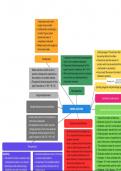
A substance reacts with
oxygen to give oxides.
Carbohydrates containing C,
H and/or O give carbon
dioxide and water if
completely combusted
Metals reacts with oxygen to
form metal oxides
Limiting reagent: The reactant that w
1 substance is broken down (decomposed) be used up before the others
Combustion Theoretical yield: the amount of
into 2 or more simpler substances.
The general chemical equation for this product which can be predicted from
type of reaction is shown as: AB → A + B stoichiometric calculations
Redox reactions in which an ion in
When salts dissociate into ions in solution, Actual yield: the amount of product
solution is displaced (or replaced) via
the reactions are called ionisation or obtained in practice
the oxidation of a metallic element.
The general chemical equation for this dissociation reactions
type of reaction is: A + BC → B + AC Limiting reagents and percentage yi
Decomposition
Single displacement
Synthesis (combination)
Double displacement (metathesis)
CHEMICAL REACTIONS Oxidation-Reduction reactions
Involves the reaction of 2 compounds to Involve the transfer of electrons.
form 2 new compounds. Reduction: A gain of 1 or more elect
Acid-base neutralisation
The elements or ions of both reactants Oxidation: a loss of 1 or more electro
change partners to form 2 new products. Reducing agent: species that is oxid
Acid-base reaction: a hydrogen ion,
The general chemical equation for this Oxidizing agent: species that is redu
H+, is transferred from one chemical
type of reaction is: AB + CD → CB + AD Oxidation number: a hypothetical ch
species to another
pairs of electrons in each bond belo
Acid: a substance that will dissolve in
Precipitation 1. The oxidation number of an atom in
water to yield hydronium ions, H3O+
2. The oxidation number of a monatom
Base: a substance that will dissolve in
Solubility: Dissolved substances react to form one 3. Oxidation numbers for common non
water to yield hydroxide ions, OH-
The extent to which a substance may (or more) solid products. Hydrogen: +1 when combined with n
Neutralisation: a chemical reaction in
be dissolved in water or any solvent Precipitates: The insoluble products Oxygen: −2 in most compounds, som
which acid and bases react
Substances with relatively large A way to produce chemicals of the called superoxides, positive values
quantitatively with one another to
Halogens: −1 for F always, −1 for oth
oxygen to give oxides.
Carbohydrates containing C,
H and/or O give carbon
dioxide and water if
completely combusted
Metals reacts with oxygen to
form metal oxides
Limiting reagent: The reactant that w
1 substance is broken down (decomposed) be used up before the others
Combustion Theoretical yield: the amount of
into 2 or more simpler substances.
The general chemical equation for this product which can be predicted from
type of reaction is shown as: AB → A + B stoichiometric calculations
Redox reactions in which an ion in
When salts dissociate into ions in solution, Actual yield: the amount of product
solution is displaced (or replaced) via
the reactions are called ionisation or obtained in practice
the oxidation of a metallic element.
The general chemical equation for this dissociation reactions
type of reaction is: A + BC → B + AC Limiting reagents and percentage yi
Decomposition
Single displacement
Synthesis (combination)
Double displacement (metathesis)
CHEMICAL REACTIONS Oxidation-Reduction reactions
Involves the reaction of 2 compounds to Involve the transfer of electrons.
form 2 new compounds. Reduction: A gain of 1 or more elect
Acid-base neutralisation
The elements or ions of both reactants Oxidation: a loss of 1 or more electro
change partners to form 2 new products. Reducing agent: species that is oxid
Acid-base reaction: a hydrogen ion,
The general chemical equation for this Oxidizing agent: species that is redu
H+, is transferred from one chemical
type of reaction is: AB + CD → CB + AD Oxidation number: a hypothetical ch
species to another
pairs of electrons in each bond belo
Acid: a substance that will dissolve in
Precipitation 1. The oxidation number of an atom in
water to yield hydronium ions, H3O+
2. The oxidation number of a monatom
Base: a substance that will dissolve in
Solubility: Dissolved substances react to form one 3. Oxidation numbers for common non
water to yield hydroxide ions, OH-
The extent to which a substance may (or more) solid products. Hydrogen: +1 when combined with n
Neutralisation: a chemical reaction in
be dissolved in water or any solvent Precipitates: The insoluble products Oxygen: −2 in most compounds, som
which acid and bases react
Substances with relatively large A way to produce chemicals of the called superoxides, positive values
quantitatively with one another to
Halogens: −1 for F always, −1 for oth