Nervous System
Stimulus - internal/external environment change to which an organism responds.
Eg. light, sound, touch, taste, temperature, chemicals.
Nervous system and endocrine system work together for communication and homeostasis in
the body, by responding to external/internal environmental change (stimuli).
Homeostasis is vital for survival of organisms (Eg. optimum temperature and oxygen levels)
When rapid response is required, impulses are conducted by nerves (Nervous Coordination)
When slower response like growth and digestion is required, hormones (chemical messengers)
are transported in blood (Chemical Coordination)
The nervous system enables a response to stimuli.
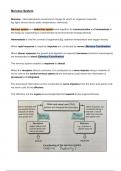
When the receptors detect a stimulus, it is conducted as a nerve impulse along a network of
nerve cells to the central nervous system (brain and spinal cord) where the information is
processed and integrated.
The processed information is then conducted as nerve impulses from the brain and spinal cord,
via nerve cells to the effectors.
The effectors are the organs (muscles/glands) that respond to the original stimulus.
,Human Nervous System
Central nervous system (CNS) consisting of the brain and spinal cord.
Peripheral nervous system (PNS) consisting of the nerves that conduct nerve impulses to and
from the brain and spinal cord. 12 pairs of cranial nerves and 31 pairs of spinal nerves.
, Central nervous system
Receives nerve impulses from the receptors, interprets the information and transmits it to the
effectors to bring about a response.
Protection of the central nervous system
Nerve cells cannot repair themselves and must be well protected against injuries.
The brain is enclosed by the skull and the spinal cord by the vertebral column.
Brain is in enveloped by three meninges (cerebral membranes)
- Pia mater: innermost membrane, tightly wrapped around brain and spinal cord, rich in blood
vessels; providing oxygen and nutrients to the CNS.
- Dura mater: tough outermost membrane that lines the skull cavity and spinal canal.
- Arachnoid membrane: thin membrane between pia and dura mater.
Between the pia mater and the arachnoid is a space filled with cerebrospinal fluid.
Functions of cerebrospinal fluid
Acts as a shock absorber.
Supplies neurons with nutrients and oxygen.
Removes waste.
Prevents dehydration of neurons.
Maintains constant pressure around the CNS.
Stimulus - internal/external environment change to which an organism responds.
Eg. light, sound, touch, taste, temperature, chemicals.
Nervous system and endocrine system work together for communication and homeostasis in
the body, by responding to external/internal environmental change (stimuli).
Homeostasis is vital for survival of organisms (Eg. optimum temperature and oxygen levels)
When rapid response is required, impulses are conducted by nerves (Nervous Coordination)
When slower response like growth and digestion is required, hormones (chemical messengers)
are transported in blood (Chemical Coordination)
The nervous system enables a response to stimuli.
When the receptors detect a stimulus, it is conducted as a nerve impulse along a network of
nerve cells to the central nervous system (brain and spinal cord) where the information is
processed and integrated.
The processed information is then conducted as nerve impulses from the brain and spinal cord,
via nerve cells to the effectors.
The effectors are the organs (muscles/glands) that respond to the original stimulus.
,Human Nervous System
Central nervous system (CNS) consisting of the brain and spinal cord.
Peripheral nervous system (PNS) consisting of the nerves that conduct nerve impulses to and
from the brain and spinal cord. 12 pairs of cranial nerves and 31 pairs of spinal nerves.
, Central nervous system
Receives nerve impulses from the receptors, interprets the information and transmits it to the
effectors to bring about a response.
Protection of the central nervous system
Nerve cells cannot repair themselves and must be well protected against injuries.
The brain is enclosed by the skull and the spinal cord by the vertebral column.
Brain is in enveloped by three meninges (cerebral membranes)
- Pia mater: innermost membrane, tightly wrapped around brain and spinal cord, rich in blood
vessels; providing oxygen and nutrients to the CNS.
- Dura mater: tough outermost membrane that lines the skull cavity and spinal canal.
- Arachnoid membrane: thin membrane between pia and dura mater.
Between the pia mater and the arachnoid is a space filled with cerebrospinal fluid.
Functions of cerebrospinal fluid
Acts as a shock absorber.
Supplies neurons with nutrients and oxygen.
Removes waste.
Prevents dehydration of neurons.
Maintains constant pressure around the CNS.