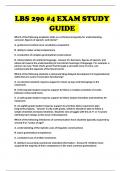
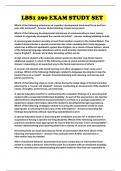
LBS 290 #4 EXAM STUDY
GUIDE
Which of the following academic skills is a critical prerequisite for understanding
sarcasm, figures of speech, and idoms?
A. grade-level content-area vocabulary acquisition
B. ability to make verbal comparisons
C. production of complex grammatical constructions
D. interpretation of nonliteral language - Answer D.) Sarcasm, figures of speech, and
idioms all require the understanding of non-literal meanings of language. For example, a
person can say,"Yeah, that's great,"but through a sarcastic tone of voice, can
communicate the opposite of the literal words.
Which of the following students is demonstrating delayed development of organizational
skills that are a part of executive functioning?
A. A preschool student requires support to clean up toys and belongings in the
classroom.
B. A third-grade student requires support to follow a complex schedule of events
between school and home.
C. A sixth-grade student requires support to follow simple checklists and timelines for
classwork.
D. An eighth-grade student requires support to prioritize tasks required to plan
long-term projects. - Answer C.) By sixth grade, children should be able to follow a
simple checklist and basic timelines. Students who struggle with this at 11 or 12 years
old likely have delays in this area of development.
Which of the following milestones of communication have students typically acquired by
around 6 to 7 years of age?
A. understanding of the stylistic uses of linguistic constructions
B. basic grammatical competence
C. consistent use of written mechanics
D. ability to accurately summarize extended information - Answer B. Children have
acquired the majority of their competence in the most common grammatical
, constructions in their language by the time they reach six to seven years old; however
finer nuances of style, mechanics, and more complex uses of language take greater
cognitive development.
During an observation of a student's motor skills, a teacher notes that a six-year-old
student can kick a ball from standing, can jump with both feet, but is not yet able to hop
on one foot and cannot maintain balance on one foot. Which of the following statements
best describes this student's development?
A. The student is demonstrating delays in fine-motor developmental milestones.
B. The student is demonstrating expected milestones of fine-motor skill development.
C. The student is demonstrating delays in gross-motor developmental milestones
D. The student is demonstrating expected milestones of gross-motor skill development. -
Answer C.) Hopping on one foot and maintaining balance on one foot are gross motor
skills that are typically acquired by the age of three to four years old, so a child who
cannot do these actions at six is demonstrating delays.
Which of the following social-emotional skills typically develops within the first six
months of infancy?
A. demonstrating simple pretend play
B. smiling and crying to show feelings
C. showing clear preference for certain toys.
D. pointing to show desire for something - Answer B. Babies can smile when happy and
cry to show displeasure or discomfort by three to six months of age; these are among
the earliest social-emotional skills that develop.
According to Piaget's theories regarding child development, which of the following
developmental changes typically happens between seven to eleven years of age?
A. Children acquire the ability to apply moral and ethical reasoning to situations.
B. Children show the development of abstract thought.
C. Children can reason about hypothetical issues.
D. Children begin to think logically about concrete events. - Answer D. The third stage in
Piaget's theory of cognitive development is the concrete operational stage that occurs
between seven to eleven years of age. It is characterized by children developing
organized and rational thinking before they extend thinking to more abstract and
advanced cognitive skills.
A nine-year-old student wears long-sleeved shirts regardless of the temperature and
requires tags to be removed from inside clothing. The student also eats primarily soft
GUIDE
Which of the following academic skills is a critical prerequisite for understanding
sarcasm, figures of speech, and idoms?
A. grade-level content-area vocabulary acquisition
B. ability to make verbal comparisons
C. production of complex grammatical constructions
D. interpretation of nonliteral language - Answer D.) Sarcasm, figures of speech, and
idioms all require the understanding of non-literal meanings of language. For example, a
person can say,"Yeah, that's great,"but through a sarcastic tone of voice, can
communicate the opposite of the literal words.
Which of the following students is demonstrating delayed development of organizational
skills that are a part of executive functioning?
A. A preschool student requires support to clean up toys and belongings in the
classroom.
B. A third-grade student requires support to follow a complex schedule of events
between school and home.
C. A sixth-grade student requires support to follow simple checklists and timelines for
classwork.
D. An eighth-grade student requires support to prioritize tasks required to plan
long-term projects. - Answer C.) By sixth grade, children should be able to follow a
simple checklist and basic timelines. Students who struggle with this at 11 or 12 years
old likely have delays in this area of development.
Which of the following milestones of communication have students typically acquired by
around 6 to 7 years of age?
A. understanding of the stylistic uses of linguistic constructions
B. basic grammatical competence
C. consistent use of written mechanics
D. ability to accurately summarize extended information - Answer B. Children have
acquired the majority of their competence in the most common grammatical
, constructions in their language by the time they reach six to seven years old; however
finer nuances of style, mechanics, and more complex uses of language take greater
cognitive development.
During an observation of a student's motor skills, a teacher notes that a six-year-old
student can kick a ball from standing, can jump with both feet, but is not yet able to hop
on one foot and cannot maintain balance on one foot. Which of the following statements
best describes this student's development?
A. The student is demonstrating delays in fine-motor developmental milestones.
B. The student is demonstrating expected milestones of fine-motor skill development.
C. The student is demonstrating delays in gross-motor developmental milestones
D. The student is demonstrating expected milestones of gross-motor skill development. -
Answer C.) Hopping on one foot and maintaining balance on one foot are gross motor
skills that are typically acquired by the age of three to four years old, so a child who
cannot do these actions at six is demonstrating delays.
Which of the following social-emotional skills typically develops within the first six
months of infancy?
A. demonstrating simple pretend play
B. smiling and crying to show feelings
C. showing clear preference for certain toys.
D. pointing to show desire for something - Answer B. Babies can smile when happy and
cry to show displeasure or discomfort by three to six months of age; these are among
the earliest social-emotional skills that develop.
According to Piaget's theories regarding child development, which of the following
developmental changes typically happens between seven to eleven years of age?
A. Children acquire the ability to apply moral and ethical reasoning to situations.
B. Children show the development of abstract thought.
C. Children can reason about hypothetical issues.
D. Children begin to think logically about concrete events. - Answer D. The third stage in
Piaget's theory of cognitive development is the concrete operational stage that occurs
between seven to eleven years of age. It is characterized by children developing
organized and rational thinking before they extend thinking to more abstract and
advanced cognitive skills.
A nine-year-old student wears long-sleeved shirts regardless of the temperature and
requires tags to be removed from inside clothing. The student also eats primarily soft