MSIS 3223 Exam 3 T/F CORRECT 100%
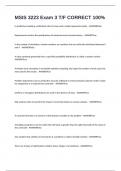
In predictive modeling, verification refers to how well a model represents reality. - ANSWERFalse
Requirements involve the specifications of minimum levels of performance. - ANSWERTrue
In the context of simulation, random numbers are numbers that are uniformly distributed between 0
and 9. - ANSWERFalse
A value randomly generated from a specified probability distribution is called a random variate. -
ANSWERTrue
As Monte Carlo simulation is essentially statistical sampling, the larger the number of trials used, the
more precise the results. - ANSWERTrue
Problem statements such as production must be sufficient to meet promised customer orders would
be categorized as a requirement constraint. - ANSWERTrue
Uniform or triangular distributions are used in the absence of data. - ANSWERTrue
Risk analysis seeks to examine the impact of uncertain inputs on various outputs. - ANSWERTrue
A constraint function is a function of the decision variables in the problem - ANSWERTrue
A binding constraint is one for which the Cell Value is greater than the right-hand side of the value of
the constraint - ANSWERFalse
Any solution that satisfies all constraints of a problem is called a feasible solution - ANSWERTrue
There are 3 types of optimisation models: linear, integer, and nonlinear - ANSWERTrue
In predictive modeling, verification refers to how well a model represents reality. - ANSWERFalse
Requirements involve the specifications of minimum levels of performance. - ANSWERTrue
In the context of simulation, random numbers are numbers that are uniformly distributed between 0
and 9. - ANSWERFalse
A value randomly generated from a specified probability distribution is called a random variate. -
ANSWERTrue
As Monte Carlo simulation is essentially statistical sampling, the larger the number of trials used, the
more precise the results. - ANSWERTrue
Problem statements such as production must be sufficient to meet promised customer orders would
be categorized as a requirement constraint. - ANSWERTrue
Uniform or triangular distributions are used in the absence of data. - ANSWERTrue
Risk analysis seeks to examine the impact of uncertain inputs on various outputs. - ANSWERTrue
A constraint function is a function of the decision variables in the problem - ANSWERTrue
A binding constraint is one for which the Cell Value is greater than the right-hand side of the value of
the constraint - ANSWERFalse
Any solution that satisfies all constraints of a problem is called a feasible solution - ANSWERTrue
There are 3 types of optimisation models: linear, integer, and nonlinear - ANSWERTrue