Respiration summary notes
22 June 2023 09:28
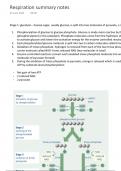
Stage 1: glycolysis - hexose sugar, usually glucose, is split into two molecules of pyruvate, a 3
1. Phosphorylation of glucose to glucose phosphate. Glucose is made more reactive by th
(phosphorylation) in the cytoplasm. Phosphate molecules come from the hydrolysis of
to activate glucose and lowers the activation energy for the enzyme controlled reactio
2. Each phosphorylated glucose molecule is split into two 3-carbon molecules called trios
3. Oxidation of triose phosphate- hydrogen is removed from each of the two triose phosp
carrier molecule called NAD- forms reduced NAD (two molecules in total)
4. Enzyme controlled reactions convert each oxidated triose phosphate molecule into an
molecules of pyruvate formed).
5. During the oxidation of triose phosphate to pyruvate, energy is released which is used
ATP by substrate level phosphorylation
- Net gain of two ATP
- 2 reduced NAD
- 2 pyruvate
22 June 2023 09:28
Stage 1: glycolysis - hexose sugar, usually glucose, is split into two molecules of pyruvate, a 3
1. Phosphorylation of glucose to glucose phosphate. Glucose is made more reactive by th
(phosphorylation) in the cytoplasm. Phosphate molecules come from the hydrolysis of
to activate glucose and lowers the activation energy for the enzyme controlled reactio
2. Each phosphorylated glucose molecule is split into two 3-carbon molecules called trios
3. Oxidation of triose phosphate- hydrogen is removed from each of the two triose phosp
carrier molecule called NAD- forms reduced NAD (two molecules in total)
4. Enzyme controlled reactions convert each oxidated triose phosphate molecule into an
molecules of pyruvate formed).
5. During the oxidation of triose phosphate to pyruvate, energy is released which is used
ATP by substrate level phosphorylation
- Net gain of two ATP
- 2 reduced NAD
- 2 pyruvate