

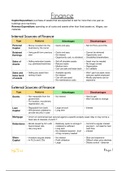
Finance
Capital Expenditure: purchase of assets that are expected to last for more than one year ex.
buildings and machinery
Revenue Expenditure: spending on all costs and assets other than fixed assets ex. Wages, raw
materials
Internal Sources of Finance
Type Features Advantages Disadvantages
Personal • Money invested into the • Quick and easy • Not for PLCs and LTDs
Capital business by the owner
Retained • Using profit form previous • Quick and easy • Cannot be retrieved
Earnings year • No interest • Opportunity cost
• Opportunity cost: no dividend • Unsatisfied shareholders
Sales of • Selling redundant assets • Sell off obsolete assets • Asset may be needed
Assets e.g. premises/machinery • Reduce waste • No longer owned
• Medium term • Depreciation
• Can use sale and lease back • Is it sellable
Sales and • Selling any asset then • Available quickly • Won’t get true asset value -
lease back renting it back • No interest reduces capital employed
of assets • Can still use asset • Mostly payments can be
• No maintenance costs expensive
External Sources of Finance
Type Features Advantages Disadvantages
Grants • Non repayable from the • No interest • Hard to get
government • Won’t be able to change
• For location, recruitment,
regeneration, etc.
Loan • Repayable from bank • Large amount • Interest
Capital • Will demand collateral to • Long term
provide security in case
Mortgage • A form of commercial loan secured against a specific property asset. May or may not be a
fixed rate of interests. A and D ↑
Debentures • Bonds issued by firm with • Relatively quick to arrange if • Commit to regular interest
fixed interest rate collateral is sufficient payment - not ideal for bad
• Very long term • Long term cash flow
• No collateral required - trust • interest
of big company needed
Share • Investors acquire shares • No interest • Slow and expensive
Capital • In PLCs and LTDs • Profit utilisation • Difficult when price declines
• Large • Dilutes control - takeover
SxTeri Page 1
Capital Expenditure: purchase of assets that are expected to last for more than one year ex.
buildings and machinery
Revenue Expenditure: spending on all costs and assets other than fixed assets ex. Wages, raw
materials
Internal Sources of Finance
Type Features Advantages Disadvantages
Personal • Money invested into the • Quick and easy • Not for PLCs and LTDs
Capital business by the owner
Retained • Using profit form previous • Quick and easy • Cannot be retrieved
Earnings year • No interest • Opportunity cost
• Opportunity cost: no dividend • Unsatisfied shareholders
Sales of • Selling redundant assets • Sell off obsolete assets • Asset may be needed
Assets e.g. premises/machinery • Reduce waste • No longer owned
• Medium term • Depreciation
• Can use sale and lease back • Is it sellable
Sales and • Selling any asset then • Available quickly • Won’t get true asset value -
lease back renting it back • No interest reduces capital employed
of assets • Can still use asset • Mostly payments can be
• No maintenance costs expensive
External Sources of Finance
Type Features Advantages Disadvantages
Grants • Non repayable from the • No interest • Hard to get
government • Won’t be able to change
• For location, recruitment,
regeneration, etc.
Loan • Repayable from bank • Large amount • Interest
Capital • Will demand collateral to • Long term
provide security in case
Mortgage • A form of commercial loan secured against a specific property asset. May or may not be a
fixed rate of interests. A and D ↑
Debentures • Bonds issued by firm with • Relatively quick to arrange if • Commit to regular interest
fixed interest rate collateral is sufficient payment - not ideal for bad
• Very long term • Long term cash flow
• No collateral required - trust • interest
of big company needed
Share • Investors acquire shares • No interest • Slow and expensive
Capital • In PLCs and LTDs • Profit utilisation • Difficult when price declines
• Large • Dilutes control - takeover
SxTeri Page 1


