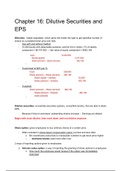
Chapter 16: Dilutive Securities and
EPS
Warrants: traded separately, which gives the holder the right to get specified number of
shares at a predetermined price and date.
- Use with and without method
- 10,000 bonds with detachable warrants, sold for $10.2 million. FC of liability
component = $9,707,852 → fair value of equity component = $492,148
-
- If exercised at $25 (par 5)
-
- If expired:
-
Dilutive securities: convertible securities (options, convertible bonds), that are able to dilute
EPS
- Because if they’re exercised, outstanding shares increase Earnings are diluted
Begin with most dilutive, then work down until not dilutive anymore
Share option: gives employees to buy ordinary shares at a certain price
- Often included in share-based compensation plans, but less and less often
o B/c incentivizes executives to manipulate numbers to get stock price higher
o restricted shares used more often now
2 ways of reporting options given to employees:
1. Intrinsic-value option: a way of reporting the granting of share options to employees
o How much the employee would receive if the option was immediately
exercised
, o Difference between share price and exercise price (usually 0)
2. Fair value method: use option-pricing methods to value the options at date of grant
a. This is the most used / required way
Accounting for Share Compensation:
- Fair value method: calculate total compensation expense using option-pricing
methods
- Allocating expense: allocate the expense in the service period (period between
granting and vesting)
Share compensation example: CEO gets options to buy 2,000 shares ($100 par) on Jan 1
2015, option share price is $6000, current market price is $7000 option-valuation gives
total worth of $22m. Expected period of benefit is 2 years.
- First Entries
o No entry at grant date
o
o (B/c expected period = 2 years divide the expense over the 2 years
- Exercise:if 2,000 of the 10,000 (20%) shares are exercised
o → 20% of the total compensation cost is subtracted from premium
o
o New shares created, but not entered at fair value
- Expiration:if options expire without being exercised
o
o If not exercised: the expenses do NOT change
- Adjustment: can compensation (determined at granting) be changed in the future?
o Service condition: if employee is required to complete a period of service
(until vested) to get the option then company CAN adjust compensation
▪ If CEO leaves after a year: reverse first compensation
, ▪
▪ If executive leaves, and 2000 of 10000 share options are forfeited →
only reverse 20% of the initial entry
● → rest of the years, the entries for expenses will only be 80%
o Market condition: if vesting of option depends on market conditions (e.g.
price) NOT allowed to change compensation (because market conditions
are already reflected in the fair value of option)
Restricted Shares: employee gets shares, but cannot be sold until vesting occurs
- Has entry at grant
- Restricted shares never become completely worthless (unlike an option)
- Result in less dilution to existing shareholders
o Because usually fewer restricted shares are given than options would have
been
- Better aligns employee interest with company interest
Restricted shares example: 1000 restricted shares given, FV is $20, service period is 5
yrs, $1 par
- On grant date:
o
o Unearned compensation is NOT an asset contra equity account
- At the end of each of the 5 years:
o
- What if employee leaves before vesting? reverse all recorded compensation
expense & reverse the shares granted
o
Employee Share-Purchase Plans: employees can buy shares at discounted price, as part
of compensation
- discount should be considered an expense
- Example: market price is $30, employees can buy for $24 expense difference
, -
Earnings Per Share
Earnings per share: income earned by each ordinary share
- If company has discontinued operations loss or gain from discontinued operations
must be shown per share
o E.g.
o
Simple capital structure: consists only of ordinary shares & no shares that can dilute NI per
ord. share
Complex capital structure: if it includes securities that possibly convert into ordinary shares
which would dilute earnings.
- If preference shares cumulative, even if company does not declare dividend, you
should subtract the dividend that normally would be paid out
- Calculating weighted average shares outstanding:
o
- Weighted average shares outstanding with share dividends / stock splits:
o The extra shares will count as if they were there for the entire period up
until that point
EPS
Warrants: traded separately, which gives the holder the right to get specified number of
shares at a predetermined price and date.
- Use with and without method
- 10,000 bonds with detachable warrants, sold for $10.2 million. FC of liability
component = $9,707,852 → fair value of equity component = $492,148
-
- If exercised at $25 (par 5)
-
- If expired:
-
Dilutive securities: convertible securities (options, convertible bonds), that are able to dilute
EPS
- Because if they’re exercised, outstanding shares increase Earnings are diluted
Begin with most dilutive, then work down until not dilutive anymore
Share option: gives employees to buy ordinary shares at a certain price
- Often included in share-based compensation plans, but less and less often
o B/c incentivizes executives to manipulate numbers to get stock price higher
o restricted shares used more often now
2 ways of reporting options given to employees:
1. Intrinsic-value option: a way of reporting the granting of share options to employees
o How much the employee would receive if the option was immediately
exercised
, o Difference between share price and exercise price (usually 0)
2. Fair value method: use option-pricing methods to value the options at date of grant
a. This is the most used / required way
Accounting for Share Compensation:
- Fair value method: calculate total compensation expense using option-pricing
methods
- Allocating expense: allocate the expense in the service period (period between
granting and vesting)
Share compensation example: CEO gets options to buy 2,000 shares ($100 par) on Jan 1
2015, option share price is $6000, current market price is $7000 option-valuation gives
total worth of $22m. Expected period of benefit is 2 years.
- First Entries
o No entry at grant date
o
o (B/c expected period = 2 years divide the expense over the 2 years
- Exercise:if 2,000 of the 10,000 (20%) shares are exercised
o → 20% of the total compensation cost is subtracted from premium
o
o New shares created, but not entered at fair value
- Expiration:if options expire without being exercised
o
o If not exercised: the expenses do NOT change
- Adjustment: can compensation (determined at granting) be changed in the future?
o Service condition: if employee is required to complete a period of service
(until vested) to get the option then company CAN adjust compensation
▪ If CEO leaves after a year: reverse first compensation
, ▪
▪ If executive leaves, and 2000 of 10000 share options are forfeited →
only reverse 20% of the initial entry
● → rest of the years, the entries for expenses will only be 80%
o Market condition: if vesting of option depends on market conditions (e.g.
price) NOT allowed to change compensation (because market conditions
are already reflected in the fair value of option)
Restricted Shares: employee gets shares, but cannot be sold until vesting occurs
- Has entry at grant
- Restricted shares never become completely worthless (unlike an option)
- Result in less dilution to existing shareholders
o Because usually fewer restricted shares are given than options would have
been
- Better aligns employee interest with company interest
Restricted shares example: 1000 restricted shares given, FV is $20, service period is 5
yrs, $1 par
- On grant date:
o
o Unearned compensation is NOT an asset contra equity account
- At the end of each of the 5 years:
o
- What if employee leaves before vesting? reverse all recorded compensation
expense & reverse the shares granted
o
Employee Share-Purchase Plans: employees can buy shares at discounted price, as part
of compensation
- discount should be considered an expense
- Example: market price is $30, employees can buy for $24 expense difference
, -
Earnings Per Share
Earnings per share: income earned by each ordinary share
- If company has discontinued operations loss or gain from discontinued operations
must be shown per share
o E.g.
o
Simple capital structure: consists only of ordinary shares & no shares that can dilute NI per
ord. share
Complex capital structure: if it includes securities that possibly convert into ordinary shares
which would dilute earnings.
- If preference shares cumulative, even if company does not declare dividend, you
should subtract the dividend that normally would be paid out
- Calculating weighted average shares outstanding:
o
- Weighted average shares outstanding with share dividends / stock splits:
o The extra shares will count as if they were there for the entire period up
until that point