Week 9 -Finance and Accounting
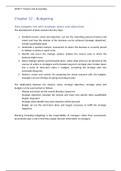
Chapter 12 – Budgeting
How budgets link with strategic plans and objectives
The development of plans involves five key steps:
1. Establish mission, vision and objectives: set out the overriding purpose (mission and
vision) and how the mission of the business can be achieved (strategic objectives),
include quantifiable goals
2. Undertake a position analysis: assessment of where the business is currently placed
in relation to where it wants to be
3. Identify and assess the strategic options: Explore the various ways in which the
business might move
4. Select strategic options and formulate plans: select what seems to be the best of the
courses of action or strategies and formulate long-term strategic plan, broken down
into a series of short-term plans (= budget), converting the strategic plan into
actionable blueprints
5. Perform, review and control: By comparing the actual outcome with the budgets,
managers can see if things are going according to plan
The relationship between the mission, vision, strategic objectives, strategic plans and
budgets can be summarized as follows:
- Mission and vision set the overall direction; long-term
- Strategic objectives translate the mission and vision into specific often quantifiable
targets; long-term
- Strategic plans identify how each objective will be pursued
- Budget set out the short-term plans and targets necessary to fulfill the strategic
objectives
Planning (including budgeting) is the responsibility of managers rather than accountants;
accountants play a role in that they supply relevant information to managers
Chapter 12 – Budgeting
How budgets link with strategic plans and objectives
The development of plans involves five key steps:
1. Establish mission, vision and objectives: set out the overriding purpose (mission and
vision) and how the mission of the business can be achieved (strategic objectives),
include quantifiable goals
2. Undertake a position analysis: assessment of where the business is currently placed
in relation to where it wants to be
3. Identify and assess the strategic options: Explore the various ways in which the
business might move
4. Select strategic options and formulate plans: select what seems to be the best of the
courses of action or strategies and formulate long-term strategic plan, broken down
into a series of short-term plans (= budget), converting the strategic plan into
actionable blueprints
5. Perform, review and control: By comparing the actual outcome with the budgets,
managers can see if things are going according to plan
The relationship between the mission, vision, strategic objectives, strategic plans and
budgets can be summarized as follows:
- Mission and vision set the overall direction; long-term
- Strategic objectives translate the mission and vision into specific often quantifiable
targets; long-term
- Strategic plans identify how each objective will be pursued
- Budget set out the short-term plans and targets necessary to fulfill the strategic
objectives
Planning (including budgeting) is the responsibility of managers rather than accountants;
accountants play a role in that they supply relevant information to managers