Week 4 – Accounting and Finance
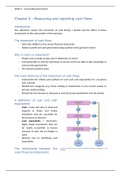
Chapter 6 – Measuring and reporting cash flows
Introduction
The statement reports the tovements of cash during a period and the effect of these
movements on the cash position of the business.
The statement of cash flows
- Fairly late addition to the annual financial statements
- Added as profit and cash generated during a period rarely go hand in hand
Why is cash so important?
- People only normally accept cash in settlement of claims
- Cash generation is vital for businesses to survive and to be able to take advantage of
commercial opportunities
- Pre-eminent business asset
The main features of the statement of cash flows
- Summarizes the inflows and outflows of cash (and cash equivalents) for a business
over a period
- Divided into categories (e.g. those relating to investments in non-current assets) to
aid user understanding
- Reveals the net increase or decrease in cash (and cash equivalents) over the period
A definition of cash and cash
equivalents
- Cash = notes and coins in hand and
deposits in banks and similar
institutions that are accessible for
the business on demand
- Cash equivalents = short-term,
highly liquid investments that can
be readily convertible to known
amounts of cash; risk of changes in
value
- Decision char for identifying cash
equivalents:
The relationship between the
main financial statements
Chapter 6 – Measuring and reporting cash flows
Introduction
The statement reports the tovements of cash during a period and the effect of these
movements on the cash position of the business.
The statement of cash flows
- Fairly late addition to the annual financial statements
- Added as profit and cash generated during a period rarely go hand in hand
Why is cash so important?
- People only normally accept cash in settlement of claims
- Cash generation is vital for businesses to survive and to be able to take advantage of
commercial opportunities
- Pre-eminent business asset
The main features of the statement of cash flows
- Summarizes the inflows and outflows of cash (and cash equivalents) for a business
over a period
- Divided into categories (e.g. those relating to investments in non-current assets) to
aid user understanding
- Reveals the net increase or decrease in cash (and cash equivalents) over the period
A definition of cash and cash
equivalents
- Cash = notes and coins in hand and
deposits in banks and similar
institutions that are accessible for
the business on demand
- Cash equivalents = short-term,
highly liquid investments that can
be readily convertible to known
amounts of cash; risk of changes in
value
- Decision char for identifying cash
equivalents:
The relationship between the
main financial statements