Week 7 – Accounting and Finance
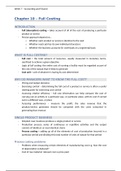
Chapter 10 – Full Costing
INTRODUCTION
- Full (absorption) costing = takes account of all of the cost of producing a particular
product or service
- Precise approach depend on…
o Whether each product or service is identical to the next
o Whether reach job has its own individual characters
o Whether the business accounts for overheads on a segmental basis
WHAT IS FULL COSTING?
- Full cost = the total amount of resources, usually measured in monetary terms,
sacrificed to achieve a given objective
- Logic of full costing: the entire cost of running a facility must be regarded as part of
the cost of the output that it helps to generate
- Cost unit = unit of whatever is having its cost determined
WHY DO MANAGERS WANT TO KNOW THE FULL COST?
- Pricing and output decisions
- Exercising control – determining the full cost of a product or service is often a useful
starting point for exercising cost control
- Assessing relative efficiency – full cost information can help compare the cost of
carrying out an activity in a particular way, or particular place, with its cost if carried
out in a different way, or place
- Assessing performance – measure the profit, the sales revenue that the
product/service generates should be compared with the costs consumed in
generating that revenue
SINGLE-PRODUCT BUSINESS
- Simplest case; business produces a single product or service
- Production process: series of continuous or repetitive activities and the output
consists of identical, or near identical, items
- Process costing = adding up all of the elements of cost of production incurred in a
particular period and dividing this total number of units of output for that period
Process-costing problems
- Problems when measuring certain elements of manufacturing cost e.g. how the cost
of depreciation is deduced?
- Cost of raw material; relevant cost vs price paid
Chapter 10 – Full Costing
INTRODUCTION
- Full (absorption) costing = takes account of all of the cost of producing a particular
product or service
- Precise approach depend on…
o Whether each product or service is identical to the next
o Whether reach job has its own individual characters
o Whether the business accounts for overheads on a segmental basis
WHAT IS FULL COSTING?
- Full cost = the total amount of resources, usually measured in monetary terms,
sacrificed to achieve a given objective
- Logic of full costing: the entire cost of running a facility must be regarded as part of
the cost of the output that it helps to generate
- Cost unit = unit of whatever is having its cost determined
WHY DO MANAGERS WANT TO KNOW THE FULL COST?
- Pricing and output decisions
- Exercising control – determining the full cost of a product or service is often a useful
starting point for exercising cost control
- Assessing relative efficiency – full cost information can help compare the cost of
carrying out an activity in a particular way, or particular place, with its cost if carried
out in a different way, or place
- Assessing performance – measure the profit, the sales revenue that the
product/service generates should be compared with the costs consumed in
generating that revenue
SINGLE-PRODUCT BUSINESS
- Simplest case; business produces a single product or service
- Production process: series of continuous or repetitive activities and the output
consists of identical, or near identical, items
- Process costing = adding up all of the elements of cost of production incurred in a
particular period and dividing this total number of units of output for that period
Process-costing problems
- Problems when measuring certain elements of manufacturing cost e.g. how the cost
of depreciation is deduced?
- Cost of raw material; relevant cost vs price paid