1|Page | © copyright 2024/2025 | Grade A+
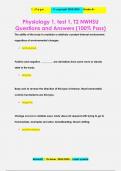
Physiology 1, test 1, T2 NWHSU
Questions and Answers (100% Pass)
The ability of the body to maintain a relatively constant internal environment,
regardless of environmental changes.
✓ homeostasis
Positive and negative __________ are deviations from some norm or steady
state in the body.
✓ stressors
Body acts to reverse the direction of this type of stressor. Most homeostatic
control mechanisms are this type.
✓ negative
Change occurs in variable ways, body does not respond with trying to go to
homeostasis, examples are labor, breastfeeding, blood clotting.
✓ positive stressor
Master01 | October, 2024/2025 | Latest update
, 1|Page | © copyright 2024/2025 | Grade A+
If the external sressors produce dramatic changes in the cell's environment
that make it impossible for the cell to maintain homeostasis, it may result in
_________.
✓ pathology
If a cell is unable to maintain its original homeostatic state, it must draw upon
reserves and adapt to the new environment. What is this called?
✓ cellular adaptation
Cell proliferation/dividing of same cell.
✓ hyperplasia
Increase in size of the cell, occurs due to a normal stressor (physiologic) or
abnormal (pathologic).
✓ hypertrophy
Decrease in size of the cell.
✓ atrophy
Reversible change from one type of cell to another.
Master01 | October, 2024/2025 | Latest update
, 1|Page | © copyright 2024/2025 | Grade A+
✓ metaplasia
When the integrity of the cell is challenged they can respond by ________ or
decline towards dysfunction.
✓ adaption
What are the three main areas of homeostatic imbalance in the body?
✓ glucose metabolism, stress response, thermoregulation
Both adults and infants have ________% of their body mass made of water.
✓ 70%
________, older adults, and _________ individuals have a lower proportion of
water in their bodies.
✓ females, obese
What are the three types of extracellular fluid?
✓ interstitial or intercellular fluid, plasma, CSF
Master01 | October, 2024/2025 | Latest update
Physiology 1, test 1, T2 NWHSU
Questions and Answers (100% Pass)
The ability of the body to maintain a relatively constant internal environment,
regardless of environmental changes.
✓ homeostasis
Positive and negative __________ are deviations from some norm or steady
state in the body.
✓ stressors
Body acts to reverse the direction of this type of stressor. Most homeostatic
control mechanisms are this type.
✓ negative
Change occurs in variable ways, body does not respond with trying to go to
homeostasis, examples are labor, breastfeeding, blood clotting.
✓ positive stressor
Master01 | October, 2024/2025 | Latest update
, 1|Page | © copyright 2024/2025 | Grade A+
If the external sressors produce dramatic changes in the cell's environment
that make it impossible for the cell to maintain homeostasis, it may result in
_________.
✓ pathology
If a cell is unable to maintain its original homeostatic state, it must draw upon
reserves and adapt to the new environment. What is this called?
✓ cellular adaptation
Cell proliferation/dividing of same cell.
✓ hyperplasia
Increase in size of the cell, occurs due to a normal stressor (physiologic) or
abnormal (pathologic).
✓ hypertrophy
Decrease in size of the cell.
✓ atrophy
Reversible change from one type of cell to another.
Master01 | October, 2024/2025 | Latest update
, 1|Page | © copyright 2024/2025 | Grade A+
✓ metaplasia
When the integrity of the cell is challenged they can respond by ________ or
decline towards dysfunction.
✓ adaption
What are the three main areas of homeostatic imbalance in the body?
✓ glucose metabolism, stress response, thermoregulation
Both adults and infants have ________% of their body mass made of water.
✓ 70%
________, older adults, and _________ individuals have a lower proportion of
water in their bodies.
✓ females, obese
What are the three types of extracellular fluid?
✓ interstitial or intercellular fluid, plasma, CSF
Master01 | October, 2024/2025 | Latest update