L8: APOPTOSIS [10/10/2022]
I. MOLECULAR PLAYER IN APOPTOSIS
Caspases: proteolytic enzymes mediate apoptosis by triggering cell death by cleaving specific
proteins in the cytoplasm and nucleus.
- It exists in all cells as inactive precursors or procaspases which are usually activated by
cleavage by other caspases, producing a proteolytic caspase cascade
II. EXTERNAL SIGNALS
Also known as “death receptors”
Detect presence of extracellular death signals and, in
response, rapidly ignite the cell’s intrinsic apoptotic
machinery
Death receptors initiate apoptosis independent of p53
There are 30 members in total:
- Cysteine rich extracellular domains
- Cytoplasmic “death domain” (DD)
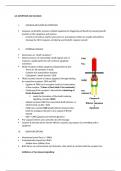
TRAIL has been shown to induce apoptosis through binding
its respective receptors, DR4 and DR5
- Ligation of TRAIL to its receptor results in trimerization
of the receptor [ Trimer of FasL binds 3 Fas molecules]
- Clustering of the receptor’s intracellular [clustering of
Death Domains DD]
Leads the formation of the death-inducing
signalling complex (DISC)
- Adapter protein FADD (Fas associated death domain, or
Mort1) binds via DD = DISC
- FADD also contains DED (death effector domain) that
binds to analogous domain in pro-caspase 8 (FLICE,
MACH)
- DED = CARD (caspase recruitment domain)
Pro-caspase 8 drives own activation by self-cleavage
Caspase 8 activates down-stream effector caspases (eg caspase 3) committing cell to
apoptosis
III. DEATH RECEPTORS
Membrane bound FasL is ~39kDa
Proteolytically cleaved by MMPs
- Soluble form (26kDa) sFasL
Both forms can self-associate and trimerize, after which it can bind with the receptor Fas
Inhibitors of Fas induced signalling:
, - FAP-1 (Fas-associated phosphates- 1) inhibits Fas export to cell surface
- SODD (silencer of (TNFR1) death domain) prevents trimerization
- FLIP inhibits FLICE (=caspase 8)
TNF is produced mainly by activated macrophages
and T cells in response to infection
TNFR1
- Activation of transcription factors
- Pro-inflammatory and immunomodulatory genes
Adapter protein TRADD (TNFR associated DD) bids via
DD
FADD or RIP bind to TRADD via DD
FADD activation leads to apoptosis if other signals
blocked = context dependent
TNFR1-TRADD-FADD-caspase 8 = DISC death-inducing
signal complex
NIK = NF-kB inducing kinase
IKK = inhibitor kB kinase
IV. EXTRINSIC APOPTOSIS
Extrinsic pathway that
initiates apoptosis is triggered
by a death ligand binding to a
death receptor, such as TNF-α
to TNFR1.
- [ TNFR family is a large
family consisting of 29
transmembrane receptor
proteins, organised in
homotrimers and activated
by binding of respective
ligand (s)]
V. INTRINSIC APOPTOSIS
Intrinsic pathway that initiates apoptosis (also known as mitochondrial apoptosis) can be
activated by a plethora of stimuli, including intracellular damage (to virtually any of
subcellular compartments) and by the so-called oncogenic stress,
Triggered by mitochondrial outer membrane permeabilization
I. MOLECULAR PLAYER IN APOPTOSIS
Caspases: proteolytic enzymes mediate apoptosis by triggering cell death by cleaving specific
proteins in the cytoplasm and nucleus.
- It exists in all cells as inactive precursors or procaspases which are usually activated by
cleavage by other caspases, producing a proteolytic caspase cascade
II. EXTERNAL SIGNALS
Also known as “death receptors”
Detect presence of extracellular death signals and, in
response, rapidly ignite the cell’s intrinsic apoptotic
machinery
Death receptors initiate apoptosis independent of p53
There are 30 members in total:
- Cysteine rich extracellular domains
- Cytoplasmic “death domain” (DD)
TRAIL has been shown to induce apoptosis through binding
its respective receptors, DR4 and DR5
- Ligation of TRAIL to its receptor results in trimerization
of the receptor [ Trimer of FasL binds 3 Fas molecules]
- Clustering of the receptor’s intracellular [clustering of
Death Domains DD]
Leads the formation of the death-inducing
signalling complex (DISC)
- Adapter protein FADD (Fas associated death domain, or
Mort1) binds via DD = DISC
- FADD also contains DED (death effector domain) that
binds to analogous domain in pro-caspase 8 (FLICE,
MACH)
- DED = CARD (caspase recruitment domain)
Pro-caspase 8 drives own activation by self-cleavage
Caspase 8 activates down-stream effector caspases (eg caspase 3) committing cell to
apoptosis
III. DEATH RECEPTORS
Membrane bound FasL is ~39kDa
Proteolytically cleaved by MMPs
- Soluble form (26kDa) sFasL
Both forms can self-associate and trimerize, after which it can bind with the receptor Fas
Inhibitors of Fas induced signalling:
, - FAP-1 (Fas-associated phosphates- 1) inhibits Fas export to cell surface
- SODD (silencer of (TNFR1) death domain) prevents trimerization
- FLIP inhibits FLICE (=caspase 8)
TNF is produced mainly by activated macrophages
and T cells in response to infection
TNFR1
- Activation of transcription factors
- Pro-inflammatory and immunomodulatory genes
Adapter protein TRADD (TNFR associated DD) bids via
DD
FADD or RIP bind to TRADD via DD
FADD activation leads to apoptosis if other signals
blocked = context dependent
TNFR1-TRADD-FADD-caspase 8 = DISC death-inducing
signal complex
NIK = NF-kB inducing kinase
IKK = inhibitor kB kinase
IV. EXTRINSIC APOPTOSIS
Extrinsic pathway that
initiates apoptosis is triggered
by a death ligand binding to a
death receptor, such as TNF-α
to TNFR1.
- [ TNFR family is a large
family consisting of 29
transmembrane receptor
proteins, organised in
homotrimers and activated
by binding of respective
ligand (s)]
V. INTRINSIC APOPTOSIS
Intrinsic pathway that initiates apoptosis (also known as mitochondrial apoptosis) can be
activated by a plethora of stimuli, including intracellular damage (to virtually any of
subcellular compartments) and by the so-called oncogenic stress,
Triggered by mitochondrial outer membrane permeabilization