CL6: CELL CYCLE [04/10/2022]
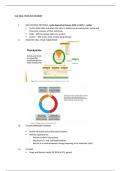
I. KEY CONTROL PROTEINS: cyclin dependent kinase (CDK or CDC) + cyclins
Cyclins bind CDKs and affect the latter’s abilities to phosphorylate, serine and
threonine residues of their substrate.
CDKs – 40% homology with one another
Cyclins – 100 amino acids residue long domain
II. FOUR KEY CELL CYCLE CHECKPOINT
III. CYCLIN DEPENDENT KINASE
Proline-directed serine/threonine kinases
Activity regulated by:
- Protein-protein interactions
- Regulatory (+ and -) phosphorylation
- Results in a conformational change (opening if the substrate cleft)
IV. CYCLINS
Large and diverse family 50-90 kDa (29+ genes)
, ‘Cyclin box’ ~100 amino acids – interaction with kinase partner
Transcriptional and post-transcriptional controls on cyclin levels:
- Transcription: cell cycle specific transcription factors
activity of cyclin/CDK complexes themselves
- Protein Abundance: rapid degradation (ubiquitylation / proteasome)
- Protein Location
D Type Cyclins (D1, D2, D3)
- Expression can be induced by
growth factors (mitogens) =
integration of multiple signalling
pathways through control of CDK4
and CDK6 activation.
- G0 progression to G1
- Oncogene activation drives cyclin D
expression
Different types of cyclins confer
distinctive substrate specificity to a
catalytic CDK subunit of complex (Cyclin
A binding to CDK2 results in a 400,000-
fold increase in activity)
Programmed phosphorylation of
specific substrates drives cell through
different phases of cell cycle
Cyclin production and degradation
ensures cell cycle can only occur in one
direction.
V. CDK
CDK proteins are inactive unless bound to cyclin partner. Non-cyclin partners can
also activate CDKs
Cyclin-CDK complex subject to further negative and positive regulation via
phosphorylation
I. KEY CONTROL PROTEINS: cyclin dependent kinase (CDK or CDC) + cyclins
Cyclins bind CDKs and affect the latter’s abilities to phosphorylate, serine and
threonine residues of their substrate.
CDKs – 40% homology with one another
Cyclins – 100 amino acids residue long domain
II. FOUR KEY CELL CYCLE CHECKPOINT
III. CYCLIN DEPENDENT KINASE
Proline-directed serine/threonine kinases
Activity regulated by:
- Protein-protein interactions
- Regulatory (+ and -) phosphorylation
- Results in a conformational change (opening if the substrate cleft)
IV. CYCLINS
Large and diverse family 50-90 kDa (29+ genes)
, ‘Cyclin box’ ~100 amino acids – interaction with kinase partner
Transcriptional and post-transcriptional controls on cyclin levels:
- Transcription: cell cycle specific transcription factors
activity of cyclin/CDK complexes themselves
- Protein Abundance: rapid degradation (ubiquitylation / proteasome)
- Protein Location
D Type Cyclins (D1, D2, D3)
- Expression can be induced by
growth factors (mitogens) =
integration of multiple signalling
pathways through control of CDK4
and CDK6 activation.
- G0 progression to G1
- Oncogene activation drives cyclin D
expression
Different types of cyclins confer
distinctive substrate specificity to a
catalytic CDK subunit of complex (Cyclin
A binding to CDK2 results in a 400,000-
fold increase in activity)
Programmed phosphorylation of
specific substrates drives cell through
different phases of cell cycle
Cyclin production and degradation
ensures cell cycle can only occur in one
direction.
V. CDK
CDK proteins are inactive unless bound to cyclin partner. Non-cyclin partners can
also activate CDKs
Cyclin-CDK complex subject to further negative and positive regulation via
phosphorylation